
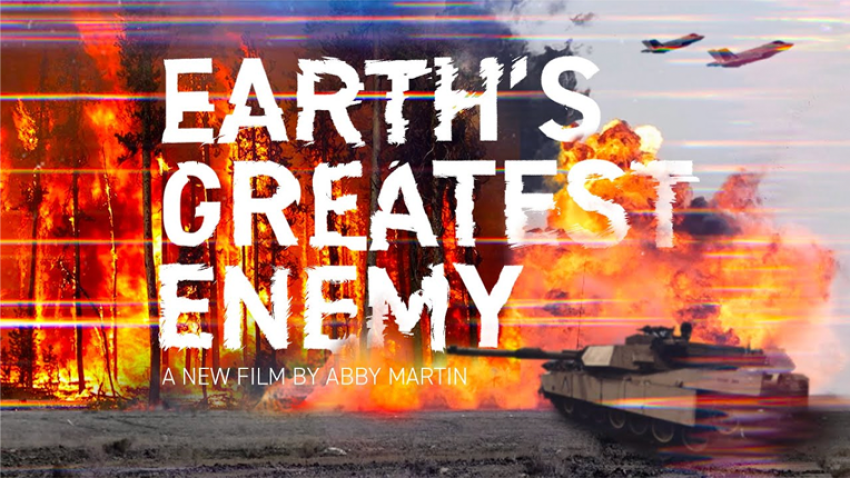
Earth’s Greatest Enemy
By Abby Martin and Mike Prysner
An Empire Files Production
120 mins
Screening in selected venues during July.
Also available on selected streaming platforms.
Visit: earthsgreatestenemy.com
Earth’s Greatest Enemy, directed by radical journalist and filmmaker Abby Martin and ex-GI Mike Prysner, reveals a hidden truth behind the climate crisis: the role of the United States military as the world’s largest institutional polluter, tracing the link between war, empire and ecological destruction.
Drawing on powerful testimonies from veterans, scientists and frontline communities, it uncovers how military operations poison ecosystems, accelerate global warming and sacrifice the future for endless expansion. From Alaska’s melting glaciers to contaminated bases across the US and toxic battlefields abroad, Earth’s Greatest Enemy delivers a provocative and unflinching examination of the untouchable institution playing an outsized role in the climate crisis.
Exempt from international climate agreements and rarely scrutinised in mainstream reporting, the Pentagon is revealed here as the world’s single largest institutional polluter — spewing carbon, contaminating water and scarring landscapes across the globe.
Combining investigative journalism, striking visuals and stories from impacted communities, the film challenges audiences to rethink the hidden costs of a global military empire and its planetary consequences. Provocative, urgent and eye-opening, this is a documentary that will change the way many people will see the military and environmentalism.
Earth’s Greatest Enemy begins with a moving scene of a Black US military veteran playing an old piano in the midst of a homeless veterans’ camp in California. The camp is later forcibly dismantled by police and sheriff’s officers, underlining the tragic human toll of the US ruling authorities’ endless wars and disregard for the lives of their own citizens.
Over the course of the film, we see the impact of climate change and global warming, to which the US military is the largest single contributor, from the melting ice of the massive glaciers in Alaska, to the huge destruction of the oceans and widespread poisoning of communities from US army and naval bases worldwide.
With Martin’s incisive commentary throughout, the film links a wide variety of situations in which the US military is acting to help destroy planet Earth, under the command of the US ruling class and government. These include scenes of the deadly pollution of forests and lakes near military bases in mainland US and Hawaii.
Martin interviews a number of people directly affected by these impacts, including a woman whose family members and herself have been poisoned by cancer-causing chemicals released by the US military at several bases inside the country, including Camp Lejeune in North Carolina. Another man has made a close study of the science of chemical pollutants in lakes and elsewhere near these military installations.
“The film reveals the cumulative impact of the bullets fired in Iraq,” a review of the film in Common Dreams on November 8, 2025, notes. “Conservative estimates suggest that, for every person killed in the US wars on Iraq and Afghanistan, more than 250,000 bullets were used. Each bullet injects lead, mercury, and depleted uranium into air, water and land.
“Furthermore, studies have found titanium in the lungs of US soldiers on bases and in the hair samples of children in Iraq and Afghanistan. The US wages wars not only on the air, water, and land, but also on bodies, bloodlines, and generations of human beings.”
The same review also explains that “One segment of the film focuses on the US military’s impact on Earth’s oceans, specifically during the US-led war games, RIMPAC, the largest maritime military exercise in the world. They fly Growler jets over the ocean and practice sinking exercises, exploding decommissioned ships in the open water. They fire live rounds and pollute the ocean for five or six straight weeks.
“Martin documents the US military detonating mountains in Okinawa and taking the dirt to fill in coral reefs so the military can use the land for part of a base. One of the film’s most surprising revelations is that the US military determines how many sea mammals they can kill. All of this affects fishing and biodiversity that sustains the oceans — and human and animal life around the world, most directly the people of the Pacific, whether it be Hawai’i, Okinawa or the other islands where the US has set up permanent military outposts.”
The film includes scenes of Martin relentlessly questioning US military officials at international defence conferences, which are promoting the latest military technology by US multinational corporations such as Boeing, Lockheed and Raytheon. They all try to fob her off and dodge corporate responsibility for the looming environmental catastrophe.
The overall impact of Earth’s Greatest Enemy is increased by the stunning pictures of huge rows of military trucks and tanks, as well as airforce planes, some of which are in current service, and many of which are outdated and due to be wrecked — with the vast ecological damage to follow.
One striking comparison with the Australian situation is the scenes of residents of the Japanese island of Okinawa paddling out to try to disrupt US naval destruction of the harbours off their islands. The similarity with the Rising Tide anti-coal blockades of the port of Newcastle is notable.
A moving background thread of the film is the partnership between Martin and Prysner, and the touching development of their two children as they become gradually aware of the disaster that is the military and its endless wars. This provides a very personal element to the story of the environmental and human cost of the US armed forces.
Earth’s Greatest Enemy is an overwhelming visual and political indictment of the ecological and life-endangering impact of the US military on our precious planet and its inhabitants, human and animal. It should be widely shown to as broad an audience as possible around this country.
[Watch the film’s trailer here. Abby Martin is touring Australia with the film in July and will appear at screenings in Boorloo/Perth (July 21), Kaurna Yerta/Adelaide (July 22), Naarm/Melbourne (July 27), Wollongong (July 28) and Gadigal/Sydney (July 29). For more information, visit: earthsgreatestenemy.com.]