
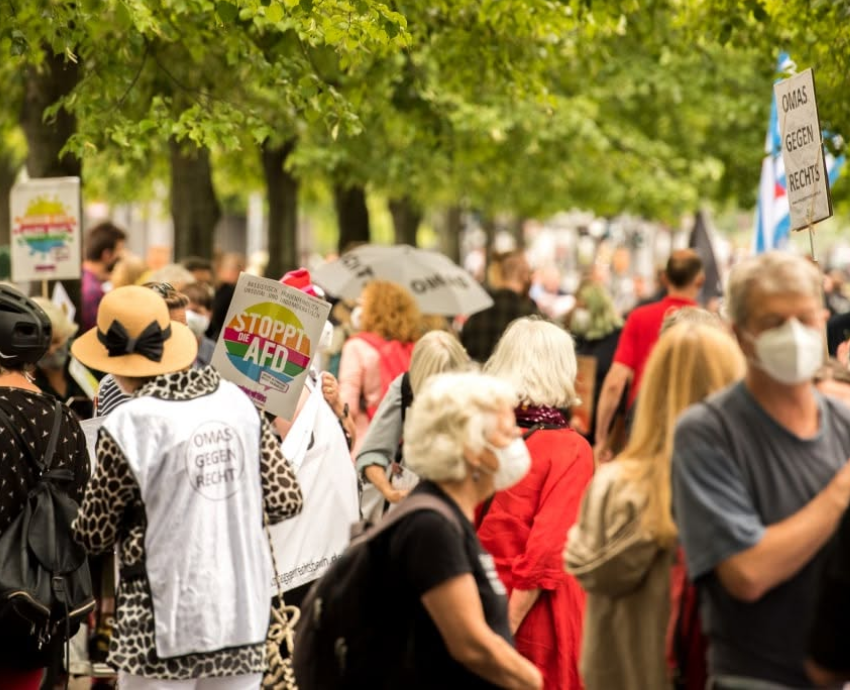
German far-right party Alternative Fuer Deutschland (Alternative for Germany, AfD) held its conference in Erfurt on July 4–5, re-electing co-leaders Alice Weidel and Tino Chrupalla.
Erfurt, the capital of Thuringia state, was part of the former German Democratic Republic prior to the collapse of the wall dividing Germany.
According to a July 4 Reuters report, “Underscoring the party’s hard line on immigration, a song called ‘Send Them Back’ played on the AfD's social media stream minutes before the convention opened. Inside the conference centre, vintage-style cards were on sale with slogans such as ‘YOU will be deported’.”
The date chosen for the conference attracted strong criticism. On July 4, 1926, during the second Nazi Party congress in nearby Weimar, Adolf Hitler successfully rallied the fragmented party and founded the Hitler Youth. The conference marked a vital point of reorganisation and ideological centralisation of the Nazi movement.
Because of the date’s significance, German historians and politicians accused the AfD of sending a coded message to voters with far-right views, while pretending to the general public that the party is innocent of ties with Nazism.
According to police, about 30,000 people protested outside the AfD’s congress.
Thousands of police were deployed to the city, and some were filmed using batons on protesters, reported Bild. Other police were seen on camera struggling to hold back crowds of demonstrators.
Protesters arrived from several directions for rallies and sit-ins to prevent or disrupt the event, reported Deutsche Welle (DW) on July 5. Demonstrators jammed roads as they marched towards the city centre.
Protesters were of a wide range of ages, from trade unions and various political orientations. They said they were scared of the AfD coming to power and saw it as their duty to act, DW reported.
Die Linke (the Left party) welcomed the protests and called on people to participate in the diverse actions of the “Zusammenstehen” (Standing Together) and “Widersetzen” (Resistance) alliances on the day.
“In view of the massive smear campaigns against the protests by the AfD, its front organisations, and right-wing media outlets, among others, we appeal to everyone: Do not let yourselves be intimidated. Take part in the diverse protests. Let us jointly send a clear and unmistakable signal against any form of exclusion, against racism, anti-Semitism, völkisch [ethno nationalist] ideology, and the extreme right-wing AfD.”
The Guardian reported on July 4 that protesters, led by the Resistance alliance, staged sit-in blockades in the city centre in an attempt to prevent the AfD’s approximately 600 delegates from reaching the conference grounds, with some abseiling from a motorway bridge and others attaching themselves to tram tracks with glue to cause disruption.
Police told Die Zeit that the demonstration had been “mostly peaceful”, with less than 100 people arrested for offences, many of them for graffiti.
A second demonstration, attended by federal environment minister Carsten Schneider and Thuringia interior minister Georg Maier, was organised by the Standing Together alliance, where the “Grandmas Against the Right” waved homemade signs.
Many protesters called for the AfD to be banned, accusing the AfD of promoting racist and anti-Muslim policies and downplaying Nazi crimes.
Noa Sander, a spokesperson for the Resistance alliance told AFP, “The AfD wants mass deportations and ethnic cleansing,” in reference to the party’s “remigration” demands. “It should be banned. We intend to do this by blockading their party conference and standing in the way of the AfD, its policies and members wherever they appear, making sure they have no place in society.”
The AfD is currently leading in opinion polls. Accordingly, it is masquerading as a party for all Germans.
There were warnings that a potentially explosive debate would eventuate at the conference, with factions within the AfD wanting to review the party’s rules on keeping out neo-Nazis and white supremacists. Ultimately, delegates decided not to have that debate and focused attention instead on the possibility of wining an absolute majority in September’s state election in Saxony-Anhalt.
If successful, the AfD would lead a state government for the first time, hoping to pave the way for success at the national level.
The AfD came second in last year’s national elections, scoring about 20% — the best result for a far-right party since World War II.
Al Jazeera reported that polls in Saxony-Anhalt put the AfD on 42%, but all mainstream parties have ruled out cooperating with the party.
The AfD has grown in popularity, caused by years of economic stagnation, rising rents, rising living costs, and proposed attacks on the welfare system and workers’ rights, including termination of contracts.
Some Germans feel a loss of community and believe life was easier in the past. According to Reuters, Bjoern Hoecke, seen as one of the AfD’s most radical and controversial leaders, promotes this nostalgia, telling voters: “A great Germany is a Germany where one need not fear taking a walk through the city park in the evening. A great Germany is a country where apartment keys can be left hanging on the outside of the door."
In response to the surge of the far right, Chancellor Friedrich Merz’s ruling coalition — made up of the right-wing Christian Democratic Union, its Bavarian sister party, the Christian Social Union and the Social Democratic Party — has announced far-reaching neoliberal attacks. It plans to reform taxes, introduce tougher rules for employee sick leave, double the maximum duration of fixed-term contracts without cause to 48 months, and scrap a range of corporate reporting obligations. It also proposes to gradually raise the retirement age from 67 to about 70 by the early 2090s.
The Guardian reported on June 24 that the government wants to implement the changes next month. However, the policies must still be debated and voted on in parliament, with Merz insisting that “failure is not an option”.
According to Merz, his coalition is united behind the changes, despite some left-wing members of the government — junior coalition partners, the Social Democrats, and trade unions — questioning the fairness of some of the recommendations.