
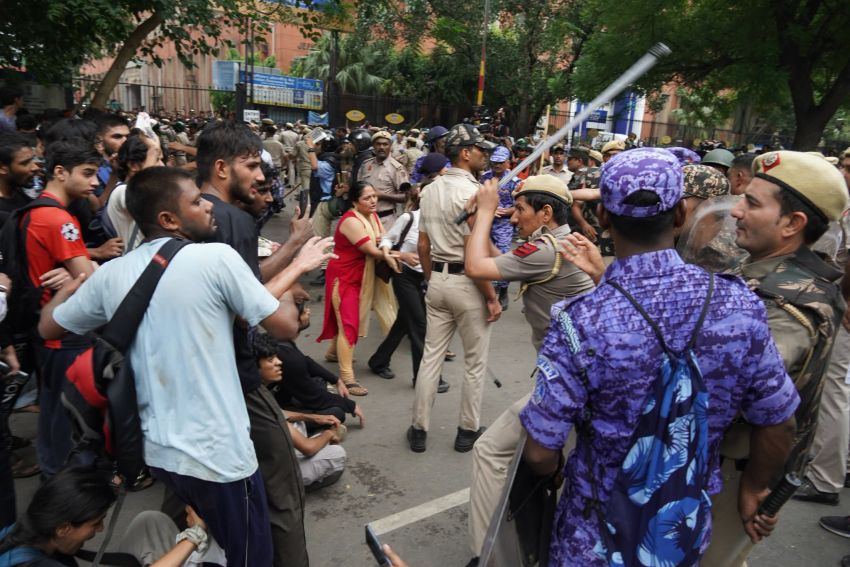
Tens of thousands of youth and student protesters were attacked by police using tear gas and batons in India’s capital, New Delhi, on July 20, as they marched towards parliament to demand that Education minister Dharmendra Pradhan resign.
More than 100 students were injured in the attacks. One student, 18-year-old Anshul Dev, told Al Jazeera the government “is treating us like terrorists and criminals”.
The youth-led protests began in May after exam papers for the National Eligibility Entrance Test (NEET) leaked online, voiding exam results and forcing more than 2 million students to re-sit.
The NEET is a high-pressure nationwide exam that screens students’ eligibility for admission to undergraduate medical programs.
Protesting students called for Pradhan’s resignation over his handling of the NEET leak, and over ongoing concerns about corruption and attacks on the public education system.
This leak is only the latest in a series of leaks that have lowered trust in the education system, which many blame Pradhan and the right-wing Bharatiya Janata Party (BJP) government for undermining.
The NEET has been the subject of longstanding controversy, including over its centralised structure, commercialised coaching culture and the immense psychological stress placed on students.
More than 12 students committed suicide after the latest exam cancellation, adding to the 93 NEET-linked student suicides across the country since 2021.
For many young people, the NEET and similar exams are critical to determining their future employment opportunities, as failure can mean lifelong poverty and disadvantage.
The protest movement gained momentum when Chief Justice Surya Kant compared unemployed youth to cockroaches and parasites, triggering widespread outrage.
In response, the satirical Cockroach Janata (People’s) Party (CJP) campaign emerged as a youth movement demanding greater transparency and accountability. The CJP campaign struck a chord with India’s “Gen Z” and has become one of the biggest expressions of dissent against Narendra Modi’s BJP government.
CJP founder Abhijit Dipke addressed a gathering at New Delhi’s Jantar Mantar — the site of an 18th century astronomical observatory — on June 6.
Dipke told the crowd that if Pradhan refused to vacate his seat, young people would refuse to vacate Jantar Mantar. Since then, a protest camp has rapidly expanded there, becoming an expression of deep anger against Modi’s attacks on youth, democratic rights and his Hindu-nationalist policies.
A wide range of student and youth groups, including the All India Students’ Association (AISA) and the Students’ Federation of India are supporting the protest movement. Several opposition politicians, celebrities and writers like Arundhati Roy have visited the camp to lend their support.
AISA president Neha Bora, alongside AISA members Manish Kumar and Aameen Amitoj, participated in a 23-day hunger strike at the camp in protest against the government. They joined renowned activist Sonam Wangchuk, who began fasting on June 28, before police forcibly admitted him to hospital over his deteriorating health, on July 18. Dozens of other students joined the hunger strike for shorter periods.
Neha, Manish and Aameen are PhD students, at Jawaharlal Nehru University, Allahabad University and Ambedkar University, respectively. While the hunger-strikers were unable to speak because of their deteriorating health, AISA representative Saiyed told AltNews they were striking because “those in power no longer believe accountability is their responsibility”.
“We are seeking Union education minister Dharmendra Pradhan’s resignation, the dismantling of the National Testing Agency, and the rollback of the National Education Policy 2020,” Saiyed said.
All three lost more than 10% of their body weight and were showing signs of ketosis before they ended their strike. Manish lost more than 10 kilograms and had begun bleeding from his gums, while Neha was in the worst condition, suffering from critically low blood sugar levels.
The July 20 march marked the culmination of the trio’s hunger strike. From her hospital bed, Neha said: “After the police lathi [heavy bamboo stick] charge, you have all returned after enduring injuries and tear gas, you are keeping this movement alive, my salute to all of you.
“Every stick, every drop of blood will have to be accounted for by Delhi Police … Your lathi charge will not break us, your tear gas will not break us, the youth will break your arrogance!”
The BJP claimed the NEP would “modernise” the country’s education system, however, in reality, it is a thinly-veiled exercise in gutting the public university system, excluding disadvantaged students and reinforcing Hindutva ideology.
Modi is yet to comment on the police violence, the hunger strike or the NEET exam leak.
AISA secretary Anjali said protests would continue “until Dharmendra Pradhan is shown the door”.
She said that in a country where farmers fought pro-corporate farm laws and compelled the government to withdraw them, “The need of the hour is that all struggling people — workers, farmers, students, teachers, Muslims, women and all marginalised sections of society — unite and resist the onslaught on their lives, rights and livelihoods.”