
Pine Gap, known as the Joint Defence Facility Pine Gap, is a prickly reminder that Australia remains annexed to the security interests of the United States, given the largely US-operated effort in Alice Springs, Central Australia.
As the late scholar of strategic studies Desmond Ball pithily remarked in 1988, it is “an espionage operation. Euphemisms should not be allowed to obscure this essential point.”
It grew out of a desire on the part of the US Central Intelligence Agency (CIA) in 1965 to establish a remote Australian-sited ground control station intended for signals intelligence satellites. Land belonging to the Central Arrernte people was accordingly excised the following year for the site.
The decision, in typically rough fashion, was made without consultation and discussion with local residents or elders, a secret place that became what Trevor Paglen would describe as a “blank space on the map … erased from the public record.”
The facility includes some 800 personnel from the US National Security Agency (NSA), CIA, the US National Reconnaissance Office (NRO) and such Australian agencies as the Australian Signals Directorate and Australian Federal Police.
Over the years, the base has become increasingly corporatised with a heavy American accent: Raytheon, Northrop Grumman and General Dynamics, IBM and Hewlett Packard all have a presence. A mere 10% of the constituted personnel are said to be Australian government employees.
The base periodically attracts protesters, angry at the base’s role in furnishing targeting data for US and allied drone and missile strikes across the Middle East and Africa.
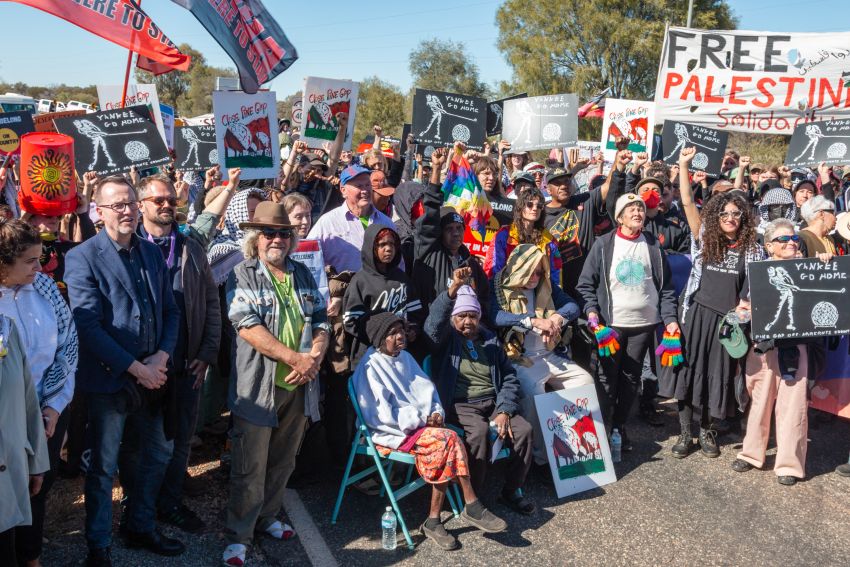
This year, the Close Pine Gap-Sacred Land Back convergence featured three days (July 18-20) of activities, with hundreds of participants gathered in Alice Springs to demand the closure of the facility through a series of workshops, panels and woven “threads of anti-militarism and decolonial movements”.
On July 20, a rally of 300 people gathered close to the front of the spy base, the largest since 1987, sporting signs and flags and chanting the stock phrases: “Shut it down”, “Close Pine Gap” and “Always was, always will be Aboriginal land.” New South Wales Greens Senator David Shoebridge was present, expressing his concern about a “foreign military base set up for the interests of a foreign military” in the service of “right wing politics” and disrespectful of international law.
The base was also a potential target for any adversaries the US might be willing to antagonise, thereby bringing “danger into the heart of our country”, Shoebridge said.
Arrernte Apmereke-artweye Traditional Custodians Felicity, Wyonna and Jacquita Hayes offered sound, if disturbing logic, that Pine Gap sits on a sacred site that not only profanes tradition but acts as vehicle for the waging of foreign wars and the conduct of genocide.
“We don’t want to be feeling guilty all the time when bad things are happening overseas to little ones. We’re not the ones controlling that facility, but we feel guilty that it's coming to our land.”
The custodians wished for the facility to be closed “so the generation coming can be safe. We want to be compensated so we can get houses at Whitegate community.” To this day, these residents have been deprived of rudimentary services, including decent housing and running water. Their water has to be brought in by truck; there is no sewerage.
Richard Tanter of the Nautilus Institute, who has studied and written about Pine Gap extensively, said: “Unless the Australian direct and indirect military relationship to Israeli activities in the Gaza Strip are closely reviewed ... it is not possible for the Australian government to assure parliament and the Australian public that Australia is no complicit in acts of genocide.”
Tanter has shed light on the facility’s broader purposes, including its use to feed Israel’s military effort in Gaza. He can point to at least three satellites having the Gaza Strip within their reach. In October 1973, for instance, satellite intelligence from Pine Gap was passed on to Israel during the Yom Kippur War, a contribution that aided Israel’s breakthrough of the Egyptian lines.
This is of little concern to the militarists in Canberra and such think tanks as the Australian Strategic Policy Institute.
Former intelligence officer Patrick White, writing for ASPI’s The Strategist, laments the diminished secrecy and security of the site, worrying that trends in signals technology have no longer made the base “irreplaceable”. The advent of extensive encryption means that satellite download feeds can be protected “almost anywhere. The remoteness that once hid the site from view no longer hides much at all.”
White is sentimental about Australia’s ties with Washington. “We have shared in intelligence and expertise far beyond anything our own resources could produce. We have no satellites of this kind.”
Pine Gap acts as a symbol of triple strength colonisation: a garrison outpost dominated by the US imperium and its personnel (a poke in the eye of Australian sovereignty), located on native land it defiles (a poke in the eye of the First Nations peoples) and it is also responsible for aiding the predations of Washington’s allies — more recently the Israeli Defense Forces’ cleansing conflict against the Palestinians.
“I understand the genocide in Gaza against my people is made possible by intelligence flowing from the heart of this colony in Alice Springs directly to the Israeli occupation forces,” stated Palestinian activist Remah Naji of Justice for Palestine Magan-djin with potency. Shoebridge agreed: “We’re letting them use our land, this key real estate, I think [to] commit some of the worst atrocities we’ve seen.”
As the AUKUS Public Inquiry continues its hearings on the war pact between Australia, Britain and the United States, the Close Pine Gap campaign should be commended as a linked, worthy extension.
The former’s proceedings have mostly been savaging the wisdom of a pact. The Close Pine Gap protests, while receiving less coverage, are no less pertinent and urgent.
[Binoy Kampmark currently lectures at RMIT University.]