
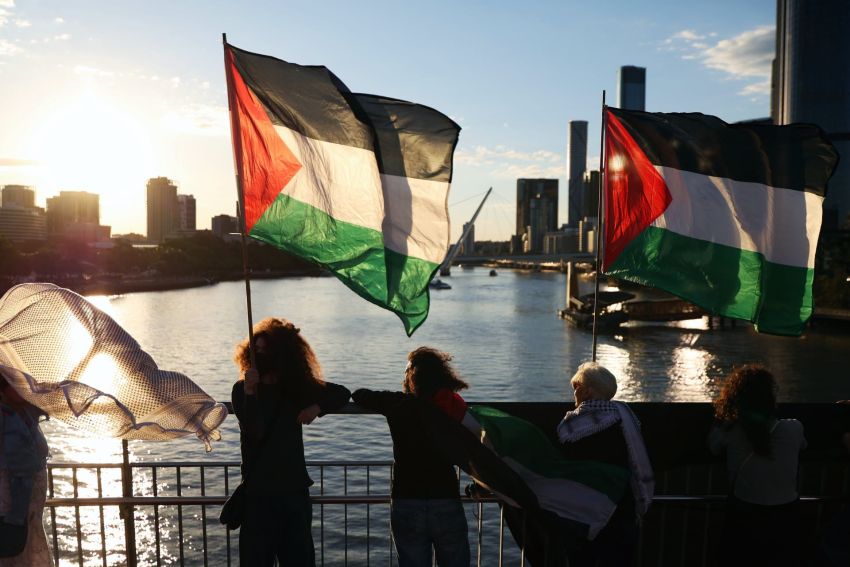
Palestinians and their supporters in Australia continue to face restrictions, accusations and exclusion, the latest example being the Royal Commission into Antisemitism and Social Cohesion where Gaza is being discussed at length, but Palestinians are being largely excluded.
That absence did not come out of nowhere.
The Palestine solidarity movement in NSW has for months been placed under suspicion for a crime it had nothing to do with — the Bondi attack. It was an antisemitic act of terrorism against Jewish Australians and the government has a duty to investigate the attack, hold those responsible to account and protect the Jewish community.
But it has gone a lot further with sweeping restrictions on public protest, even criminalising it.
The commission’s third round of public hearings examined antisemitism and hateful speech online, in the media and in public broadcasting. The ABC and SBS were questioned about their coverage of Gaza, with claims that they focused too heavily on Gaza, portrayed Israel too negatively and gave too much space to critics of the Israeli government.
While Gillian Segal, Australia’s Special Envoy to Combat Antisemitism, wants greater oversight, the ABC and SBS executives defended their editorial independence and complaints processes.
There is nothing wrong with examining accuracy, bias or editorial standards. But the same standards must be applied across the board.
If Palestinian casualty figures and sources are questioned, official Israeli claims should face the same scrutiny. If extensive reporting on Gaza is presented as evidence of bias, another question must be asked: Does the amount of coverage simply reflect the scale of the destruction, death and humanitarian catastrophe?
Most importantly, the commissioner should have asked who was being allowed to speak about Palestinian suffering. It heard from Segal. It heard from senior representatives of the ABC and SBS. It heard from the Australian Communications and Media Authority and from technology platforms.
But no Palestinian representative was given an equivalent opportunity to answer questions about Gaza, Palestinian sources and the way Palestinian suffering was represented.
Some say that these hearings were for executives and regulators, not community representatives. That argument might make sense if the discussion had been limited to broadcasting procedures and editorial standards.
But it did not. The hearings moved into questions about Palestinian sources, criticism of Israel and the representation of Palestinian suffering. Once that happened, Palestinian perspectives became directly relevant.
This is not a demand for a Palestinian witness at every hearing. It is also not a claim that only Palestinians can speak about media coverage or antisemitism. The point is much simpler: The Commission spent a great deal of time discussing Palestinians, yet they were given little opportunity to respond to claims that directly affected them.
The same imbalance was evident from the commission’s treatment of the Australia Palestine Advocacy Network (APAN) which submitted evidence on antisemitism, racism and social cohesion. It sought permission to participate in the first round of hearings, where definitions of antisemitism and their limits were central. Its request to question expert witnesses was rejected on the argument that the commissioner was not satisfied that APAN had a “direct and substantial interest” in the hearings.
That is difficult to understand. How could Palestinians lack a direct interest in definitions that may shape how the Nakba, Zionism, occupation, protest slogans and criticism of the Israeli state are discussed and judged?
A direct interest does not arise only when people are accused of wrongdoing or become the direct targets of violence. It also exists when official definitions, policies and recommendations may affect a community’s rights, reputation and ability to speak, organise and participate in public life.
APAN was later permitted to participate in the university hearings. But it did not correct the absence of a meaningful Palestinian voice during the media hearings.
Edward Said showed that representation is closely tied to power. Those who control the platform have greater power to define others. When Palestinians are discussed as objects of inquiry, rather than as people with history, political agency and lived experience, the picture will always be incomplete.
Power also works through classification. Once Palestinian protest is shifted out of the language of politics and rights and into the language of security and suspicion, Palestinians are forced to keep proving themselves.
They must prove that their anger is not hatred and that their protests are not a threat. They must prove that opposing occupation is not the same as hostility towards Jewish people. That is why the process matters.
Who is invited to speak? Who is recognised as an expert? Who is treated as a legitimate participant? Who must constantly defend the legitimacy of their views?
These are not minor procedural questions. They shape whose experiences are believed. They determine which voices carry authority. They influence what conclusions become possible.
The royal commission was established in the name of strengthening social cohesion. But that will not come from publishing recommendations at the inquiry’s end. It must also be reflected in the way the inquiry is conducted.
There must be one standard for everyone. Jewish Australians must be protected from antisemitism and violence. Palestinians, Muslims, Arabs and their supporters must be protected from collective suspicion, exceptional restrictions and exclusion. That means recognising anti-Palestinian racism and Islamophobia. It means applying equal scrutiny to Palestinian and Israeli sources. It means giving Palestinians a real opportunity to respond when their history, suffering and political speech are being examined.
The current approach has gone far beyond what can reasonably be justified in the name of security or social cohesion. The attacks on Palestinians and those who stand with them must end.
[Shamikh Badra, originally from Gaza, Palestine, is a PhD candidate at the School of Humanities and Social Inquiry at the University of Wollongong.]