
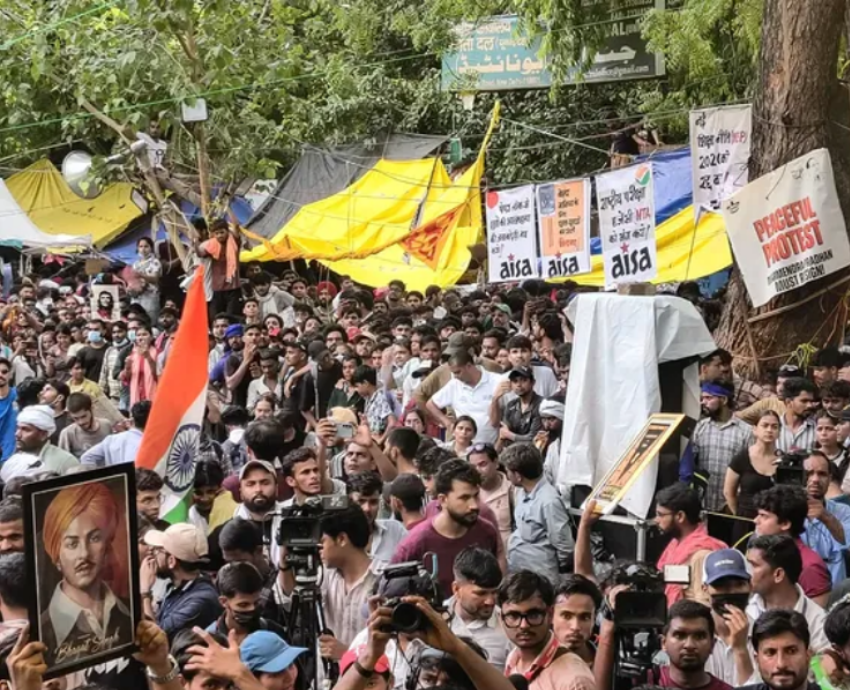
The youth-led Cockroach Janata Party (CJP) movement in India forced education minister Dhamendra Pradhan to resign over corruption in the education system.
Isaac Nellist spoke to Manish Kumar, Uttar Pradesh state president of the All India Students’ Association (AISA) and PhD student at Allahabad University, about this powerful dissent against Narendra Modi’s government.
Kumar was one of three AISA members who participated in a 23-day hunger strike at the Jantar Mantar protest site in Delhi, alongside well-known activist Sonam Wangchuk.
* * *
What sparked this powerful movement?
To access education or government employment in India, you have to go through an examination process. While people who have money have easy opportunities to get admission, many families spend their life savings or go into severe debt to give their children opportunities to sit [entrance] exams.
The National Eligibility Entrance Test (NEET) — the exam for medical programs — was leaked in 2024, and again this year. In 2024, an unprecedented 67 students received a perfect score because of the leaks.
This year, 22 students committed suicide because of the despair and hopelessness caused by the mismanagement of the examination system. It is not only the NEET, there are several other examinations, including the postgraduate eligibility tests, which were also leaked.
This also includes recruitment exams. For example, I am from Uttar Pradesh, a northern Hindi-speaking state. The paper for admission as a constable, the lowest-ranking police official, was leaked.
Admission papers for top administrative posts and higher examination papers for the position of assistant professor were also leaked.
Not a single exam has gone through a transparent and fair process and this led to a strong resentment among students and all those concerned about education and employment.
There are already minimal vacancies for government positions, because there are less publicly funded government jobs.
This resentment culminated when Surya Kant, chief justice of India, compared the youth and those speaking out for justice and demanding accountability to “cockroaches” and “parasites”.
[CJP founder] Abhijeet Dipke made a social media page called Cockroach Janata Party as a satirical response, playing on the name of the ruling Bharatiya Janata Party, and that got millions of supporters within a few days.
From there, they started demanding accountability, fairness and transparency in the education system.
People started questioning the government policies and its insensitivity, having not said a single word about the people who committed suicide.
Why did you decide to join a hunger strike?
The cockroach label started to generate social momentum, which became a mass movement centred around Jantar Mantar, about one kilometre from Parliament, in Delhi.
We staged a protest, which continued for weeks. Sonam Wangchuk, a renowned scientist, educator, scholar and climate activist, declared that if the government is not listening to the CJP movement, he will start a hunger strike.
We, as AISA student activists, decided that if Wangchuk, who is not directly involved as a student, is concerned enough to go on hunger strike, then why are we not?
Six AISA members joined the hunger strike: Neha, AISA national president and PhD student at Jawaharlal Nehru University (JNU); Danish Ali, PhD scholar and joint secretary of the JNU student union; Ameen Amitoj, PhD scholar at Ambedkar University, Delhi; Deepak, vice president of AISA at Delhi University; Hrishikesh, PhD student and president of Barak hostel at JNU; and myself [along with other hunger strikers].
Myself, Neha and Ameen continued our hunger strike for 23 days. I lost 11.5kg.
While on hunger strike, we heard that more papers had leaked in several states, including Maharashtra and Madhya Pradesh.
The government was not taking on any accountability; it was not listening to us or paying attention to what we were saying.
Police grabbed Wangchuck from Jantar Mantar and threw him in the back of a white van. It looked like a dead body was being picked up. He was detained in hospital in the name of medical treatment.
The police tried to vacate the site, but our comrades and colleagues showed us solidarity — physically and on social media. They continued their strong support for this movement and the government had to step back.
What happened on July 20?
July 20 was declared a march on Parliament, because the government was not listening. [The hunger strikers] had lost dozens of kilograms, but the government was totally ignoring us.
We began our march and the government started to crack down on the students and youth, those who were demanding fair examination processes, a transparent education system and accountability from those ministers who were invisible, inefficient and incompetent to prevent the paper leak.
Students had to face a brutal lathi (baton) charge, water cannons, pellet guns and tear gas. That created a stampede, where many were crushed.
Many students had their hands broken, their legs broken and were hit on the head. Women had their clothes torn off.
It was a scene in which the government was treating us like cockroaches; they were hitting us just like how you might hit a cockroach in your house. They wanted to show that this will be the outcome of protesting against the Modi government.
But even after this barbaric cruelty, students and youth haven’t stopped. Their heads, legs and hands might have been broken, but their commitment, resilience and valour was not broken. They continue to protest.
Protest camps like Jantar Mantar began to rise in many different parts of the nation. In every district, every state, every city, people came out on the street and demanded the resignation of the incompetent education minister Dharmendra Pradhan.
Finally, on July 24, the government had to step back and the lead minister had to resign from his post.
What is next for the movement?
The CJP is not a political party; it is a movement in which people from all different identities are all involved. We collectively participated and have beaten back this authoritarian regime. Students and youth will not tolerate more.
Our demand for Pradhan to resign was achieved, but this was not our sole demand. Our protests must continue for accountability, but also for structural reforms.
The National Testing Agency (NTA) is the private agency that conducts the NEET and other exams. It only has only two dozen permanent employees, it has no office, it conducts more than 2.2 million student exams without permanent employees, without permanent structure. That resulted in the corruption and paper leaks.
We are demanding urgent structural reform to scrap the NTA, and our demand is not yet fulfilled.
We are also calling for the repeal of the National Education Policy 2020 (NEP), [under which] the government will not take any more responsibility for education.
That’s why you see the fees for courses rising, dropout rates rising and the government stepping back and giving private players more opportunities to rot these institutions and get more profits by extracting more money from the masses.
The government is creating favourable conditions for these private institutions, while destroying public universities and destroying secure, guaranteed, dignified employment.
Our democracy is being bulldozed, and this government, with a nexus of media, corporate goons and elite bureaucrats, have manipulated the democratic mandate.
With this they are winning elections, manipulating the election commission and putting their political puppets in top positions in many institutions.
They are tearing down our democracy. They are not listening, they are not showing accountability. They are creating a humanitarian crisis.
India is the most populated country in the world and has the highest youth population. We have unemployed youth who are starving, malnourished and living in tents. They live their life without opportunity to work, and often fall into depression, frustration and, being alienated from society, feel compelled to commit suicide.
Gen Z has taken the social media platforms that the Modi government uses to pollute the minds of the Indian youth and turned them into a weapon against their propaganda.
From the start, the government labelled us as terrorists, anti-nationals, viruses, but the youth have strongly expressed their solidarity, have stood with us, and all of that propaganda has failed.
While the language was diverse, the message was the same: that this government has to go down.
This was the victory of the student and youth movement. When people stand up against corruption and authoritarianism, they can win.
Women of this nation, when the BJP was threatening citizenship rights against Muslim people, stood up in the anti-CAA [Citizenship Amendment Act, which fast-tracks the citizenship for non-Muslim refugees] movement and the Shaheen Bhag Delhi movement, and forced the government to step back.
When the land and agriculture of the country was being destroyed and given to the big corporations, the farmers stood up and forced the government to repeal the three farm laws it had passed.
This is not only a matter of education and employment, but also of democracy.
On one side, we have a $5 trillion economy, but on the other side, our students are committing suicide, and not able to go to school. Two crore (20 million) students are not in the education system.
Students are ready to reclaim our socialistic, secular, republican democracy. We are fighting even though we face heavy crackdowns and they are bulldozing our constitution.
We want to consolidate this energy and focus on the demands to abolish the NTA, repeal the NEP and force the resignation of home minister Amit Shah, who is responsible for the brutality against protesters on July 20.
The government has to take responsibility or it has to go.