
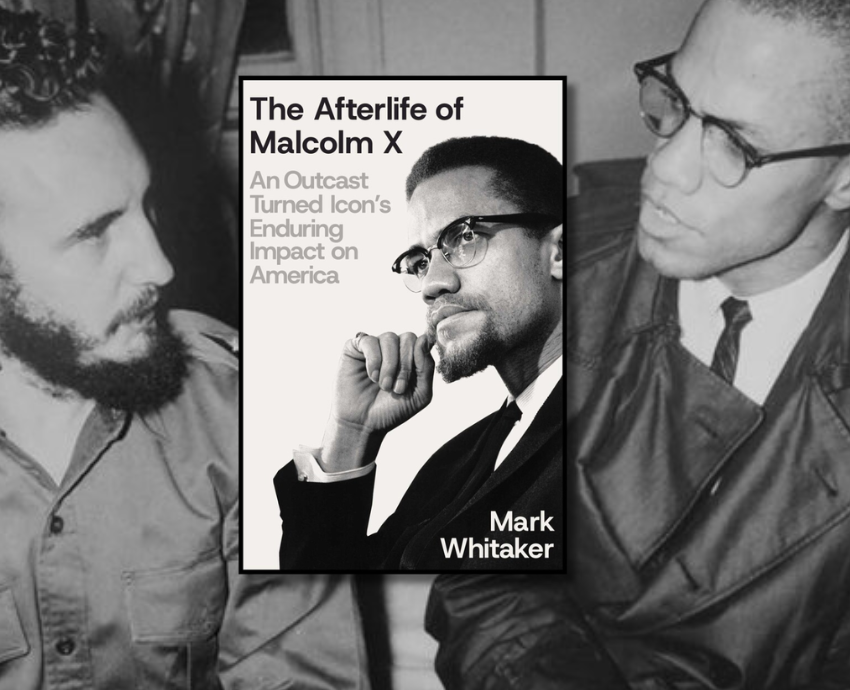
The Afterlife of Malcolm X: An Outcast Turned Icon’s Enduring Impact on America
By Mark Whitaker
Simon & Schuster, 2025
448 pp
Author Mark Whitaker was the first African American editor of Newsweek. In his book, The Afterlife of Malcolm X, he sets out to explore Malcolm X’s legacy and impact in the decades since his assassination nearly 60 years ago.
Although the book contains some details that earlier chroniclers, such as Alex Haley, may have missed, this is not a biography.
Whitaker studies Malcolm X’s influence beyond the Black left, exploring his enduring impact on culture, politics and civil rights. Malcolm X’s views remain relevant today to Black activists — Black Lives Matter, for example — and all those seeking fundamental change.
In the context of US President Donald Trump’s era of state violence and authoritarianism, it is important to listen to and study Malcolm X’s speeches in the years before his assassination in Harlem’s Audubon Ballroom in New York City.
Malcolm X was born Malcolm Little in Omaha, Nebraska. He became Malcolm X after he joined the Nation of Islam (NOI), but died as El-Hajj Malik Shabazz, after converting to orthodox Sunni Islam in his final year of life.
He is now viewed by the mainstream media and politicians as a sanitised US icon — much like Abraham Lincoln, John F Kennedy, and Martin Luther King jnr — independent of his actual views and vision.
During Bill Clinton’s second term as president in 1999, the Postal Service even made a stamp in Malcolm X’s image.
When Malcolm X was assassinated, he was still seen as a dangerous outsider. White America especially found him alienating, and mainstream African American leadership, including civil rights groups and Christian figures, found him divisive.
Many of his admirers even found him too radical.
Nevertheless, Malcolm X’s influence has been deeper in death than it was during his life, Whitaker explains.
Legacy
Whitaker tracks Malcolm X’s legacy from founders of the Black Power movement such as Stokely Carmichael (Kwame Toure) and Huey Newton (co-founder of the Oakland based Black Panthers Party) to hip-hop pioneers such as Public Enemy and Tupac Shakur.
Malcolm X also influenced leaders of the Black Arts and Free Jazz movements — from Amiri Baraka to Maya Angelou, August Wilson and John Coltrane — who credit their political awakening to him. He also influenced some of the most influential athletes of the time — from Muhammad Ali to Kareem Abdul-Jabbar, and more.
Spike Lee’s 1992 biopic and the Black Lives Matter movement reintroduced Malcolm X to new generations of young people — Black, white, Asian and African.
Whitaker notes that Malcolm X has been cited as a formative influence across the political spectrum — from the first Black president Barack Obama — who venerated Malcolm X’s “unadorned insistence on respect” — to right-wing Supreme Court Justice Clarence Thomas — who was drawn to Malcolm X’s messages of self-improvement and economic self-help.
In new detail, Whitaker’s book retraces the long road to exoneration for two men wrongfully convicted of Malcolm X’s murder, with detail confirming the part the Federal Bureau of Investigation (FBI) and New York Police Department (NYPD) played in eliminating Malcolm X and other Black leaders.
Malcolm X was a master of modern media, who understood the power of images, delivering what would become arresting sound bites, viral videos and memorable memes before those concepts even existed.
Whitaker notes that his elegant fashion sense — the conservative dark suits and thin ties; the distinctive glasses, with their horn rims on the top and wire rims on the bottom — evoked the look of the bebop era then and remain in vogue among artists and intellectuals even now.
Assassination
Stretching over the decades, Whitaker explains, has been the mystery of Malcolm X’s murder and who was responsible for his death.
The book traces that story, which began with the arrest of young Black New Jersey resident Talmadge Hayer minutes after Malcolm was assassinated, on February 21, 1965.
In the days following, two members of the Harlem NOI Mosque, known as Norman 3X Butler and Thomas 15X Johnson were also arrested. In the middle of their trial, Hayer abruptly changed his testimony to swear that the other two weren’t involved, but all three were convicted nonetheless and sentenced to life in prison.
In the end, Butler and Johnson — who while behind bars embraced orthodox Islam and changed their names to Muhammad Abdul Aziz and Khalil Islam — languished in prison for a combined 42 years before they were paroled.
The case was officially reopened in 2020 by Manhattan District Attorney Cyrus Vance jnr, after exculpatory evidence was unearthed by the makers of a Netflix documentary.
In a 22-month investigation, a special task force appointed by Vance found that numerous pieces of evidence to support Butler’s and Johnson’s claims of innocence were deliberately suppressed, in order to protect the identity of FBI informants and undercover agents working for an NYPD secret intelligence unit.
While not definitively answering the question of FBI or NYPD involvement, the probe offered new proof as to how much federal agencies and the NYPD knew about the threats to Malcolm X’s life, before leaving him largely unprotected on the day of his murder.
Following the investigation, Vance submitted a 43-page motion to a New York County Supreme Court judge, requesting that the convictions of Aziz, now 83, and Islam, who had died in 2009, be quashed.
When the judge declared the two men were exonerated, the courtroom erupted into applause and there were celebrations outside the court.
Yet that version of the story, Whitaker explains, wasn’t complete. Much earlier and less remembered was the work of mid-western white journalist Peter Goldman, who wrote The Death and Life of Malcolm X.
Goldman had developed a personal connection with Malcolm X while he was alive. In the late 1970s, he interviewed the three murder suspects in prison and tried, along with lawyer William Kunstler, to get the case reopened.
As Whitaker writes, “Despite those efforts, the wrongful conviction saga would extend well into a new century — along with the stirring echoes of Malcolm X’s voice that reverberated across six decades of American history.”
Revolutionary
Three days before his assassination, Malcolm gave a speech at Barnard College, the women’s university affiliated to Columbia University. He had just returned from London where he had met with African leaders about the struggle of Blacks in the US.
As Whitaker writes, Malcolm X told the crowd that he hadn’t come “as a person representing the religion of Islam” and that his travels had made him see a bigger picture than the racial battle in the US.
“It is incorrect to classify the revolt of the Negro as simply a racial conflict of Black against white, or as a purely American problem,” he told the crowd. “Rather, we are today seeing a global rebellion of the oppressed against the oppressors, the exploited against the exploiter.”
More than two years before Martin Luther King jnr would come out against the Vietnam War, Whitaker notes, Malcolm X linked the fight against racial inequality to the war. “If you don’t want bad things to happen,” he told the students, “you better put pressure on your parents to put pressure on [President] Johnson”.
In the year prior to his death, Malcolm X had evolved way beyond the politics of the NOI. He rejected the NOI’s concept of Islam as he became more orthodox. He built his own Islamic group, Muslim Mosque Incorporated, but also a secular civil rights group, the Organization of Afro American Unity.
Malcolm X began to see the Black freedom struggle as part of the worldwide struggle of the oppression of people of all colours and the working class.
It is why in 1964 he spoke at the Militant Labor Forum in New York, organised by the Socialist Workers Party (SWP) and its newspaper, the Militant.
George Breitman, a founder of the SWP who wrote The Last year of Malcolm X and edited Malcolm X’s other speeches and writings for Pathfinder Press, discussed his views on the Black struggle and Malcolm X with me, on many occasions.
As Whitaker shows throughout his book, all Black leaders were seen as a threat to the US ruling class. J Edgar Hoover, long-time director of the FBI, created the COINTELPRO program and openly declared that its job was to neutralise these leaders. Malcolm X and Martin Luther King jnr were at the top of his hit list.
Malcolm X will continue to be studied. Haley’s The Autobiography of Malcolm X remains a top-seller, read by young Blacks and others. Whitaker’s book is a significant contribution to Malcolm X’s life story and impact in the “Afterlife”.
[Malik Miah is an advisory editor of Against the Current, where a similar version of this article first appeared.]