
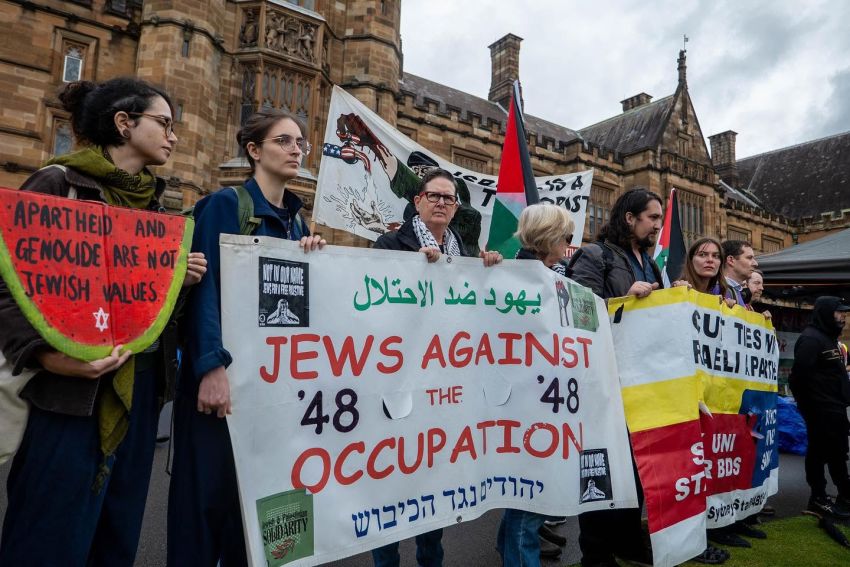
Students for Palestine activist Yasmine Johnson used her appearance at the Royal Commission on Antisemitism and Social Cohesion to demolish the argument that student protests for Palestine are antisemitic.
Johnson, who is Jewish, said the idea that campus protests “create a dangerous atmosphere is farcical”. She said the conflation of Palestine solidarity activism with antisemitism is an attempt to silence the anti-genocide movement.
This conflation of antisemitism and anti-Zionism is a feature of the Universities Australia (UA) definition of antisemitism, adopted by 39 universities in February last year.
It came at a time of heightened student activism across the continent, following the establishment of Palestine solidarity encampments on campuses from April to July 2024 and regular rallies in most cities.
Students used these protests to highlight the increasing ties between higher education and militarism, including links with the Australian Defence Force and companies that sell weapons and parts to Israel.
Universities framed the adoption of the UA definition as a step towards making campuses “safer” and used it to rewrite student conduct rules and disciplinary processes. But, under the guise of safety, students and university staff were silenced.
University managements’ claims that restricting protests and political speech makes campuses safer is not credible, particularly when they are deepening their involvement in military research.
Whose safety are we being asked to protect? Universities are more interested in protecting their relationships with harmful industries and institutions than in protecting student’s rights to freedom of expression and political activism.
They have shown that they want to prevent students from making a legitimate challenge to these relationships with political and economic structures that reproduce violence.
It is increasingly clear that the language and the invocation of safety as a principle is not being applied consistently. It is being deployed when the powers-that-be are subject to public scrutiny.
This phenomenon extends beyond the UA definition. The questions that need to be asked are how universities are deploying the definition to exercise discipline and whether intellectual freedom and political dissent are allowed under these conditions.
These disciplinary manoeuvres have been imposed in response to a broad movement for Palestine. The anti-genocide movement favours an emergent solidarity, democratic participation and collective resistance to oppression. It does not agree to the policing of our right to free speech.
Within Jewish political thought, there are competing visions of what safety means. Jewish intellectual and political traditions have long debated how safety is achieved and whose interests particular visions of safety ultimately serve. One such tradition, embodied in the Bundist idea of doikayt, understands safety as something built through collective struggle alongside other communities facing oppression.
In recent years, that tradition has found renewed expression among many Jews participating in the Palestinian solidarity movement. It is a tradition that refuses to accept that safety and dissent are incompatible — and it is not about to disappear quietly.