
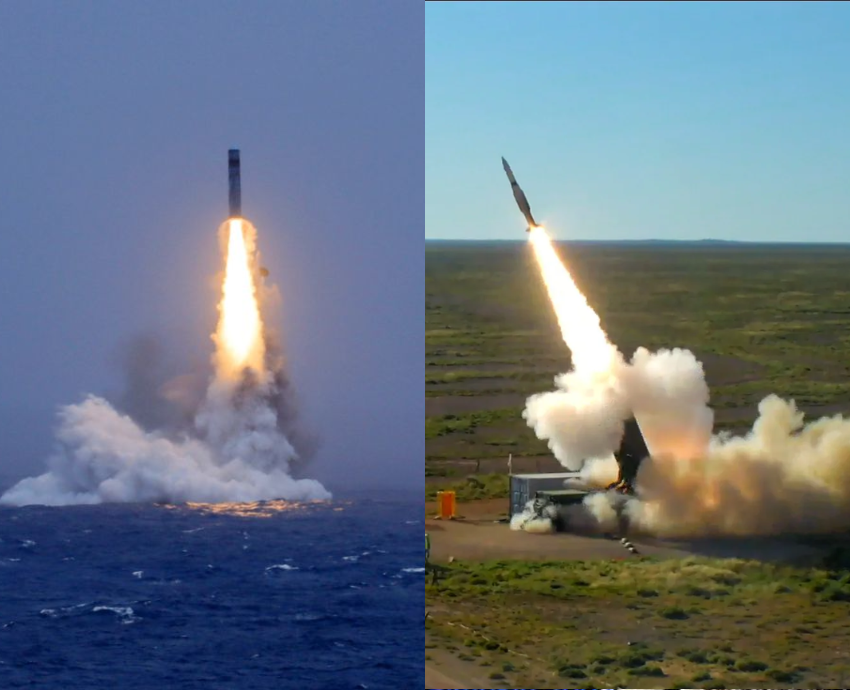
Labor foreign minister Penny Wong glibly told the ABC’s 7.30 on July 6 that China’s test of an intercontinental ballistic missile, launched by a strategic nuclear submarine, was “destabilising” for the region.
Wong was not asked about the scores of nuclear-capable missiles the United States has fired into the Pacific over the past decade, or the 318 nuclear tests carried out by the US, Britain and France in the Pacific region between 1946 and 1962 — all of which were carried out with bipartisan support.
According to journalist Peter Cronau, the US test fired nuclear-capable ICBM missiles 7000 kilometres into the mid-Pacific, possibly as recently as March.
Wong wasn’t asked about, nor did she mention, Australia’s current participation in the biannual Pacific Rim 2026 (RIMPAC26) war exercises, along with the US, and dozens of other countries, including Israel.
Wong complained that China’s test was “inconsistent” with Pacific leaders’ requests for the ocean to be one “of peace”. Yet, RIMPAC26, which purports to promote a “free and open” Pacific is, in fact, a rehearsal for a potential US-Australia conflict with China.
RIMPAC26, according to the Department of Defence, creates opportunities “to test Australian and US personnel interoperability”. It includes live-fire exercises, anti-submarine warfare, air defence, mine clearance and explosive ordnance disposal, as well as diving and salvage operations.
This year’s exercises, from June 24 to July 31, include “advanced capability integration with AUKUS Pillar II partners conducting sub sea and seabed warfare experimentation”. Elsewhere this is explained as “sinking exercises”, in which several countries coordinate to target, fire upon and sink decommissioned naval ships.
Such interoperability is deemed essential to the AUKUS war pact. The exercises are being led by vice admiral John F G Wade, commander of the US 3rd Fleet, and involve approximately 40 surface ships, five submarines, 140 aircraft and 25,000 personnel. About 430 Australian Defence Force personnel, including the guided missile destroyer HMAS Sydney, are in Hawai‘i for the world’s largest international maritime exercise.
Wong is correct about the dangers posed by nuclear missiles, and even their testing, however, her hypocrisy is galling. Since she criticised China, the Coalition has gone further, saying Australia’s air defence systems are inadequate. So, Labor has had to reveal that a joint Australia-US test of a Standard-Missile 2 (SM-2), a medium-to-long range conventional surface-to-air missile, took place in June as part of Exercise Taipan Strike 26, at Woomera in South Australia.
While not a nuclear missile, it nevertheless is a weapon and has a range of more than 166 kilometres. Labor is complicit in weakening the non-proliferation safeguards by signing up to the AUKUS war alliance in the first place. Under the deal, Australia will not only acquire nuclear-powered submarines capable of carrying ICBMs with nuclear warheads, but it will be given the technological expertise to make the submarines here.
Australia and Fiji signed the “Ocean of Peace Alliance” — a defence pact obliging the two countries to “assist each other” during armed attacks and security crises. It is one of two treaties to give practical effect to the Blue Pacific Ocean of Peace Declaration, which is supposed to “collectively promote security conditions conducive to regional peace and stability”.
However, for years, indigenous peoples of Hawai‘i have criticised RIMPAC26 taking place in their unceded waters. The exercises include several countries coordinating targeting, firing upon and sinking decommissioned naval ships, as well as testing unmanned systems and robotic surface vessel-fired missiles.
Jonathan Kay Kamakawiwo’ole Osorio, a professor of Hawaiian studies at the University of Hawaii Manoa, told Truthout that RIMPAC26 has enveloped Hawai‘i “despite the fact that our nation, our Kingdom was devoted to peace, did not militarize, and saw our relationship with other countries in the world … as unquestionably peaceful and where diplomacy was the actual tool that we used to further our own interests.”
Twelve authors of the report, The true cost of the military in Hawai‘i: A comprehensive analysis of the economic, environmental, strategic, and social impacts of the U.S. military presence in Hawai‘i, argue that Hawai‘i is central to US President Donald Trump’s planned military build-up against China.
The report, released in May and produced by the Institute for Policy Studies, alongside ʻĀina Aloha Economic Futures, The Costs of War Project, ʻĪlioʻulaokalani Coalition, Sierra Club of Hawai‘i and the Transition Security Project, argues that Hawai‘i is both a casualty of and “an instrument of US imperialism”.
It makes the case that the US’ Indo-Pacific strategy is based on its illegal invasion and annexation in 1893. The authors say the US’ plan to “deter” China “requires a forward, offensive posture with capacity for deep strikes into Chinese territory and possible nuclear war”. They say this is “both dangerous and unnecessary because it intensifies the security dilemma with China, places Hawai‘i at direct risk as a military target and may be premised on overstated threat assessments”.
The Pacific Regional Non-Governmental Organisations (PRNGO) Alliance, on July 13, criticised China’s ICBM test and added that it opposes “all forms of militarisation and nuclear threats in the Pacific, irrespective of which state is responsible”. It then named and shamed the US and Australia, singling out the US testing of Minuteman III ICBMs in the Pacific, AUKUS, RIMPAC, Valiant Shield, Talisman Sabre and “the continued expansion of foreign military presence and infrastructure across our Blue Pacific.”.
PRNGO includes climate action, aid, gender and diversity networks, Oxfam and the Pacific Conference of Churches. “For Pacific peoples, this is not an abstract geopolitical contest. It is our home”, PRNGO said.
While Wong and Albanese insist that military exercises and weapons tests are promoting peace in the region, we know it is really about softening up the public for a potential war against China — a war which most Australians, Chinese and the peoples of the Pacific don’t want.
[This article was updated on July 13.]