
Natural disasters have the uncomfortable ability to reveal the harsh truth of a situation. They do not cause crises on their own; they simply strip away the facades concealing them.
The two major earthquakes that recently struck Venezuela, with epicentres in Caracas and La Guaira, not only shifted the tectonic plates of the Caribbean and South America, but also completely shattered the political, social and economic normality in a country already struggling, with great effort, to get back on its feet.
This tragedy also unfolds against an already complex backdrop marked by the January 3 military aggression and imposition of United States tutelage over the nation.
Aid as control
Forty-eight hours after the most powerful earthquakes to hit the country in 125 years, the US has exploited the humanitarian catastrophe to accelerate its military control over a country it invaded just six months ago.
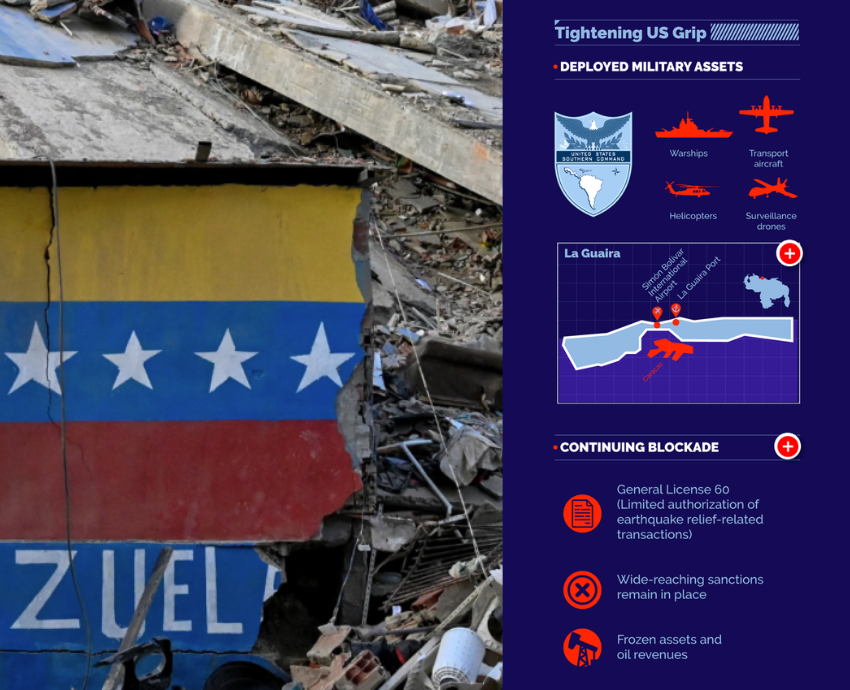
US Southern Command announced the deployment of about 100 airforce personnel to take over managing Venezuela’s Simón Bolívar International Airport, now operating at reduced capacity due to structural damage. About 130 marines arrived at La Guaira port to assist authorities in the terminal’s reopening, helping deliver humanitarian aid and heavy equipment.
Several US military helicopters have already transported state department personnel tasked with leading the aid mission. Meanwhile, US Southern Command has confirmed that the US Space Force is providing satellite imagery to assess damaged infrastructure.
To date, Venezuela has welcomed more than 1600 international rescue workers. As for on-the-ground coordination, US general Kevin J Jarrard arrived in Caracas on June 25 to lead the humanitarian response. On behalf of the Venezuelan government, Acting President Delcy Rodríguez appointed general Juan Ernesto Sulbarán as the sole authority for the emergency, placing the La Guaira region under strict military administration.
Economic impact
The United Nations Development Programme (UNDP) preliminarily estimates damage caused by the two earthquakes at US$6.7 billion (about 6% of GDP), concentrated mainly on homes and property in La Guaira and Caracas, and not counting the enormous long-term reconstruction costs.
The president of Fedecámaras [Venezuela’s big business chamber] ruled out widespread shortages and said the economic impact would be limited because the private sector continues to function. But the tragedy threatens to bring Venezuela’s fragile economic recovery to a sudden halt, following a decade of deep recession. In response, the government announced an initial reconstruction fund of US$200 million drawn from International Monetary Fund (IMF) reserves, a figure analysts consider wholly insufficient given the scale of the disaster.
Compounding this crisis is a sovereign debt, which various estimates put at $240 billion. This staggering figure greatly complicates the state’s ability to finance a huge reconstruction effort without relying on external support.
Gov’t under scrutiny
The double earthquake has placed the executive’s operational capacity and nature of its institutional control under intense public scrutiny. Far from being a simple logistical challenge, the emergency exposes the state’s weaknesses: the constant friction between military control of security and the free flow of aid, the pre-existing collapse of healthcare infrastructure and an information blackout that breeds mistrust through inconsistent casualty figures.
The interim Rodríguez government is staking its survival and political capital on its handling of the crisis. This will determine whether it can consolidate power or whether a misstep, corruption scandal or perceived neglect will catalyse mass protests by a society unwilling to tolerate further mistakes.
Elections and power
Disasters of this magnitude redefine national priorities, altering the relationship between social classes and those in power. In the current climate, the crisis caused by the earthquakes provides the perfect pretext to postpone any electoral process or discussion of political transition until the end of this year. It also puts wage demands on hold under the unifying banner of national reconstruction.
However, amid disasters, social solidarity often flourishes outside of the government’s political apparatus: neighbours clear rubble with their own hands, students transform into rescue workers, doctors improvise field hospitals and churches, universities and community organisations coordinate relief centres.
In just a few days, a social force has emerged whose significance will far transcend the current emergency. This phenomenon not only reveals the strengths and weaknesses of official institutions, but also the enormous capacity of a society to organise itself, care for the most vulnerable and build responses from the grassroots up — a popular energy that will undoubtedly shape the country’s political future.
Sanctions and assets
The double earthquake has forced the international community to adopt a pragmatic shift. The US announced a $150 million humanitarian aid package and temporarily suspended some economic sanctions to facilitate the flow of emergency funds. Meanwhile, the European Union increased its aid to victims but refused to amend its restrictive measures.
Washington’s move reveals a stark paradox: the nations now providing temporary support are the same ones imposing the sanctions that have strangled Venezuela’s economy and hampered its independent capacity to respond to disasters.
Estimates of the value of Venezuelan assets frozen abroad vary, but are calculated to run into billions of dollars. Economist Asdrúbal Oliveros estimates the total as about $22 billion, although a formal audit has not been conducted. Of these assets, about $8 billion from oil sales are under the US treasury department’s direct control.
A workers’ emergency plan
Venezuela’s reconstruction must not follow free-market logic nor become a source of profits for financial elites or the traditional bourgeoisie. It is crucial that the people and the working class develop a national emergency plan based on active solidarity, sovereignty and popular control. To prevent resources being misappropriated and the crisis worsening, we raise three urgent demands:
• IMF emergency funds, international aid and resources from sanctions exemptions must be allocated exclusively to repair homes and schools, ensuring they are not lost to bureaucracy, corruption or the Central Bank of Venezuela’s foreign exchange auctions.
• Housing and logistical solutions must come from organised communities. The state must facilitate aid without imposing bureaucratic hurdles, military cordons or accepting foreign interventions that compromise national sovereignty.
• Repatriating frozen funds is vital. We must demand the immediate return of Venezuelan assets held in foreign banks due to oil sanctions. It is unacceptable that, while the country faces a severe shortage of funds for machinery and medicines, its own resources remain frozen. Likewise, the suspension of debt renegotiation is unacceptable.
The working class must not allow itself to be distracted amid the crisis. The traditional right and conservative sectors will try to divert public debate towards artificial and self-serving discussions, but today the absolute priority is addressing people’s material needs, who demand a dignified life and have taken to the streets not only to save lives, but to demonstrate that they constitute the country’s true social majority.
[Abridged from a translation by Federico Fuentes published in LINKS — International Journal of Socialist Renewal.]