
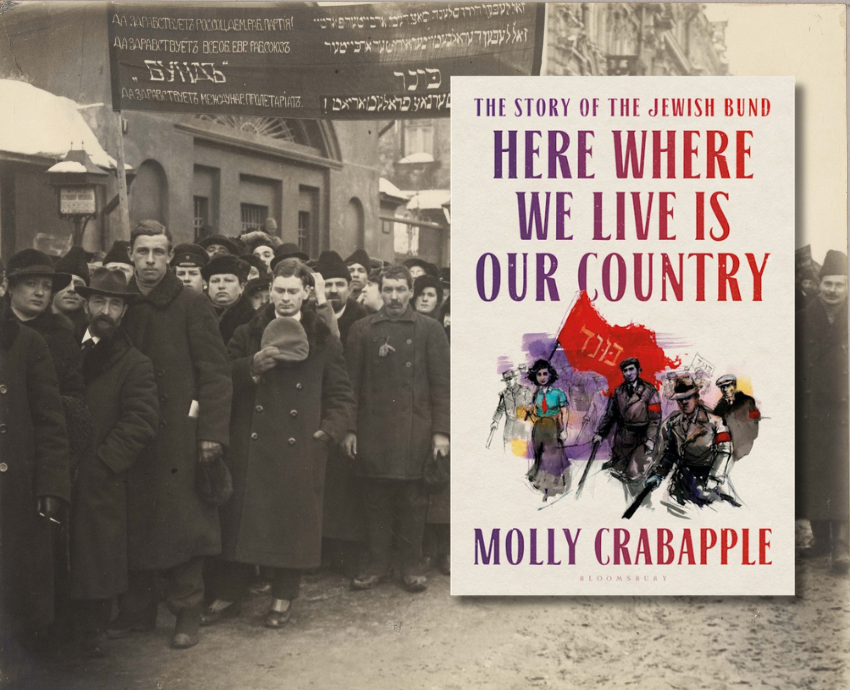
Here Where We Live is Our Country: The story of the Jewish Bund
By Molly Crabapple
Bloomsbury Publishing
Due September 2026
480pp
Here Where We Live is Our Country is a long-awaited contribution to the sparse field of knowledge about the Jewish Labor Bund, a group that played a key role in late 19th and early 20th century Marxist history, including the February 1917 revolution and the Petrograd Soviet.
However, it is also a deeply personal book, eschewing “straight” history for a dramatic retelling of the events and characters that carried this movement throughout the Pale of Settlement in eastern Europe, and their connections: both locational (to the immigrant world of New York, and the glittering capitals of Europe where revolutionaries gathered, in exile), and political (to more contemporary activists for racial and economic justice, with whom the author draws a comparison).
Author Molly Crabapple draws from her own background as a journalist and artist who has documented and worked alongside anti-capitalist protesters, starting with Occupy Wall Street in 2011. She also has a familial connection to the Bund, through her great grandfather Sam Rothbort, whose journey from the shtetl of Volkovysk to New York City is traced throughout the book.
In more general terms, Here Where We Live is Our Country is also a response to Israel’s genocidal destruction of Gaza, which has galvanised activists worldwide, but also revealed the dark, ethnonationalist heart of Zionism — which offered one response to persecuted Jews in Europe.
This book shines the light on another response, the Bundist movement, which was founded in 1897 — the same year as Zionism — largely extinguished by the Holocaust, but whose moral clarity remains enticing.
Crabapple illuminates the distinctions that existed between Zionism and Bundism from the beginning, including their respective class profiles, noting that, “While the Bund’s first congress comprised a few fugitives in a Vilna attic, the inaugural Zionist congress filled a posh Swiss casino and turned Theodor Herzl, its founder, into a superstar.”
Furthermore, modern Israel’s mistreatment of Palestinians is foreshadowed by Herzl’s private commentary on the need for these people to leave, having been stripped of their land. Or, as Crabapple observes: “When Zionist leaders bothered to mention Palestinians at all, their approaches ranged from condescension to calls for ethnic cleansing.”
Crucially, these two ideologies within the European Jewish community existed in visceral opposition to one another. The Bund closed its membership to Zionists, while the latter group’s Chaim Weizmann — who later became president of Israel — claimed that “our hardest struggle everywhere is conducted against [the Jewish Labor Bund]”.
The antagonism could be explained through the concept of “do’ikayt” (“hereness”), which encapsulates the Bund’s belief that Jews had as much right to live free and with full civil rights in the lands of their birth (“here”), rather than looking for a future in Palestine (“there”). This freedom would be achieved through involvement in the wider class struggle in eastern Europe, and through armed defence of the Jewish community during pogroms, with Crabapple recounting the exploits of several street fighters, including Iskra the Bundist, Bernard Goldstein (head of the Bund’s self-defence militia in Warsaw) and Rothbort.
For Marxists looking to delve into the cauldron of pre- and post-revolutionary Eastern Europe, Here Where We Live is Our Country also provides a rich feast.
Crabapple points out the central role of the Bund in Russian socialism — as co-founder, in 1898, of the Russian Social Democratic Labour Party (RSDLP), which it left in 1903, due to a debate over the right to organise Jewish workers autonomously, and the Bund’s association with the Mensheviks throughout the revolutions of February and October 1917.
Bundists Raphael Abramovich and Mark Liber were among the protagonists of the Petrograd Soviet, and the book traces the rightward drift of this organisation, the seismic impact of Lenin’s return on the exhausted city’s inhabitants and the Jewish Labor Bund’s place within this historical tapestry.
The calamity of the Holocaust presents an important question to the Bund and to the author: could Jewish people really be safe and free in a world that had abandoned them, whether this was evidenced through participation (by the wider Christian population) in the Nazi’s mass killing, the failure of Allied countries to open their borders to desperate refugees or the unwillingness of Poland’s Home Army to help the Warsaw Ghetto fighters until it was too late? (It should also be mentioned that at this moment, the Zionist and Bundist movements put aside their differences and fought together in the bunkers.)
I won’t give away the conclusions Crabapple comes to, but it’s enough to say that she challenges the very premises of “winning” or “losing”, and what that would mean for those embracing the struggle for economic and racial justice, and those embracing ethnonationalism, respectively.
Enriched by the individual stories of Bundist heroes, such as Pati and Arkady Kremer, Vladimir Medem, Anna Lipshitz, Sophia Dubnova, Henryk Erlich, Esther Frumkin, David Lipetz, Viktor Alter and many others, Here Where We Live is Our Country is a timely exploration of a movement that shaped much of early revolutionary thinking in Eastern Europe and carries parallels to those struggling for equality and against capitalist repression today.