
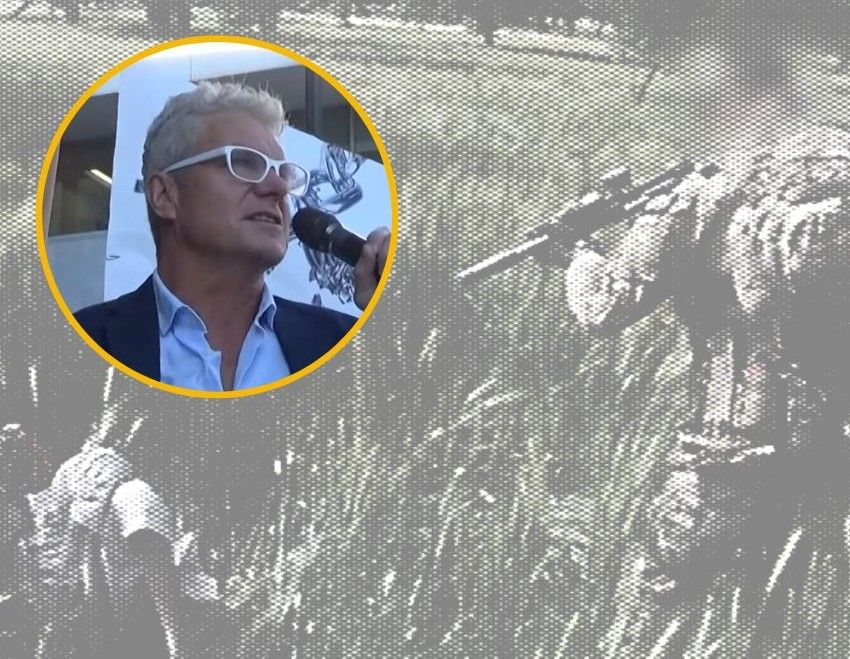
Australian Defence Force whistleblower David McBride was released from prison on August 13 after serving a 2 year and 3 month non-parole period for leaking classified documents about war crimes in Afghanistan to the ABC.
Those documents revealed a culture of cover-up among senior management in the battlefield. McBride is the only person to have served time over the war crimes scandal.
McBride was sentenced to 5 years and 8 months by the ACT Supreme Court’s Justice David Mossop in May 2024. Federal Attorney General Michelle Rowland had the power to release the former military lawyer.
After serving as an Australian Defence Force legal officer in Afghanistan over 2012 and 2013, McBride became concerned over a decision by then ADF chief David Hurley to overhaul the rules of engagement, or the directives regarding soldier behaviour in battle, in late 2013. McBride considered that the ranks were being blamed for the manner in which top brass had been running the war.
At the same time as the ADF lawyer was questioning the way the ADF was undertaking its rules of engagement, a researcher was raising the alarm about a culture that viewed war crimes favourably. McBride was also pondering briefings, relating to incidents that were said to justify the reforms, that didn’t involve the required legal prerequisites to start prosecution.
As he was leaving the Alexander Maconochie Centre, on Ngunnawal land in Canberra, McBride told the media that his incarceration had been “a very positive experience”. He will now serve the more than three years left of his sentence on conditional release in the community.
“I’m very happy to be out. It’s a beautiful day to be free,” McBride said. “I thank all my supporters. I thank the attorney general for granting me parole. I’m just happy to be here with my wonderful family.”
McBride leaked multiple classified documents to ABC journalists over 2014 through to 2016 to highlight issues with ADF management. Journalists reported evidence of multiple war crimes, perpetrated by Australian special forces in The Afghan Files in 2017 and this subsequently led to his arrest in September 2018.
The father of two went on to fight his charges, but he was blocked in the courts on two occasions. The first was during his 2022 public interest defence hearing. The second time was during his 2023 criminal trial as the prosecution had been empowered to remove great swathes of his evidence at both proceedings for “national security” reasons. It meant he couldn’t argue his case.
McBride was then left with the option to plead guilty to three, out of an initial five criminal charges. He accepted responsibility for one count of theft, contrary to section 131.1(1) of the Criminal Code Act 1995, and two counts of unlawfully communicating naval, military or air force information, contrary to section 73A(1) of the Defence Act 1903.
McBride’s case was among three high profile whistleblower prosecutions, launched under former Coalition Attorney General Christian Porter around 2018. These included the prosecution of Witness K and Bernard Collaery for exposing the 2004 Timor-Leste bugging scandal and that of ex-Australian Taxation Office employee Richard Boyle, who exposed unlawful garnishee practices.
The determination to prosecute these whistleblowers shone a light on the failures of the Public Interest Disclosure Act 2013 (NSW), initially drafted by then Labor AG Mark Dreyfus, who was returned to that position in 2022 under Anthony Albanese’s government.
The 2016 Moss Review had considered the laws within the Public Interest Disclosure Act 2013 (PID) Act. It found that the PID protections were insufficient, making 33 recommendations to improve them. The Coalition refused to do that and Dreyfus delivered 21 of them by mid-2023, including the roll-out of the National Anti-Corruption Commission. The then AG made it clear that this was not the major overhaul.
Witness K plead guilty to charges that had sat on the back burner for years, prior to being pressed against him in mid-2018. The charges against Collaery, his lawyer, were dropped in mid-2022, with Labor responding to the public outcry against the high profile “political prosecutions”. Boyle was eventually released in August last year, after pleading guilty to four minor charges.
Rowland opened up the draft exposure of the Public Interest Disclosure and Other Legislation Amendment (Whistleblower Protections) Bill 2025 in September last year. It contains the second tranche of PID Act reforms and aims to establish the Commonwealth Whistleblower Ombudsman, as well as strengthen supports for disclosers and clarify rights. Yet, this bill is yet to be introduced.
In 2016 McBride was expressing concern about the ADF behaviours in Afghanistan. Military sociologist Dr Samantha Crompvoets was inquiring into the culture of the Special Air Services (SAS), producing a report citing war crimes, and the Brereton inquiry, or the ADF investigation into war crimes in Afghanistan, had started. That 4.5 year inquiry led to a November 2020 report that found evidence that 39 Afghan civilians and prisoners-of-war had been murdered, likely by 19 members of the SAS.
The Office of the Special Investigator was set up in January 2021 to inquire into these matters and progress has been slow. Former SAS officer Oliver Schulz was charged in 2023 over the alleged murder of an Afghan civilian. He has since pleaded not guilty and is set to stand trial next year. In April, Australia’s most decorated war hero, Ben Roberts Smith, was publicly arrested and charged over five counts of the war crime of murder.
[Paul Gregoire writes for Sydney Criminal Lawyers where this article was first published.]