
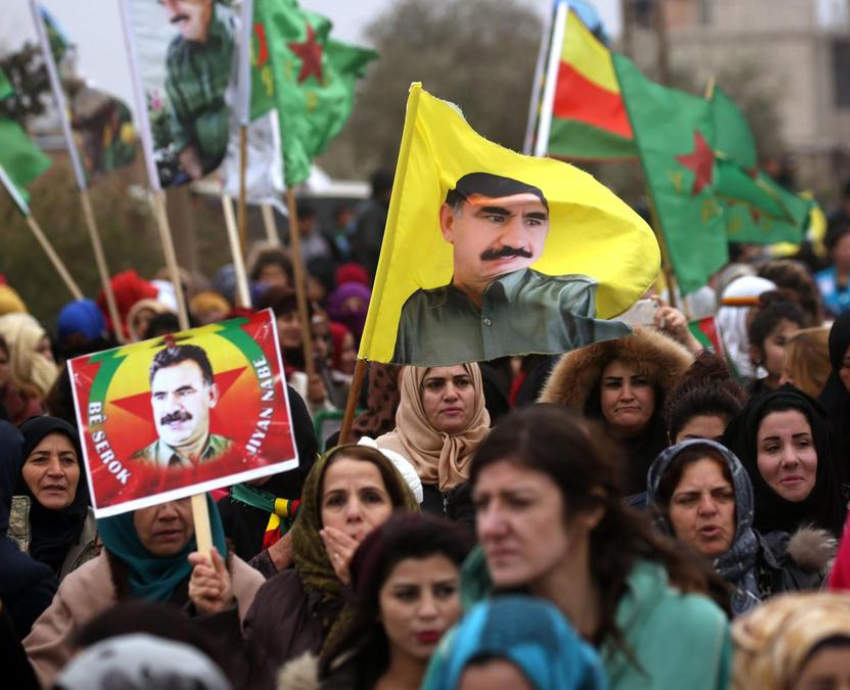
After months of promises, the Turkish Parliament has committed to producing a legal framework law to enable the final dissolution and disarming of the Kurdistan Workers’ Party (PKK).
Sarah Glynn asked Peoples Equality and Democracy (DEM) Party MP Berdan Öztürk — who was in Strasbourg for the Parliamentary Assembly of the Council of Europe, in June — about the progress of the “Peace Process” between the Turkish state and the PKK.
* * *
Öztürk: Let me start at the beginning. Concrete steps need to be taken by the government. They have been taken by the PKK, and of course, the process has been moved forward by [imprisoned PKK leader] Abdullah Öcalan.
There are many examples from conflicts across the world: if one party to the negotiation takes steps towards a solution, they expect the other side to take steps as well. The PKK dissolved itself. The PKK burned down their guns — as a symbolic gesture, but it’s important. They have decided to lay down guns as well, but for that we need a law. We need legislation. After they lay down their guns, where will they go?
What do you expect to be in this law? And will it apply to everybody: to the guerrillas, to the PKK leaders, to imprisoned politicians, to people in exile in Europe?
Every one of them. We have to build trust between the PKK and the state and government. As the DEM Party, I’m saying that. We need to build trust between people, Kurdish people and Turkish people, as well. This is important.
In this kind of process you should go step by step because we have to convince the Turkish public as well. The conflict has taken a long time. We are talking about 50 years. The last 10 years were very difficult, very harsh on Kurdish people. But the government has been telling Turkish society that the reason for that is Kurdish people, the DEM Party, the HDP [Peoples’ Democratic Party]. They call us “terrorists”. We have to change their perception as well.
For the next step, for us to move forward, some small steps need to be taken. We are in the Council of Europe. There are key judgments (by the European Court of Human Rights) that can open the way for Turkey — to democracy, to respect of human rights and to the rule of law.
These judgments start with Öcalan’s judgment of 2014, the Right to Hope [the right to the possibility of parole]. And there are many other judgments as well. Implementation of these judgments alone can ease tension and allow the process to move forward.
But you don’t need a law change to implement those judgments, do you?
That’s my point. You don’t have to do anything extra. But for the PKK members, for our political prisoners, for those people that had to leave the country and that live in European countries, for our comrades, of course we need a law. For the solution to the Kurdish issue, this law is a must.
It has the support of almost all parties?
Except for the İYİ [Good] Party. The goal of the İYİ Party right now is to get the votes of MHP [Nationalist Movement Party] voters and other nationalist votes. They play to nationalists, but in the end they are going to lose. They are saying that war should be continued and people should be dying, killing each other. But other political parties and NGOs and unions, they are supporting the peace process, and they are really excited about this and are ready to do whatever they can do to contribute.
Have there been moves to build up public trust?
For Kurdish people, it’s almost two years that they have been waiting for the government or state side to take steps. The state hasn’t done anything concrete except from organising the Parliamentary Commission.
So, for Kurdish trust you need the government to act?
Yes.
But what about for Turkish people?
For Turkish people, as Öcalan said, you have to include all political parties that are in the parliament. We have to convince people. As the DEM party, we held more than a thousand public meetings and we discussed the peace process with our people, our voters. CHP [Republican People’s Party] and MHP should do that as well.
Have they?
Yes. And when we met with the Turkish delegation to the Council of Europe in Ankara, one AKP [the ruling Justice and Development Party] member of parliament, a woman, said that they had had many meetings as well with women. She said that people are convinced. People want a solution to the Kurdish issue. That’s really great.
If political prisoners are released and guerrillas come back to Turkey, would they be totally free? Would you expect certain restrictions on what they could do?
There should be no restrictions. The PKK says that it has changed its armed struggle to political struggle. When they come back to Turkey, of course they are going to do politics. Restrictions would be a problem for the peace process to move forward.
Can you imagine the leaders of the PKK being allowed to do democratic politics in Turkey?
The leaders of the PKK, if you cannot guarantee their lives, they shouldn’t come to Turkey at the beginning of all this. Because no one can guarantee their lives, not even the state, the government. It’s going to take time maybe for their return. This is my personal opinion — not the DEM party’s opinion. We have to guarantee their safety as well. It’s important. Without safety, they cannot do politics or anything else. But other PKK members should come back and do politics.
Can you trust the government, even if they make a law, that they will abide by it?
The building of trust is going to take time. If you ask the government, they will say they don’t trust the DEM party. Because this issue has been going on for more than a hundred years — and 50 years of armed struggle.
But it’s not them that’s expected to give up arms. The guerrillas are expected to give up arms, so they have to trust the law.
Without law, no one should expect the PKK to lay down their guns. But with law, is there any guarantee? No.
Very often in these things there’s a third party. Is that something that you’re arguing for?
Not right now, but in the future, it’s an option.
The Turkish state has done everything it could during these last 10 years to defeat the PKK, and the PKK aimed to defeat the state. Neither could succeed. It’s a stalemate. They decided to choose a different route, which Öcalan has been calling for since 1993. The situation in Turkey is terrible for the people: not just the economic situation — social, cultural and the institutions of the state. They have to rebuild. For that, they need a peaceful solution. Many things are changing around the world. Turkey has to adapt to new situations. For this, Turkey needs to have peace with the Kurdish people…
[Turkish President Recep Tayyip] Erdoğan has exhausted every way for Turkey to move forward. Democracy is backsliding, human rights have been destroyed, no one trusts the judiciary — I’m talking about the majority of Turkey.
But he seems to be concentrating on making lots of foreign friends.
Yes, of course. Look at the European countries. Their main concerns are not human rights, are not democracy, are not rule of law — they are security, defence and armaments. It’s a really dangerous situation for Europe as well. They close their eyes. They don’t want to see what’s going on in Turkey or to hear anything negative.
After the Russian aggression against Ukraine, the countries are investing more in armaments. And they need Turkey. The security concerns can be understandable, but we have to keep a balance between human rights, democracy and rule of law and security.
We’re talking about this law that would bring people back to take part in democratic politics, but is there going to be any democracy for them to take part in?
We have to build democracy together — to turn a new page for a new Turkey, a powerful, improved Turkey.
What about people in other parties? What role do you see for the CHP?
The CHP is the main opposition party. It can and should play a very important role. CHP needs to change as well. You cannot expect to repeat yourself and find new solutions.
I am not going to intervene with internal issues, but I have been saying for a long time that the CHP should sit down and decide what they are going to do, what kind of country they want to live in. Assimilation policies didn’t work.
This is an opportunity for all of us — not just the DEM party, but all of us — to build a new country. I’m not talking about changing the name of the country. We have to change the system, and we have to change the perception against Kurdish people. We (Kurds) are a nation — a strong nation. Millions of Kurdish people live in Turkey, Iran, Syria and Iraq. It’s a big advantage for Turkey as well. But first, Turkey needs to have peace with its Kurdish citizens.
If any change is going to happen in Turkey, it cannot be without the DEM Party.
You could also say you’re not going to have the change that you envisage without the CHP.
What is the CHP going to do if they win the election? It’s going to take 20, 30 years to mend this disastrous situation in Turkey. And CHP cannot do it by itself. We have to work together.
What will Özgür Özel do? Is he going to set up a new party? [For the judicial coup against the CHP, see my earlier blog post on News from Kurdistan.]
I don’t want to comment on that. I’m going to leave it to the CHP…
Most people don’t accept these actions against the CHP. It’s unacceptable. It’s the main opposition party. They might have internal problems; they might have problems with the judiciary as well. But this is not the way. To appoint [Kemal] Kılıçdaroğlu to the CHP. It’s unacceptable.
On the one hand, we are talking about the peace process, democratisation of Turkey, and, on the other hand, you are moving against the CHP. It’s really unacceptable.
That doesn’t mean the CHP should act against the peace process. We have to struggle together to change things in Turkey. It’s not just the CHP, there are other political parties as well, whether in parliament or outside of parliament. We have to decide together.
As well as a legal framework, the other thing that you are currently asking for is greater freedom for Öcalan.
Let me start by saying that he is a chief negotiator. He’s the main political figure for Kurdish people, and of course he’s the leader of the PKK. His physical freedom is necessary for the process to move smoothly. They sometimes don’t allow the DEM Party delegation to visit Öcalan. Before the last time, they waited two months. His lawyers cannot visit him when they want.
The recent delegation from the Council of Europe’s United European Left couldn’t visit him either.
They came to Turkey, they wanted to visit Figen Yüksekdağ, Selahattin Demirtaş and Öcalan. But they weren’t allowed to.
If you are going to find a solution to this huge issue, I mean the Kurdish issue, you have to have the right to meet other political parties. I’m not talking about just in Turkey. Other political groups here (in Europe), academics, journalists should have a right to go and visit Öcalan, to share their opinions or their suggestions. It’s very important. He has a right to meet other people as well.
This could happen on Imrali Island (where he is currently imprisoned)?
It could be on Imrali Island, it could be somewhere else. The place is not important. He has the right to meet whoever he wants to meet, and the Turkish state has the obligation to provide this.
You’ve just had the visit of the United European Left. How do you think that contributes to the peace process?
Their visit was very meaningful for us, and for the public as well. They met with the Peace Mothers [a Kurdish-led women’s civil rights movement]. They had heard many things before, but when they listened to the Peace Mothers’ stories, they were faced with reality. They felt everything — maybe not everything, but they felt their emotions.
The timing of the visit was very important. Applying to visit Öcalan was very important. It’s a note for history that the United European Left was with us, with our struggle. It lightened up our mood.
What can the Council of Europe do for the peace process more generally?
We don’t ask them to intervene in internal issues, but Turkey is a member of the Council of Europe; Turkey has obligations to the Council of Europe. The main obligation is to implement the judgments of the European Court of Human Rights. Now is the time to take an active role, to contribute to the peace process. Take some initiative and be active for the implementation of these judgements. It will be a huge contribution from the Council of Europe.
This is a general problem with the European Court of Human Rights — that it can’t enforce judgments.
But there are many mechanisms that the Council of Europe can use, that the Committee of Ministers can use. As I said, it is the right time for Turkey. If you are going to use the geopolitical situation of Turkey as an excuse, then you should shut down the Council of Europe and we shouldn’t come here.
[The original transcript was edited for length and clarity and has been abridged from Sarah Glynn’s blog site, News From Kurdistan.]