
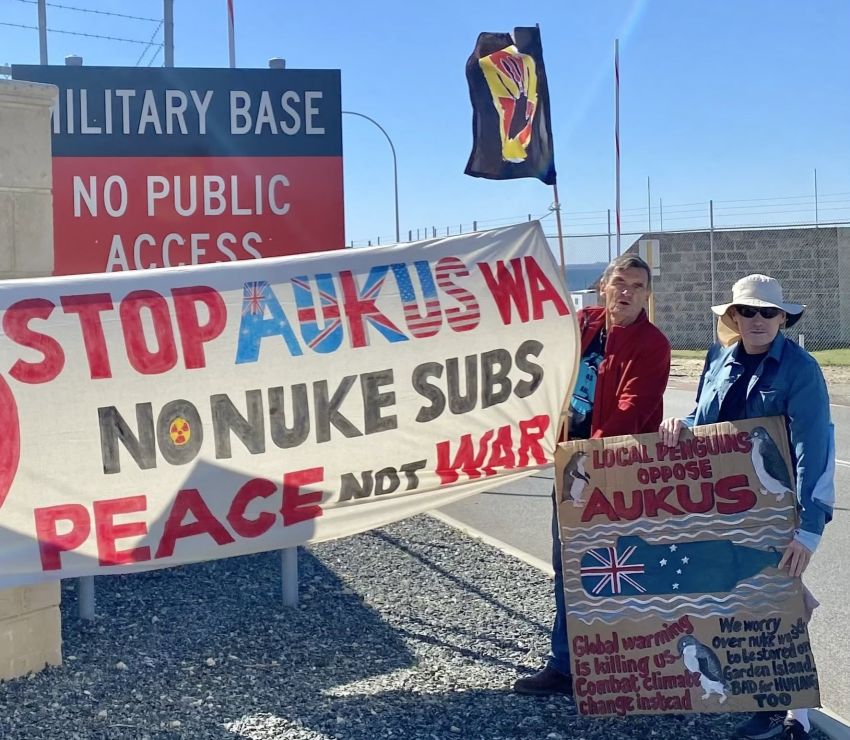
Australia’s role in the global arms trade and its connection to the AUKUS pact is coming under increasing scrutiny, particularly over the past near three years of Israel’s genocide in Gaza.
Representatives from Stop AUKUS WA told the AUKUS Public Inquiry on June 29 about the dangers of Australia becoming enmeshed in United States war plans.
Stop AUKUS WA organisers Sam Wainwright and Leonie Lundy said people living in proximity to Cockburn Sound — including many in their 500-strong group — would be affected by the proposed nuclear-powered submarine base on Garden Island and submarine dry dock maintenance facility at the Henderson Defence Precinct — both key parts of AUKUS Pillar 1.
“Stop AUKUS WA strongly believes AUKUS was ill-conceived and debases our democracy, threatens our sovereignty, is financially obscene and is creating a safety, security and nuclear risk for our community — in the first instance here in Cockburn Sound and coastal communities,” they said.
Wainwright and Lundy said on both national and international levels the deal is likely to bring tension rather than peace. “AUKUS threatens to undermine the Nuclear Non-Proliferation Treaty to which we are signatory and cause distrust with our regional neighbours,” they said. “It encourages other non-nuclear states (such as South Korea and Brazil) to build nuclear powered submarines, furthering the global nuclear creep.
“It commits a disproportionate defence expenditure, currently estimated at $375 billion, although with a substantial contingency, to nuclear powered submarines, whose purpose is fundamentally offensive rather than defensive, and which are becoming highly detectable — so may soon to be obsolete assets.”
The local impact is of particular importance to Stop AUKUS WA, they said. The sovereignty of First Nations people has not been considered, particularly the use of Garden Island, a designated nature reserve, as a site for expanded wharf facilities and a Controlled Industrial Facility (CIF).
“The lack of social licence and community consultation and the secrecy and deception around the AUKUS security pact is on full display in the implementation at a local level,” Wainwright and Lundy said.
“There is a lack of apparent free, prior and informed consent from the traditional owners of Garden Island pertaining to both the CIF and expansion of Stirling [HMAS Stirling naval base] to accommodate nuclear powered submarines.”
Given that nuclear waste is set to be stored at this location, it was essential to pin down what that would mean for local people, they added.
“The public was misled about the exact nature and level of the waste to be managed and stored at the Garden Island CIF, with the ASA [Australian Submarine Agency] initially claiming it was all ‘similar to hospital and research lab waste which after time can go into landfill’.”
They said Dr Margaret Beavis, from the Medical Association for the Prevention of War, had exposed this disinformation. It was then revealed that part of the waste will require secure storage for up to 300 years.
The Garden Island CIF has a life span of 50 years — irrespective of rising oceans due to climate change and its location at the edge of the island. They said the Australian Radiation Protection and Nuclear Safety Agency CEO later inferred that such details were considered “too technical” for the general public.
Other speakers at the inquiry included representatives of Global Nuclear Security Partners and the Conservation Council WA, former federal defence minister Linda Reynolds, Dr Mike Gilligan - the former head of the Force Development and Analysis Division at the Department of Defence, KA Garlick from Nuclear Free WA, long-term peace activist Jo Vallentine and Indigenous elder Heidi Mippy.
[The next AUKUS Inquiry hearing dates can be found here.]