
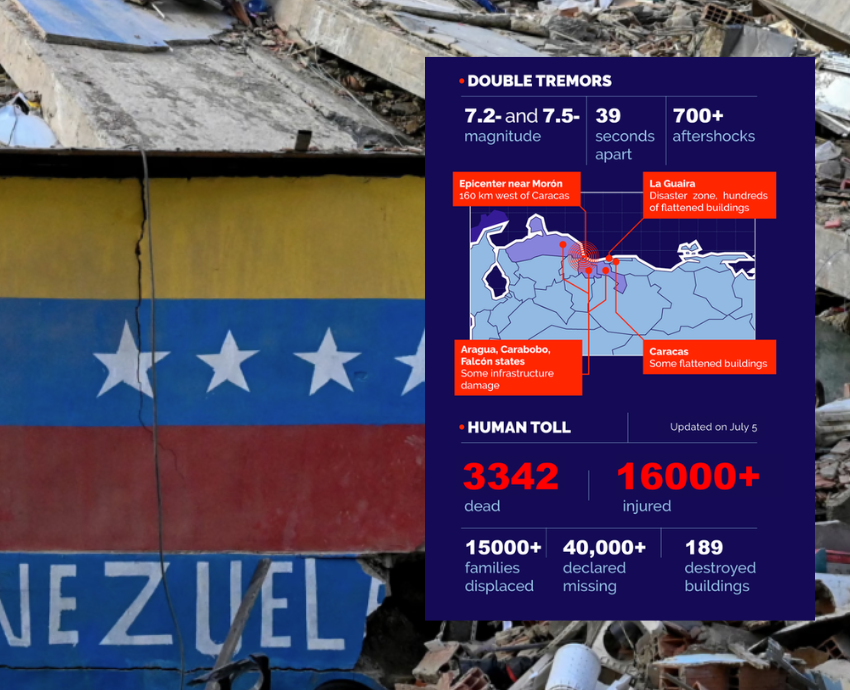
While La Guaira state struggles to rebuild out of the ruins of the double earthquake, one financial factor is worsening the humanitarian crisis. Technical reports and expert statements say the United States administration’s sanctions policy ensures most of the foreign currency Venezuela generates from oil sales remains under US control, drastically limiting the funds available for reconstruction.
Oil engineer, Einstein Millán Arcia, who is also a former manager at Venezuela state oil company, PDVSA, says since January Washington’s control over Venezuela’s trade decisions has been “growing and sustained”. International buyers, via a network of Treasury Department licenses, are having to deposit oil payments into US-supervised accounts.
The figures to May reflect the magnitude of this discretionary control:
• From January–May, Venezuela exported about 152.38 million barrels of oil.
• This generated a gross value of $11.673 billion. However, 70% of this remains frozen in US Treasury-managed accounts.
• Washington only allowed a small fraction of these funds to flow into Venezuela. The US State Department reported to Congress that it had authorised the disbursement of some $3.5 billion (via intermediaries such as Qatar), primarily for the public payroll and foreign exchange market. The Central Bank of Venezuela (BCV) has not formally confirmed this figure.
Fewer cranes, more inflation
This has direct consequences on the state’s ability to respond to the natural disaster, which has caused US$6.7 billion in damage (about 6% of Venezuela’s GDP) according to preliminary United Nations Development Programme (UNDP) estimates.
Economist Francisco Rodríguez, author of The Collapse of Venezuela, warns the structural impact of this policy is severe, especially in the area of infrastructure:
“During Venezuela's long economic implosion, the sector that contracted most was construction — with its GDP falling by a whopping 95.9% between 2013 and 2020…
“We should not forget that for more than 7 years, US sanctions barred the Venezuelan government from purchasing the heavy machinery that is needed to dig people out of the rubble today.”
Added to this is the problem of macroeconomic instability. As most oil revenue does not enter the country in a sovereign and regular manner, the BCV has fewer tools to stabilise the exchange market, driving up prices and devaluing budgets allocated to humanitarian aid.
Even the US Treasury department admits that prior to the earthquake there were obstacles to coordinating international assistance and acquiring disaster relief equipment.
Financial crossroads
The scale of the destruction, which has left more than a hundred buildings collapsed along the central coast, exceeds the country’s current liquidity. Analysts agree the lack of transparency and discretionary management of Venezuela’s funds abroad adds a layer of uncertainty to the tragedy.
According to UN experts, the financial urgency is so profound that addressing the housing and infrastructure crisis could require immediate relief, and even the complete lifting, of financial restrictions on Venezuela’s energy industry.
In response to the crisis, the Autonomous and Independent Workers’ Committee joins the national and international demand for the US Treasury department to give back Venezuela’s financial resources.
[Abridged from a translation by Federico Fuentes published in LINKS International Journal of Socialist Renewal.]