
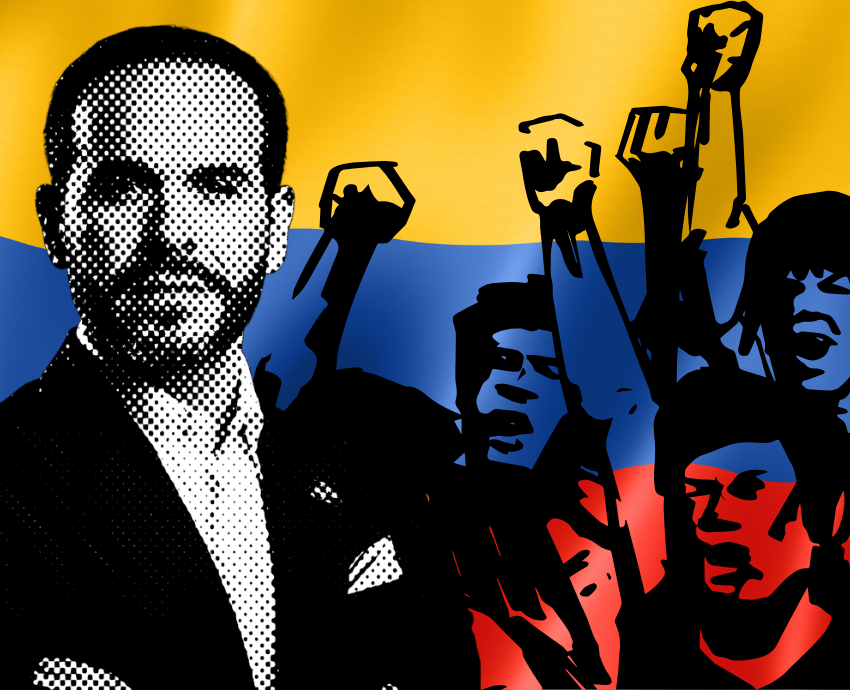
Far-right candidate Abelardo de la Espriella narrowly defeated leftist Iván Cepeda in Colombia’s run-off presidential election on June 21. De la Espriella won by just 250,000 votes — less than one percentage point — which is the tightest presidential electoral victory in the country’s history.
Cepeda was widely seen as the successor to Gustavo Petro — the country’s first leftist president — who was barred from seeking re-election due to constitutional term limits.
Cepeda founded the National Movement for Victims of State Crime, which campaigns for justice over decades of state-orchestrated killings and disappearances. Cepeda’s father Manuel — a longtime leader of the Communist Party — was assassinated in 1994 and Cepeda was forced into exile in 2003.
Cepeda served in the Chamber of Representatives from 2010–14, has served as a senator since then and is part of the ruling Historic Pact party.
De la Espriella, on the other hand, is an openly racist, misogynist millionaire who wants to cut public spending by 40%, expand the extractivist sector and take a militaristic approach to fighting “narcotrafficking”.
Following a similar narrative to other far-right candidates, De la Espriella presented himself as an “outsider” and “anti-establishment” candidate during the campaign. However, he has close ties to the right-wing political establishment, particularly with former far-right president Álvaro Uribe, and has extensive real estate and business interests in the United States.
De la Espriella maintained close ties with the United Self-Defense Forces of Colombia — a far-right paramilitary and drug trafficking group responsible for killing almost 100,000 people in the 1990s and early 2000s. He founded the euphemistically named Foundation for Peace Initiatives, which platformed paramilitary commanders at university forums and campaigned against prosecuting them for human rights violations.
Military and state-backed paramilitary groups were responsible for the more than half of the 500,000 people killed and disappeared from 1985–2018.
In his career as a lawyer, De la Espriella defended corporate criminals and high-profile paramilitary leaders, while amassing a fortune in various other business interests.
The Supreme Court ordered an investigation in 2011 into De la Espriella for money laundering and conspiracy, but it was blocked by the Attorney-General’s Office, which was led by his friend.
Modelling much of his campaign and rhetoric on far-right Salvadorean President Nayib Bukele and Argentine President Javier Milei, De la Espriella promised a return to the “mano dura” (iron fist) military approaches to security, characterised by police and military violence.
De la Espriella has vowed to “disembowel” the left and use lethal force against protesters.
He is a vocal supporter of Israeli Prime Minister Benjamin Netanyahu and the Zionist genocide in Gaza, saying that Colombia should employ the same tactics used against Palestinians to “defend Colombia”. He has pledged to reverse Petro’s 2024 decision to cut ties with Israel and promised to relocate the country’s embassy to Jerusalem.
De la Espriella — a US citizen and Republic Party member — has the full endorsement of US President Donald Trump and Colombia’s big business elite, who control most of the mainstream media and social media platforms.
In the lead-up to the elections, social media was inundated with disinformation about Petro and Cepeda’s supposed links to organised crime and guerillas. Unsurprisingly, De la Espriella’s actual links to organised crime were not subjected to scrutiny in the sympathetic corporate media.
‘Total Peace’
Petro and the ruling Historic Pact enacted a policy of “Total Peace”, seeking dialogue with the National Liberation Army, the remaining guerrilla group, and other armed groups willing to commit to peace.
The Colombian Truth Commission — which brought together interviews with thousands of victims and military and paramilitary leaders — urged an end to the US-backed militarised approach to drug policy and security, which only exacerbated violence.
Now, De la Espriella looks set to reverse the slow, shaky process towards peace that was deepened under Petro. He has promised to abandon any peace processes and negotiations with armed groups and legalise civilians being able to carry firearms.
He envisions a “Plan Colombia 2.0”, a repeat of the US-sponsored militarism responsible for widespread violence and human rights abuses, under the guise of combatting drug trafficking.
Irregularities
The run-off vote was marked by significant irregularities, such as vote-buying, falsification of signatures and modification of voting slips. International electoral observer COHESIA declared that the run-off did not meet the conditions required to be considered a “fair and democratic election”.
Colombia has a quasi-privatised vote counting system, with tallies done by private security firm Thomas Greg & Sons. The company does not share the source code for the count, which means it cannot be verified. Furthermore, its owners are under investigation for fraud in Mexico and have been previously convicted for fraud in the US.
US Senator Bernie Moreno, as part of a US delegation ostensibly “observing” the first round of elections, violated Colombia’s electoral laws by meeting with right-wing candidates, including De la Espriella.
Petro alleged voter fraud in the run-off election, citing manipulation of the handwritten tally of votes at each polling station.
Gains under threat
A De la Espriella presidency threatens to roll back some of the progressive gains made during Petro’s time in office.
Petro raised social spending, implemented land redistribution policies and enacted reforms for the benefit of ordinary people. Several of these are longstanding demands from the country’s workers’ and social movements.
The Center for Economic and Policy Research’s report, Colombia Under Petro: Social Gains Amid Monetary and Fiscal Constraints, released in May, details some of the gains made under the Petro government.
By last year, the government had formalised, acquired or redistributed more than 2.5 million hectares of land to campesinos, indigenous and Afro-Colombian communities and victims of the armed conflict.
Since Petro took power in 2022, multidimensional poverty — an indicator that considers factors like health, housing conditions, education and access to services — reduced by about 23%, equivalent to about 1.38 million people.
During his presidential term, Petro called for national mobilisations in support of progressive reforms in healthcare, labour and pensions. He also introduced a historic 23% minimum wage rise earlier this year.
Late last year, Petro's government banned new oil and mining projects in the Amazon region — which covers 42% of the country’s territory. De la Espriella openly supports extractivism and rejects the energy transition being brought forward by social movements and tentatively implemented by Petro.
Following the run-off election, thousands took to the streets in the cities of Bogota and Cali in protests against De la Espriella.
The Historic Pact is in a decent position to block new anti-worker laws, having consolidated itself as the party with the biggest electoral representation in the March 8 legislative elections. The party gained five seats in the Senate and nine in the House of Representatives.
However, strong social movements will prove the most decisive in resisting De la Espriella’s far-right agenda.