
Global demand for Colombian coal has been steadily declining, as the main buyers, formerly in Europe, reduce coal consumption. The biggest consumers, now in Asia, purchase coal from nearby countries, which outcompete Colombian coal due to lower shipping costs.
Workers in the country’s mining regions face an uncertain future as companies wind down production and reduce their workforces.
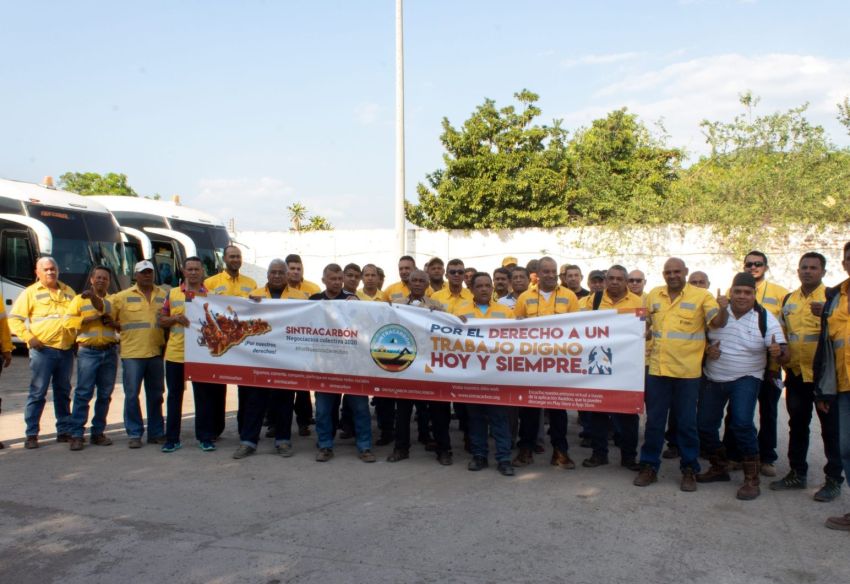
The National Union of Coal Industry Workers (Sintracarbón) represents thousands of workers at the Cerrejón mine in northern Colombia, the biggest coal mine in Latin America. The workers are employed by Carbones del Cerrejón, a subsidiary of Swiss multinational Glencore — which is scheduled to cease operations by 2034.
In the second of our two-part interview, Sintracarbón President Jaime López García speaks to Green Left’s Ben Radford about how workers are responding to Colombia’s declining coal industry and bringing forward demands for a just transition for coal workers and their communities.
***
How are you responding to the energy transition and declining demand for Colombian coal?
The energy transition is extremely important for us as workers, because when these changes occur, workers are caught in the middle. We must acknowledge that the energy transition is a reality.
Every day, we see that countries that once consumed coal are no longer doing so. Even three years ago, when the Russia-Ukraine war temporarily increased coal consumption, the trend has now reverted.
We cannot ignore this reality. If we do not act; if we are not active participants in the energy transition, the consequences for us workers will be much worse.
So, we are trying to establish dialogue roundtables between unions through the Collective for a Just Energy Transition. This collective is made up of three coal-sector unions: Sintracarbón, Sintradem and Sintramienergética.
This collective jointly created a sectoral framework. In this framework, we seek to reach an agreement with companies on guarantees for workers, communities and environmental protections for when operations at Cerrejón cease. We want — and are in the process of trying — to establish a negotiation table with the companies and national government. We have already held two meetings, but so far formal dialogue has not begun, mainly due to the companies’ material lack of interest in discussing the framework.
We recognise the willingness of the Colombian government — through the energy ministry and labour ministry — to participate in the process. We know it is not a simple process.
We know companies may have the intention of carrying out an energy transition, but not necessarily a just energy transition — which is different. A just transition must have workers and communities as central actors, because we are the ones who will ultimately suffer the consequences if there is no real just transition that reduces the impacts of mine closure. For Cerrejón, closure is planned for 2034 — less than nine years away. We are already behind, given the complexity of reaching agreements.
In Germany it was done, but it took time to reach agreements. Based on that, we say the time we have left is short.
We want to avoid a situation where, when operations cease, workers are left stranded, and severe labour, economic and social impacts fall on La Guajira, where Carbones del Cerrejón operates. Forty-seven percent of the department’s GDP [gross domestic product] comes from coal mining.
Are there specific demands or proposals you are bringing forward?
The sectoral framework we created in the Collective for a Just Energy Transition covers many vital issues. It seeks to affirm and guarantee, for workers, aspects such as social security for those who may be close to retirement age. For example, if the mine closes in 2034 and some workers are two or three years short of retirement, ensuring their social security so they can attain their pension.
The framework also includes the possibility of labour reconversion for workers who have only been employed a short time and are trained exclusively for mining. At closure, they would have no other field in which to work because they lack training in other occupations.
We propose that labour reconversion begin now, so that workers have opportunities to work in other sectors when the mine closes, minimising the economic impact on our families and on the region.
We also propose the productive reconversion of the region. What does that mean? Before Cerrejón’s arrival, La Guajira was a primarily agricultural and livestock-based region, with a small tourism sector. Because of extractivism, those activities were displaced, and the main economic activity today is mining.
If Cerrejón closes in 2034 and there is no productive reconversion beforehand, unemployment levels will be alarming, and the social and economic impacts disastrous. It is therefore necessary to begin rebuilding those earlier economic activities, with the added possibility of expanding tourism, which has grown over time. Tourism represents significant potential for the region as part of a productive reconversion.
Our organisation, while one of our main priorities is negotiating the sectoral framework, has also independently sought support for labour reconversion. We have cooperation agreements with, for example, the IG BCE [IG Bergbau, Chemie, Energie] union in Germany, which has provided important support for projects we are developing to prepare for mine closure. We also have agreements with CNV [a trade union confederation] in the Netherlands, which are helping with labour reconversion.
We have begun training workers in photovoltaic [solar] energy installation and maintenance — which has strong potential in the department because we have far more hours of sunlight than many other regions. Along with wind power, this represents a potential sector that, although it will not fully replace the jobs of thousands of Cerrejón workers, is one of several options.
Our trade union organisation is not simply waiting for the government and the company to guarantee everything. We know this is a complex and costly process, and that we must seek cooperation wherever we can. The more we advance individually and collectively in this transformation process, in labour reconversion, the easier it will be for everyone when Cerrejón’s mining operations end.