
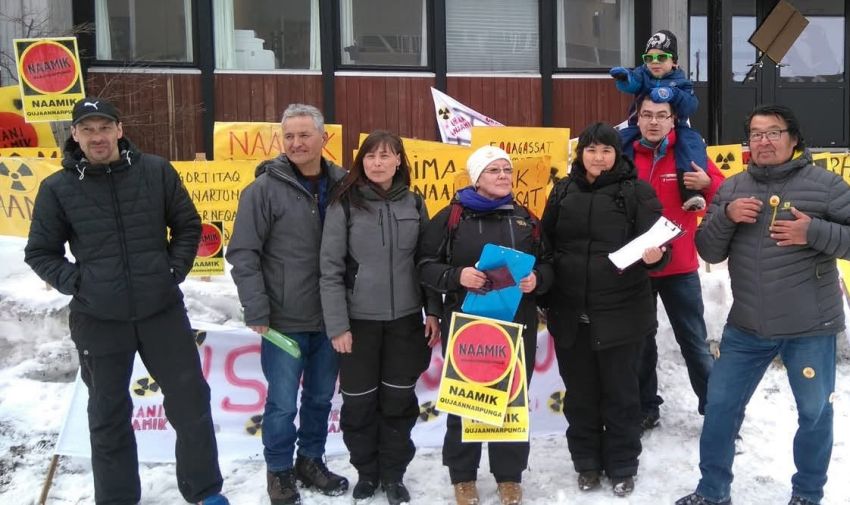
Environmental activists have applauded a June 26 decision by the Greenlandic government to reject an extension to a controversial exploration license held by Western Australian-based mining company Energy Transition Minerals (ETM).
Kuannersuit/Kvanefjeld, in the country’s south, contains the second-largest uranium deposit in the world, possibly the largest thorium deposit and the third-largest rare earth deposits.
When ETM (formerly Greenland Minerals Ltd) came up against Greenland’s 2021 reinstatement of its ban on uranium mining, the company shifted its pitch to the rare earths potential. It also successfully lobbied United States President Donald Trump into threatening to take over Greenland.
Mariane Paviasen Jensen — a Greenlandic MP for the democratic socialist, pro-independence Inuit Ataqatigiit party and founder of the Urani? Naamik (Uranium? No thanks) group — described ETM as “arrogant” and having no concern for the local community and environment.
ETM also made an aggressive intervention into Greenlandic politics and launched a series of court cases in Danish and Greenlandic courts, claiming the company was owed €10 billion in compensation — four times Greenland’s gross domestic product.
Dave Sweeney, nuclear free campaigner for the Australian Conservation Foundation, told Green Left that the decision by the Greenlandic government “is a major community victory”.
“Over many years, locals and environmentalists have worked to highlight the serious risks posed to the region by the planned uranium and rare earth mine.
“As climate disruption sees Greenland’s glaciers and ice sheets retreat, the drill rigs and external actors from Donald Trump to ETM are advancing in search of new fields to exploit.
“ETM is an Australian-based junior company that held big hopes and pushed hard to advance its radioactive ambitions.
“Many locals were deeply concerned over safety and contamination risks to their harsh but fragile region and their local communities and economy and maintained sustained opposition to ETM’s plan.
“They campaigned in Greenland, Denmark and internationally — including in Australia, where they formed connections with Australian nuclear free, corporate accountability and public health representatives.
“The end of the ETM threat is great credit to the local Urani? Naamik group and their supporters in Greenland and Denmark and a powerful and welcome reminder of the importance of struggle and solidarity as we seek to build a safer, cleaner, more respectful future.”
Niels Henrik Hooge, an activist with NOAH Friends of the Earth Denmark, told GL that the decision effectively marks the end of the large uranium/rare earth mining project, although one more lawsuit is still pending before the Greenlandic court.
He said the company will likely lose this case because their argument case has already been dismissed in the Arbitration Tribunal in Copenhagen and in the Copenhagen City Court.
“This decision represents the culmination of 13 years of campaigning by environmental activists, NGOs, and green politicians who have campaigned successfully to get Greenland’s uranium ban reinstated and stop the Kvanefjeld mining project.
“This unmitigated success is the result of a collective effort by Urani? Naamik, green politicians and civil society in Greenland as the main drivers, supported by Danish NGOs and an extensive international network.
“It demonstrates that civil society has an important role to play and can win, even when faced with mining companies commanding vast financial resources.”
Hooge added that campaigners now have another goal in sight.
“Kvanefjeld and its surroundings must be included in the nearby Kujataa UNESCO World Heritage Site, one of Greenland’s three world heritage sites, which was artificially restricted to make the mining project possible.
“Eight years ago, Urani? Naamik in Narsaq submitted a proposal to Greenland’s Ministry of Education, Culture, Research and Church and the Danish Ministry of Culture’s Agency for Culture and Palaces for such an extension. The proposal didn’t go far because of the mining project, but now that it has been terminated, the time has come to extend the world heritage site to its natural borders.”
[Visit the Friends of the Kujataa UNESCO World Heritage Site Facebook group.]