
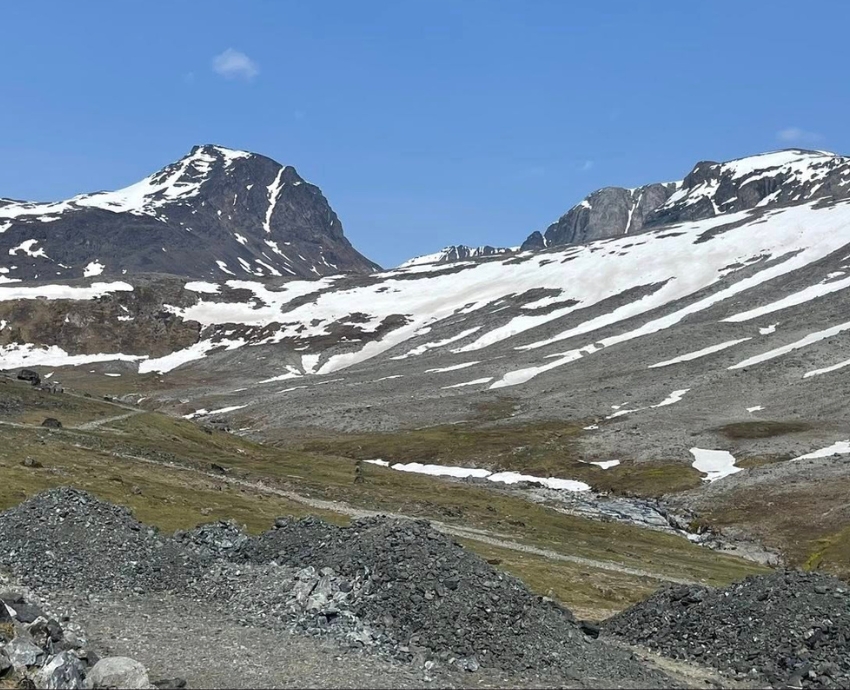
Western Australian-based mining corporation Energy Transition Minerals (ETM) lost its bid to overrule a 2023 decision by the Greenland government to reject its application to mine uranium and rare earths in Kuannersuit/Kvanefjeld.
Greenland’s ban on uranium mining was reinstated in 2021 after a successful grassroots campaign led by Urani? Naamik (Uranium? No) environmental group.
Kuannersuit, in southern Greenland, contains the second-largest uranium deposit, possibly the largest thorium deposit, and the third-largest rare earths deposits in the world. After ETM successfully lobbied United States President Donald Trump into threatening to take over Greenland, the company has focused on the rare earths potential.
ETM demanded €10 billion in compensation — four times Greenland’s gross domestic product — in its appeal to a Danish arbitration tribunal .
Mariane Paviasen Jensen, a Greenland MP for the Inuit Ataqatigiit party and prominent environmentalist, told Green Left in August that ETM had made “many statements about the ‘amazing’ economic benefits but less about environmental consequences, as well as consequences for existing businesses, such as food production and tourism.
“There is also this arrogance again that ETM has the right to mine in Kuannersuit, and that the locals are just ignorant and therefore against it. What an arrogant attitude!”
Currently, ETM has an exploration, not an exploitation license.
ETM has never operated a mine, has a shady corporate record, but nevertheless got Channel Nine’s 60 Minutes Australia to screen an episode promoting ETM executives and Trump’s claim to Greenland’s resources.
Even while the Danish tribunal considered whether it had jurisdiction over this claim, ETM launched a similar case in the Greenlandic courts, confirming opponent’s suspicions that it started the action in Denmark to put external political pressure on Greenland’s government.
Greenland is a self-governing territory within Denmark and has control of its mineral resources. However, because uranium is classed as a dual-use mineral with possible military applications, the company argued that Denmark had jurisdiction because it retains defence powers.
If the Danish tribunal had decided that it had jurisdiction, this would have been a serious blow to Greenland’s autonomy.
This decision was strengthened when the Copenhagen City Court ruled on November 10 that the Greenlandic authorities will not be made a party to ETM's compensation claim against Danish authorities. That case will now proceed after the Greenland courts decide on ETM's compensation claim against the Greenlandic government.
NOAH/Friends of the Earth Denmark’s Niels Henrik Hooge told GL that ETM’s multiple compensation claims were designed to “put pressure on Greenland’s political community.
“When ETM filed its complaint before the arbitration tribunal in 2022, it happened shortly before the chairperson election in Greenland’s then co-government Siumut party, a party that supports uranium mining, but at the time had agreed to put this on hold while in government [in coalition with the anti-uranium mining Inuit Ataqatigiit party].
“Two competitors to the incumbent [Siumut party] chairperson wanted a renegotiation of the government coalition agreement, were willing to call an early general election where the uranium issue would be a central issue.”
However, the election ended with a convincing victory for the incumbent chairperson, Hooge said.
“People, politicians and media in Greenland have lived with ETM’s scare tactics for more than a decade and learned to take announcements from the company with a grain of salt. Not so in Denmark, where ETM’s large claim triggered a panic mood in parts of the political community.”
Now that the Danish tribunal has left the matter to Greenlandic courts, ETM’s claim will be heard in Nuuk, and both Greenlandic and Danish law will be applied, Hooge said.
“ETM management already knows that the case might be lost, but the legal proceedings could continue for years and, in the meantime, ETM will keep its exploitation license and could hope that the political climate will change following a change of government, either because of a [future] general election or US annexation of Greenland.”
The consensus in Greenland and Denmark is that Trump’s threat to annex Greenland is only about expanding US territory, not securing threatened access to rare earths, Hooge said.
“As of now, US companies could secure supply chains for rare earths by just buying up mining projects in Greenland. So far nothing prevents them from doing so. Arguments related to supply chains, etc, aim to combine the notion of American annexation of Greenland with economic rationality, but these are just excuses.”
NOAH successfully used public access to information laws to obtain and publish the Greenlandic and Danish governments’ legal defence to ETM’s claim.
These documents confirmed what environmental groups like NOAH have said for a long time: that for more than a decade, actors in the mining industry have tried to undermine Greenlandic society and unduly influence elections and government decisions, according to a detailed report by the World Information Service on Energy (WISE).
“Some of them might even have been successful in delaying Greenland accession to the Paris Agreement," said the WISE report. "In all this, ETM has played a crucial role, as the mining company was responsible for the abolishment of Greenland’s uranium ban 10 years ago, which until then had been in effect for a quarter of a century.” WISE branded the company’s case as political rather than legal.
“The main reason that ETM has a bad case is because Greenland has not ratified the Energy Charter Treaty and other international and bilateral investor protection treaties. This means that the dispute will be settled according to Greenlandic and Danish law and not within the framework of a privatised international arbitration system. Thus, one could argue that the case is first and foremost political.”
The WISE report said that even if ETM loses all its cases, the Greenlandic and Danish authorities will have spent large amounts of money in legal costs which ETM would not have the means to pay.
“We in NOAH also feel somewhat vindicated by the tribunal decision,” Hooge added.
“After ETM contacted the arbitration tribunal, the company presented a lot of so-called experts, who claimed that ETM had a good case and the Greenlandic and Danish governments either should settle out of court or budge.
“NOAH complained to The Danish Bar and Law Society … that one of its members pretended to be an expert and gave his opinion in bad faith. However, we were told that we had no standing in the society.
“We complained to the Danish Broadcasting Corporation, alleging that it had made itself part of the ETM’s case by blindly conveying the messages of the so-called experts, but this complaint was also rejected.”