
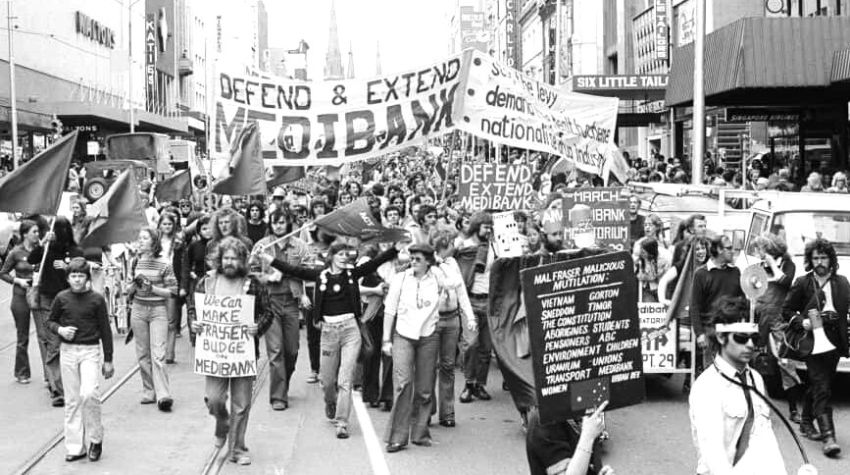
Fifty years ago in July marks the Australian Council of Trade Union’s (ACTU) organised national general strike to defend Medibank — Australia’s first universal, tax-funded public health insurance scheme, which predated Medicare.
The Gough Whitlam Labor government had introduced Medibank in 1974, after having been elected on a promise to extend public services.
But the then-Coalition government of Prime Minister Malcolm Fraser modified it in 1979 and then decided to dismantle it, prompting the ACTU to organise a strike.
Fraser was intent on cost cutting. When the Bob Hawke Labor government reintroduced Medicare in 1984, the scheme had been modified, including with Medibank Private, a government-owned statutory authority that later became fully private.
The ACTU’s 24-hour nationwide general strike on July 12 was historic. Never before or since has the ACTU organised such an action. The ACTU executive’s call for it was endorsed by more than 200 delegates at a special national unions conference a few days before.
The ACTU had organised a series of stoppages, rallies, marches and meetings all over the country in the months leading up to it. Together with countless meetings on the job in many states, workers were prepared to take action.
The strike reflected a deepening polarisation as the Fraser government stepped up its drive against welfare, jobs and wages.++
Direct Action, the socialist newspaper, reported in July 1976: “Australia’s first, nationwide 24-hour strike around Medibank was a resounding success … Around the country basic industry was brought to an almost total standstill. Transport, both in the public commuter sector and in the industrial and commercial area, was almost non-existent in most major cities. In the two biggest cities, Sydney and Melbourne, there was hardly a bus or truck on the road. No trains ran anywhere in the country.
“Warehouses were largely shut down, the waterfront was silent, and all scheduled flights from airports were cancelled. A considerable number of pubs were closed, as well as all other bars relying on members of the Liquor and Allied Trades Union, which called its members out.”
Even the Australian reported: “The whole experience of July 12 has been invaluable for Australian workers, and quite unprecedented in this country. Not even the [anti-penal powers] upsurge around [the imprisoning of tramways union official] Clarrie O’Shea in 1969 involved so many unionists in action at once.”
In the end, the Medibank general strike was not enough to force Fraser to drop his plan to undermine the universal national health scheme. This was partly due to ACTU’s president Bob Hawke refusal to follow up the successful strike with more industrial action.
However, the strike did begin to undermine support for Fraser, and his government was defeated in 1983.
The Hawke Labor government in 1984 reintroduced a national public health scheme under the new name Medicare. It provided a basic universal coverage, but failed to cover all aspects of healthcare and retained paid additional services at cost through Medibank Private — in competition with the private health funds.
The Tony Abbott Coalition government fully privatised Medibank Private in 2014. It also threatened to introduce a Medicare co-payment and other measures to privatise other aspects of the network, including the sell-off of its administration and payment system. However, a strong community campaign against these latter measures, as well as rank-and-file pressure from within the union movement forced Abbott to back down.
The Malcolm Turnbull Coalition government had spoken about selling off the administration and payments system, but abandoned the idea in 2016.
Today, Medicare is still far from a universal, free public health insurance scheme. Anthony Albanese’s Labor government has made some limited moves since 2023 to boost bulk billing rates, but it is estimated that less than half of all general practitioner consultations are bulk-billed, compared to more than 80% a decade ago.
The great Medibank general strike of July 1976 showed the power of a united union movement in industrial and political action to defend our public health system. Building and consolidating a stronger and broader union movement can help lay the groundwork for mass action to maintain and extend the Medicare system into the future.
[Jim McIlroy is a retired public servant, lifelong unionist and member of the Socialist Alliance.]