
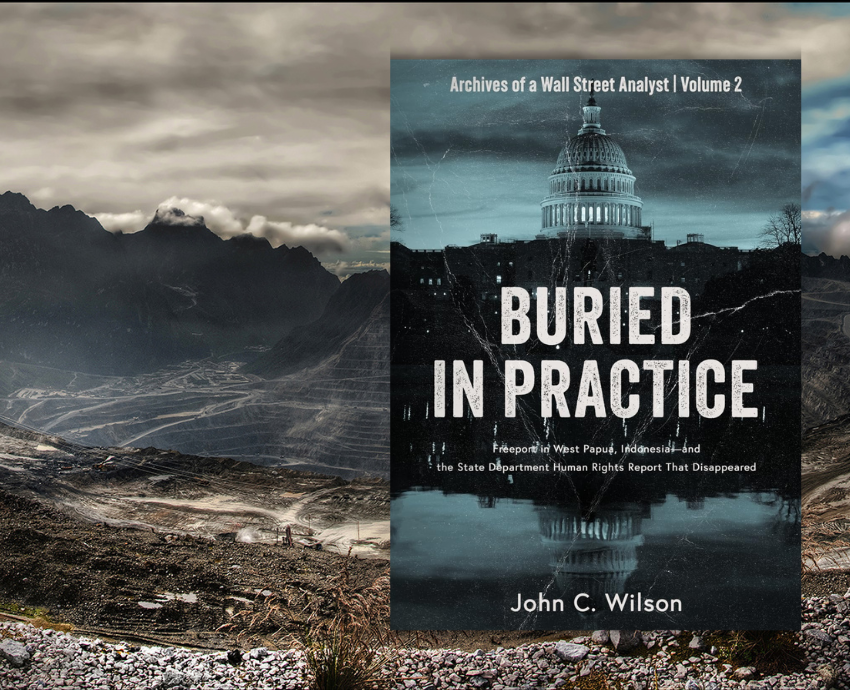
Buried in Practice: Freeport in West Papua, Indonesia — and the State Department Human Rights Report That Disappeared
By John C Wilson
Self published
April 2026
960pp
In Buried in Practice, John C Wilson has done something that the machinery of the state and the titans of industry have spent 30 years trying to prevent: preserved a record of truth for the Indigenous peoples of West Papua.
As someone who has spent decades fighting for the rights of those whose voices are drowned out by the roar of chainsaws and the grinding of mine gears, I find this book to be an essential weapon against institutional amnesia.
Wilson’s account of the “militarisation of mining” at the Grasberg mine is a chilling reminder of the human cost of our hunger for resources. The descriptions of Papuan villagers being tortured in shipping containers and displaced from their sacred mountains are not just historical footnotes; they represent a continuing trauma for the Amungme and Kamoro peoples.
Wilson correctly identifies this as “development aggression” — a violent imposition of Western economic will that treats traditional forest lifestyles as an obstacle to be cleared.
What makes this work uniquely powerful is Wilson’s exposure of the “home front” of this war.
Most activists understand that indigenous communities face bullets and displacement, but Wilson shows us the sophisticated, silent repression used to protect these profits in Washington and New York.
The FBI’s targeting of a mining analyst, for simply asking a question about human rights, is a terrifying glimpse into how corporate power has hollowed out democratic oversight. The state’s use of psychological operations and “virtual gulags” against its own citizens to shield a company like Freeport-McMoRan should alarm anyone who believes in the rule of law.
The disappearance of the US state department’s human rights report is the “smoking gun” of this narrative. It is a textbook example of how the “revolving door” between government and big business creates a culture of impunity. When men like Henry Kissinger can transition from shaping foreign policy to advising the very companies that profit from the annexation of indigenous lands, accountability becomes a performance rather than a reality.
Wilson’s massive archive — the hundreds of pages of cables and Freedom of Information denials — is more than just a legal record; it is a testament to the persistence required to challenge a system built on secrecy.
This book does not just ask us to trust the author; it invites us to “test the evidence” for ourselves.
For the rainforests of West Papua and the people who have lived there for millennia, the path to justice is buried under 30 years of bureaucratic evasion. Wilson has begun the hard work of digging it out.
This is a vital, courageous and deeply unsettling book that every advocate for human rights must read.
[John Seed OAM is the founder of the Rainforest Information Centre.]