
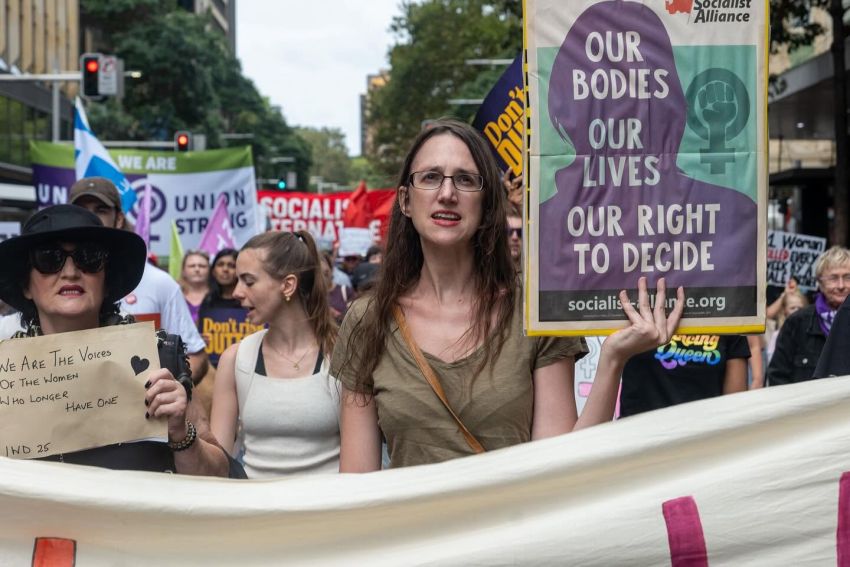
Attempts by conservative forces to whittle back abortion rights in NSW, South Australia and Queensland have all been defeated for now. But what’s behind these efforts and what is at stake?
In the 19th century, each state and territory inherited a version of the British criminal or penal code. All contained some kind of offence of “illegal abortion” with most not stipulating what in particular made abortion illegal. However, all of them formed a framework of prohibition that (like alcohol prohibition) gave rise to illicit, often dangerous, abortion provision and corruption.
At least in some places, abortion providers (sometimes doctors, sometimes not) paid off police to look the other way when abortions were performed. That extended to not investigating deaths and injuries resulting from the absence of safe surgical methods and the fear of prosecution, which prevented treatment for complications.
According to one of my gynaecology lecturers, it was typical in those days for about a third of the patients of a hospital gynaecology ward to be suffering complications from a “backyard” abortion.
Alongside the suffering that came from unsafe, illegal abortion, the women’s liberation movement of the 1960s and 1970s, with its demands for safe, legal abortion, created the impetus for change.
Each state and territory underwent its own specific path, but the overall trajectory has been the expansion of safe services and the liberalisation of abortion law. Typically, the safe medical services came first, followed by case law as courts handed down rulings confirming a widening list of criteria that could be used to determine that a given abortion was legal.
Most recently, each state and territory has removed abortion from their respective criminal codes. Each has enacted laws permitting abortion by the decision of the pregnant person up to the time of foetal viability, with restrictions thereafter giving doctors the final say on whether a physical or mental health condition affects the pregnant person, or foetus, that makes abortion warranted.
Since decriminalisation, many more general practitioners (GPs) now provide medical abortion (prescribing medication to bring about miscarriage — generally possible in the community up to nine weeks from the beginning of the last period).
Surgical abortion (using sterile instruments to empty the pregnant person’s uterus with suction) is now available in more public hospitals.
Since decriminalisation, some states and territories have extended the range of healthcare practitioners permitted to provide abortion care beyond doctors. They include some categories of credentialled nurses and midwives — further improving access to services, particularly in regional and remote areas where there may not be medical practitioners available or willing to provide services.
Reducing stigma
Decriminalisation has reduced the stigma of illegal abortion and opened the way for improved accessibility to services.
But whether or not abortion is available (for free or at all) is still the subject of what a recent Senate report referred to as the “postcode lottery”.
Where someone lives can determine whether the public hospital that serves them will provide abortion when needed. In some urban centres, people will have a completely different experience of access, even if their circumstances are similar, merely because they are in the catchment of different public hospitals.
Living in a regional or remote area makes it even more unlikely that abortion will be easily accessible. Like all healthcare, when abortion is not free close to home some people will miss out on the care they need.
The 50–60 year period of intertwined abortion rights activism and reform has been accompanied by a backlash, led by religious anti-abortion organisations. From protests outside abortion services and through city streets, promoted from mainstream and Pentecostal pulpits and newsletters, to the horrific 2001 murder of a security guard at a Melbourne clinic, to efforts to remove the Medicare payment for abortion, all contributed to maintaining the social stigmatisation of the healthcare procedure.
Only one initiative, however, had any significant practical impact — the 1996 federal ban on importing abortion medication. It lasted 10 years, casting a shadow on access to the medication even after the ban was lifted in 2006.
Weak points in law
Although past efforts to restrict abortion have largely failed, most states’ abortion care laws have some weak points that can be exploited.
In NSW, for instance, the 2019 decriminalisation law included a statement of parliament’s opposition to abortion solely for the purpose of sex selection. While it did not ban abortion outright for this reason, it did mandate the collection of data to determine the extent of sex-selective abortion and commissioned a report on the practice, with recommendations on how to stop it.
This provided the opening for the bill, introduced last year by the Libertarian MP John Ruddick, to ban sex-selective abortion. If this had passed, it would have established the principle that the state and medical practitioners get to decide whether a person’s reason for abortion is acceptable, a short step to more restrictions.
Similarly, the existing South Australian (SA) law, like every jurisdiction apart from the ACT, provides an upper gestation of pregnancy, beyond which abortion is only permissible with the approval of two doctors after considering certain health and welfare criteria.
Very few women seek abortion after the time of potential foetal viability, but most states rule out abortion on request after 22 or 23 weeks since the last period. The potential of a foetus to survive birth, if cared for in intensive care units, has become a means for conservatives to try to undermine a pregnant woman’s decision-making and replace informed consent with a determination by doctors.
The SA bill, which passed the Legislative Council but was defeated in the Legislative Assembly, attempted to narrow the permissible reasons for abortion from 25 weeks on to life-threatening health conditions for the pregnant woman and severe conditions incompatible with life for the foetus.
In Queensland, the original decriminalisation law of 2018 stipulated that for abortion to be legal, it could only be performed by a medical practitioner.
In 2024, the restriction was loosened to include certain nurses and midwives for medical abortion up to nine weeks. Even so, specifying in law which healthcare practitioners can provide abortion maintains a vulnerability that other pregnancy-related healthcare does not face.
Influence of far right
Recent efforts across Australia to roll back abortion rights can not be understood solely in the context of social movements, healthcare advances and law.
The rise of the far right across the globe, its successes in building electoral support through appealing to religious anti-abortion sentiment and the spectacular 2022 anti-abortion victory in the US when the US Supreme Court overturned the historic Roe vs Wade ruling, together add a powerful extra dimension to recent efforts to restrict abortion rights here.
Like the Nazis, whose plan for women was the three Ks — kinder, küche, kirche (children, kitchen, church), the far right in Australia includes a strand of anti-feminist activism that is tied to building electoral support among religious conservatives and men who blame policies that seek to address centuries of oppression of women for their real, or perceived, grievances.
Although religiosity has not played as significant a role in Australia’s politics as it does in the US, conservative churches do provide an ideological base and organising space for conservative forces. Abortion has been one such issue for several generations now.
The fact that One Nation now leads opinion polls, using Donald Trump’s playbook to build itself, gives the anti-abortion right wing a shot in the arm.
We should expect further attacks, whether cloaked in the language of concern about discrimination (as in the rationale for banning sex-selective abortion) or in outright hostility to women and health professionals (as exemplified by Abolish Abortion Australia, a new anti-abortion coalition, with opaque funding, which emerged in 2024).
Those who support the right to abortion should continue to defend the healthcare rights that have already been won and push to expand service provision, so that every woman who needs an abortion can undergo a safe, free procedure on request — as early as possible and as late as necessary.
[Kamala Emanuel is a Socialist Alliance member, an abortion rights activist and a medical practitioner who has provided contraception and abortion care in most Australian states and the ACT.]