
Islamophobia is a greater problem than antisemitism in Australia today, but government agencies and the mainstream media would have you think the opposite.
Since the Bondi terror attack last year, the Islamophobia Register Australia reported a huge 740% spike in hate incidents.
Even the conservative Centre for Independent Studies said that while Israel’s standing is at a “low ebb”, the public’s warmth towards Jewish Australians is “generally encouraging”. It said while there is “a perception” of increasing antisemitism, especially among older Australians, “in terms of attitude alone, Australia does not have a particular problem with antisemitism”.
The study found that Australians are much more likely to be negative towards Muslims: About 30% have negative feelings towards Muslims, while only 12% have negative feelings towards Jews. Ten percent have an “extremely negative” view of Muslims compared to just 3% towards Jews.
The brutal bashing of a Muslim father of three in late June has prompted the Australian Federation of Islamic Councils (AFIC) to again call on the federal government and media organisations to commit to a serious national response to Islamophobia.
Video evidence shows that two men asked Samir Raghbat if he was Muslim in the Al-Ihya Musallah car park, in Hampton Park in Naarm/Melbourne, before punching him repeatedly and choking him, while a third man watched on. Raghbat told the ABC that one man instructed the others to “kill him”; they used what Raghbat described as an ice pick.
This year, two mosques in Western Australia were identified as being targets in an alleged planned terrorist plot. An Australian man, motivated by white supremacist and Islamophobic beliefs, killed 51 people at the Al Noor Mosque in Christchurch, Aotearoa New Zealand, in 2019.
Special Envoy to Combat Islamophobia Aftab Malik made 54 recommendations last September, on which we have since heard very little.
In his submission to the Royal Commission on Antisemitism and Social Cohesion, Malik said that for any exploration of how Jews are to be kept safe, “the proper course is to ... unequivocally [protect] the rights of all citizens”. Further, he said if this “legitimate objective is pursued at the expense of others’ rights, actual or perceived, it will likely generate resentment, potentially fuel further anti-Semitism, and ultimately serve to erode, rather than reinforce social cohesion”.
Islamophobic attacks are on the rise, according to the Islamic Council of Victoria, the Islamophobia Register and The Tackling Hate Lab. However, it is hard to find up-to-date statistics, perhaps because these crimes are not taken as seriously as other forms of racism and their collation (many of which are probably not reported) has been left to community organisations, often run by volunteers.
Nevertheless, Tackling Hate's report, From Shock to System: The Rise of Anti-Muslim Hate in Australia, looked at the rise of anti-Muslim hate in Australia, between January 2023 and January this year. It said online anti-Muslim hate rose after October 7, 2023, and escalated after the Bondi terrorist attack on December 14 last year. Anti-Palestinian hate also rose after October 2023 and Bondi, but “did not exhibit the same sustained baseline growth observed in anti-Muslim hate”.
Overall, the report found that anti-Muslim hostility became increasingly embedded into the mainstream discourse and that the “dominant narratives” link Muslims to violence, terrorism, threat and collective responsibility.
AFIC said the attack on Raghbat must be taken as a warning about “what happens when anti-Muslim hatred is normalised”. It is calling for reforms, including: stronger recognition of Islamophobia and anti-Muslim hate in national and state social cohesion strategies; better reporting on anti-Muslim incidents; investment in community-led prevention, education and safety programs; stronger protections for mosques, Islamic centres and Muslim community spaces; and “meaningful engagement” with Muslim communities to shape the responses to racism, extremism and social cohesion.
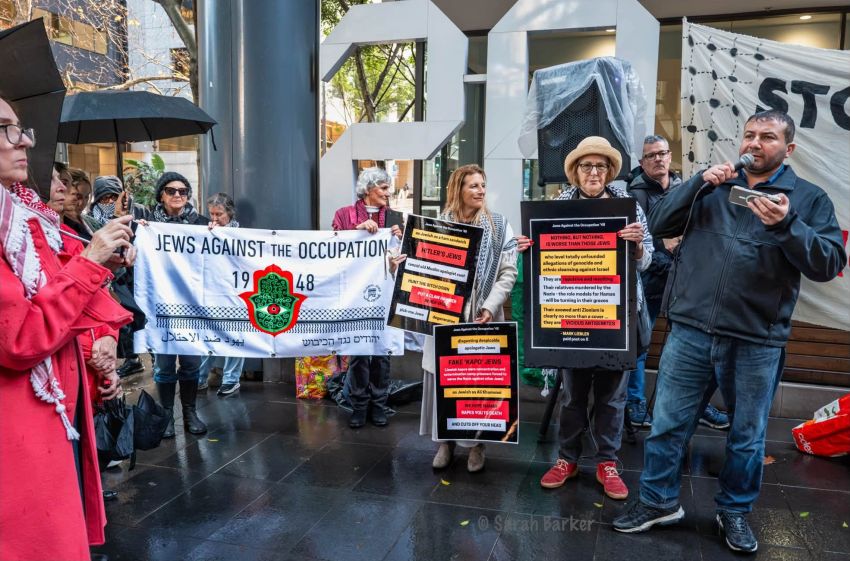
Palestinian activist Shamikh Badra believes that while antisemitism is real and must be combated, so too must racism and hate against Palestinians, Muslims and Arabs. He told a rally outside the Royal Commission into Antisemitism and Social Cohesion on July 9 that “if we want … to strengthen our society, every community affected by these issues must have the opportunity to be heard."
“Social cohesion cannot be built by listening to only some voices while excluding others,” he said, adding that it is wrong for the royal commission not to hear from the Australian Palestine Advocacy Network, or many anti-Zionist Jewish groups.
“If we want to understand the experiences of different communities, we must hear directly from those communities. You cannot have a meaningful conversation about Palestinians without listening to Palestinians. You cannot have a meaningful conversation about anti-Zionist Jewish Australians without listening to anti-Zionist Jewish Australians. Listening is where social cohesion begins.”
Badra also recounted how he and his brother were attacked in full public view on a train in the day, after attending a rally against the genocide in Gaza. They were wearing Palestinian keffiyehs.
“We reported the attack. We provided evidence. Members of parliament raised questions about our case. The offender later pleaded guilty to the offence. Yet we felt that the racist nature of what happened was never properly recognised,” Badra said.
“Many Palestinians, Muslims and Arabs feel that their experiences are not taken as seriously as those of other communities. That needs to change. Political disagreement is normal in every democracy. Racism is not.”