
July 3 marked 1000 days since Israel launched its onslaught on Gaza. One thousand days of live-streamed slaughter. One thousand days in which the world's most powerful states have had every opportunity to intervene, and chose instead to keep arming, funding and diplomatically shielding the state carrying it out.
This is not a war we failed to see. It is a genocide we watched, in real time, on the same phones we use to order dinner.
The numbers are almost impossible to hold in the mind, which is precisely why they must be repeated until they are. More than 73,000 Palestinians killed. More than 21,000 of them children and more than 1000 of them babies who had barely begun to live. Tens of thousands more wounded, maimed, amputated. Nearly 60,000 children orphaned.
A ceasefire was declared in October 2025, and still the killing has not stopped: The United Nations International Children’s Emergency Fund says a Palestinian child has been killed in Gaza on average almost every day since. Ninety per cent of Gaza's buildings are destroyed. A population of two million people repeatedly displaced, starved and bombed again on the land they were told to flee to for safety.
This is what 1000 days of "restraint", "self-defence" and "targeted operations" looks like.
The UN says what Palestinians have always known
Last month, the UN's Independent International Commission of Inquiry released a report that should have ended any lingering debate about what is happening in Gaza.
The commission found that Israeli authorities and security forces have deliberately targeted and killed Palestinian children, and that this targeting of children is one of the key elements establishing genocidal intent, evidence weighed against the definition of genocide under Article II of the 1948 Genocide Convention.
The commission had already concluded, in an earlier report, that Israel is committing genocide against Palestinians in Gaza. This is not an activist slogan. It is the finding of the UN's own investigators, backed by testimony, documentation and forensic evidence gathered over more than two years.
The deliberate killing of children is not an unfortunate consequence of urban warfare. According to the commission, it is a strategy, a way of destroying not just a population in the present, but its future. Kill the children, and you dismantle the next generation of doctors, teachers, farmers, poets and organisers. You do not just end lives; you attempt to end a people's continuity.
That is the logic the UN commission's chair, Sri Lankan jurist Srinivasan Muralidhar, laid bare when he said the evidence showed Palestinian children had been deliberately targeted and killed by Israeli security forces.
Behind every one of these findings is a name, a face, a family. Seven-year-old Yousef, whose mother searched hospital corridors describing him by his curly hair. Premature babies left to die in their incubators when Israeli forces stormed a children's hospital and cut off power. Eleven-year-old Ahmed Al-Raqab, killed by a missile while playing on a beach beside his family's tent, months after the ceasefire was supposed to have ended this.
These are not statistics. They are the deliberate, documented destruction of childhood.
Why looking away is not an option
It would be easier, in a sense, to let 1000 days become just another grim milestone that scrolls past, noted, mourned for an afternoon, forgotten by the weekend. Genocide relies on exactly this kind of exhaustion. It counts on solidarity burning out before the killing does. It counts on the gap between moral clarity and political consequence being wide enough that governments arming and funding this can wait us out.
We cannot let that happen. Not because outrage alone will stop a single bomb, but because sustained, organised pressure has, historically, been how atrocities are made costly enough for the states enabling them to change course. This is where the ecosocialist and internationalist left has real work to do, work that goes well beyond posting and grieving.
Boycott, Divestment and Sanctions (BDS) remains one of the clearest tools ordinary people have to impose a material cost on complicity. Every institution divested from weapons manufacturers, every union that refuses to handle military cargo, every superannuation fund pressured to drop holdings in companies profiting from the siege, chips away at the machinery of occupation. This is not symbolic. Companies and governments respond to sustained economic pressure in ways they do not respond to petitions alone.
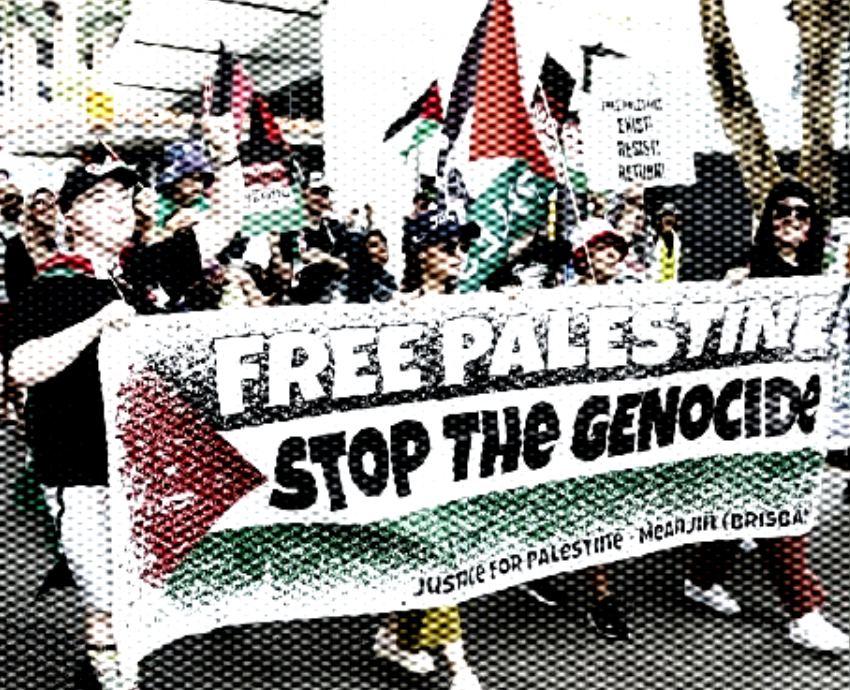
Rallies and public mobilisation keep this crisis from disappearing into the background noise of a news cycle designed to move on. They also build the infrastructure of solidarity, the networks, the organising skills, the political education that outlasts any single moment and can be turned to the next struggle, and the next.
Advocacy and lobbying of our own governments matter enormously, especially in a country like Australia that continues its own arms and diplomatic entanglements with Israel. Local MPs can be pressured. Trade agreements can be scrutinised. Every letter, every delegation, every question asked in parliament forces a public reckoning that governments would rather avoid.
Simply speaking and refusing the silence that normalises all this remains its own form of resistance. Genocide depends on a permission structure of silence and looking away. Naming what is happening, insisting on the word genocide when institutions reach for softer language, is part of dismantling that permission structure.
None of this is enough on its own. But together, sustained over the long haul, this is how movements have historically achieved change, such as South Africa's Apartheid regime. It took years, not days.
Gaza's 1000 days demand the same commitment from us: not a single furious week of attention, but the slow, unglamorous, unrelenting work of solidarity until the killing stops and Palestinians are free.