
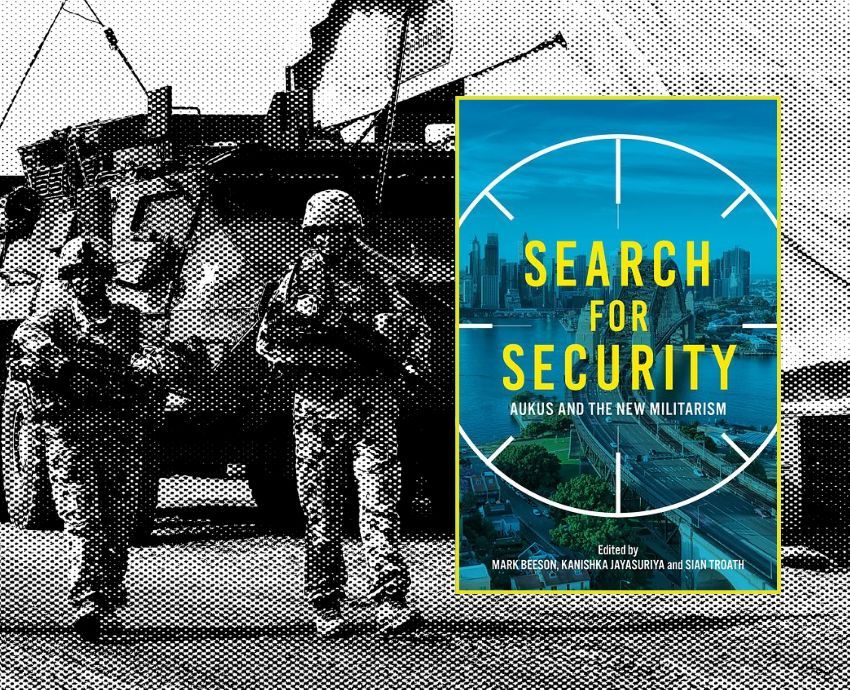
Search for Security: AUKUS and the new militarism
Edited by Mark Beeson, Kanishka Jayasuriya and Sian Troath
Melbourne University Press, 2025
336pp, $40
Search for Security: AUKUS and the new militarism is a penetrating and thorough critique of the military alliance between Australia, Britain and the United States — a defence con-trick that continues to be imposed on the Australian public by the Anthony Albanese Labor government, with dangerous long-term consequences.
As the publisher notes, the 2021 AUKUS announcement by the Scott Morrison Coalition government committed Australia to “the single greatest security investment in the nation’s history” — acquiring nuclear-powered submarines and deepening technological and military integration with the US and Britain.
Yet, as the book makes clear, serious doubts persist about whether the submarines can even be delivered, by whom and on what timeline, alongside broader concerns about the role of the US in the world.
Search for Security brings together a diverse group of scholars to explain the politics of AUKUS within a wider global context of intensifying militarism.
In their introduction, “Sleepwalking into a new militarism”, the editors note that the pact was highly controversial from the outset, with former Labor prime minister Paul Keating declaring it the “worst deal in all history”.
It was not just the extraordinary cost of the project — at least A$368 billion — that attracted so much criticism.
“The fact that the newly installed ALP government of Anthony Albanese had endorsed — with seemingly no internal, let alone public debate — a strategic policy that had been developed by the thoroughly discredited, scandal-plagued Liberal-National Coalition government of Scott Morrison was especially galling for supporters of progressive politics,” the book says.
The editors write that AUKUS is “symptomatic of the crisis of the US imperial order and the form of neoliberal globalisation that marked the end of the Cold War”.
“These changes signify not so much the end of neoliberalism as its mutation to a form of militarised neoliberalism.”
A “key dimension” of this new militarised neoliberalism, the editors write, is the entanglement of economic and security institutions that are reshaping state institutions, in areas such as academia, foreign investment and climate action.
The opening chapter, “The Anglosphere and the new strategic orientalism”, analyses the legacy of the British empire and its expression in a new world of challenges to Western imperialism by China and other nations of the former colonial world.
“When it comes to understanding AUKUS — why these states, and why now — the history is important. It is this legacy the leaders are drawing on to forge these bonds, building on decades of racialised thinking about the Anglosphere and ideas about Western civilisation.”
In their chapter, Kate Clayton and Katherine Newman argue that “the Anglosphere is connected to the resurgence of Anglo-Saxon racial awareness across Britain, the Atlantic, and the settler colonies of Oceania”. In other words, AUKUS is in part connected to the rising racist, far-right movements throughout the Anglo-Saxon world, in particular anti-Chinese racism.
The book critiques Australia’s deepening alignment with US interests and foreign policy. In “Hostage to the empire”, Van Jackson writes that AUKUS was a product of the failing Joe Biden presidency. However, under the Donald Trump administration’s more openly imperial posture, AUKUS is a symbol of “Australian elites’ conformity to US machtpolitik, the always-changing preferences of the will of the strong”.
“If Australia wishes to remain a sub-imperial power,” Jackson writes, “it will have to expose itself to US rent-seeking via AUKUS and repeatedly shift its foreign-policy priorities at America’s whim, abandoning a pretence of ‘stable’ security interests.”
It also increases the likelihood that Australia becomes a direct military target in any US-China war, given the expanded US military presence associated with AUKUS.
Jackson details the concern across the Pacific, where governments are “mostly hostile” to AUKUS. The Pacific Islands Forum stated in 2023 that “AUKUS will bring war much closer to home and goes against the Blue Pacific narrative on nuclear proliferation and the cost to climate change”.
Clinton Fernandes, in his chapter on “Australia as a sub-imperial power”, argues that the “organising principle of Australian foreign policy is to remain on the winning side of a worldwide confrontation between the empire and the lands dominated by it”. However, this could run up against China’s expanding influence in the developing world, while the US faces deep internal divisions and democratic decline.
Chengxin Pan and Xuemei Bai note that no other foreign policy issue seems to consume more energy in Australia than how to “deal with China”. While the Australian government doubles down on its alliance with the US, Pan and Bai write that “China has become one of the most important centres of gravity in world politics, for the region in general and Australia in particular”.
The domestic consequences of AUKUS are another focus. As the most expensive military project in Australian history, it diverts resources from pressing social needs and accelerates the growth of the military-industrial complex.
Trissia Wijaya highlights how the AUKUS-enabled military-industrial complex “is being propelled into a peculiar trajectory of capitalist production alongside the rise of state developmentalism in the Global North with the requirement of onshore production”.
Sian Troath points to the increasing integration of defence, the defence industry and academia, which they refer to as the “military-industrial-academic complex”. Universities, facing funding pressures, are becoming more reliant on military-linked research contracts.
Marianne Hanson writes that AUKUS is “flawed on many levels” and may ultimately “wither or be transformed into something quite different and more sensible”.
“By the time the submarines are due to be deployed, strategic factors will undoubtedly have changed, military technology will have evolved and climate change and other pressing issues will no longer be able to be avoided by governments, rendering military ‘defence’ an anachronism at best.
“The problem, however, is that in the meantime an enormous amount of damage is being done.”
Addressing the question, “Why AUKUS?” Joseph Camilleri replies that “AUKUS begins to make sense once it is seen to be part of an overarching strategic orientation that includes ever-higher levels of interoperability with the US military, intimate links with US intelligence operations and heavy reliance on the acquisition of expensive US military hardware.”
At the same time, opposition to AUKUS is growing. Camilleri points to the efforts of the Australian Anti-AUKUS Coalition to link resistance to the submarine program with calls for a reorientation of foreign policy, improved relations with China, greater investment in diplomacy and a shift in public spending towards social needs such as health, education, housing and climate action.
Search for Security provides a comprehensive account, from a variety of perspectives, of the vital debate over the AUKUS disaster looming for Australia and the Asian region. As the realities of the AUKUS project loom closer, its harsh political impact and the developing anti-AUKUS campaign in this country may combine to force the abandonment of this monumentally dangerous military-industrial project.