
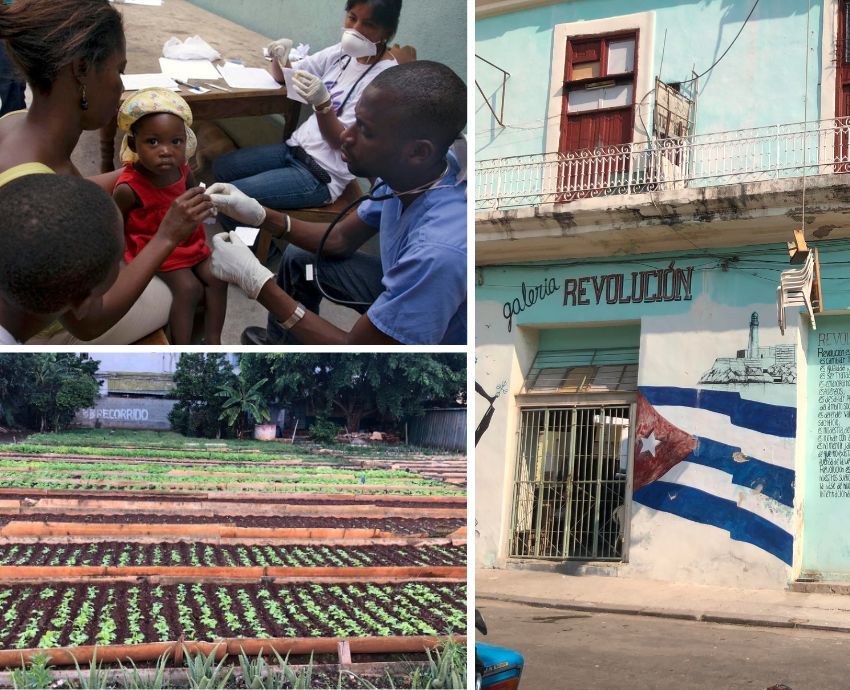
Helen Yaffe is a professor of Latin American political economy at the University of Glasgow and has written extensively on Cuban history and politics. She spoke to Green Left’s Alex Bainbridge about international solidarity efforts with Cuba and how it represents an alternative to United States neoliberalism.
This is the second part of a two-part interview. Read part one here.
* * *
Could you talk about international solidarity efforts?
Cuba has been abandoned by international institutions, trade blocs, it’s already excluded from development banks, even green climate funds and so on. There are things that we can’t depend on the authorities to do to defend Cuba — we have to depend on ourselves.
There are different ways we can do this. We can put pressure on our own governments. The huge and generous donations of humanitarian aid from Mexico have also been the result of pressure from the Mexican population, who have responded amazingly well to calls to donate goods, to donate money to buy humanitarian aid and ship it to Cuba.
There have also been some successes in Canada, where they’ve managed to pressure the government to make a donation of humanitarian aid to Cuba.
We also need to defend Cuba ourselves actively and directly. That’s why this mobilisation [the Nuestra América (Our America) Global Convoy] taking place on March 21 in Havana was so important.
I know my social media is full of pictures of people arriving or leaving and big boxes of material aid, but this has been mobilised by Progressive International organisations and many other organisations and individuals have got on board.
It’s an important message that we need to amplify, that the people of the world support Cuba, defend Cuba [and] will go into a zone, which is potentially a war zone, where the US has threatened to “take” this small Caribbean island.
Cuba represents the power of a good example. How much of that is under threat?
It’s absurd that [US President Donald] Trump said that Cuba is a threat to the national security and foreign policy of the US.
It is absurd in any military sense. But the only way we can make sense of this claim is if we understand the political and ideological symbolism of Cuba. In that way, yes, it’s true — Cuba is the threat of a good example. Because of its indicators in health, but also Cuba leads the world, or is a leading country, in terms of sustainable development.
It has the world’s only completely state-led long-term plan to confront climate change, which takes Cuba to the end of the century. That plan is based on important premises that are an example to the world.
First, it’s rooted in science. The policy is led by scientists. That might seem obvious to us, but that’s not what happens in other countries — it’s led by corporations.
Second, it looks for national solutions. Cubans are blocked out of international financing systems, even for green financing. They’ve had only a couple of projects awarded and faced opposition from US representatives in those bodies.
With relatively small amounts of money, they’ve done amazing things. One project, Mi Costa [My Coast], focusing on coastal resilience, received about $20 million — which is very little in global terms — and will benefit 1.3 million people.
These projects are collective. They begin with community consultation. Scientists and communities work together. The local community often comes up with solutions themselves.
Cuba has built a complex grassroots democracy — street committees, civil defence, women’s organisations, small farmers, student organisations. These structures enable collective responses.
There was a recent paper looking at deaths from malnutrition globally, and they looked at Cuba as the benchmark.
People always talk about Cuba as a poor country, which is true in terms of consumerist standards. But until this recent crisis, which really battered the state’s capacity to provide for the population, on the whole, people have their needs met.
What the analysis showed is that the food distribution system, which is based on equal access to food and prioritising the vulnerable — getting them special diets and so on — means that Cuba has an extremely low rate of malnutrition and deaths from malnutrition.
If the rest of the world implemented a Cuban-style system of distribution, in the short period they look at, something like 16 million people around the globe would not have died.
A surprisingly huge number of those are in the US, a massive number in Brazil and India. These are emerging powers, we’re told their GDP growth is so high, but yet they have people dying unnecessarily of malnutrition because they don’t have a kind of socialist distribution of food that Cuba has.
It’s tragic but true that infant mortality is rising in Cuba significantly. This is a country that before the revolution had an infant mortality rate equivalent to Haiti, but got it to under four children dying per thousand, which was far better than the US and better than Britain.
Obviously, the first set of Trump sanctions dovetailed with the [COVID-19] pandemic. Most countries saw the figures rise for the pandemic and then fall back down, but Cuba’s didn’t.
The infant mortality rate has doubled, which is a sign of how sanctions kill. Sanctions are killing people in Cuba right now, such as people who can’t get cancer care. There are over 11,000 children waiting for surgery. I know people who are waiting years for operations in immense pain.
It is so cruel, because Cuba has the capacity to give its population such a high standard of living — and care for the Global South as well. This is an extraordinary feat of the Cuban revolution, and one of the biggest threats to US foreign policy — the fact that they have sent medical professionals around the world.
Amid this crisis, last year, they had 24,000 healthcare professionals, most of them in the Global South, providing healthcare that’s free at the point of delivery for the most vulnerable populations in the poorest countries. Although, they also have a team in Italy because they demonstrated they were so effective during the COVID-19 pandemic, when they sent an emergency team to Italy when it was the epicentre.
There’s this Guatemalan researcher, Henry Morales, who pointed out that Cuba’s medical aid, and its construction and development aid, is always left out of international statistics — it’s ignored or censored.
He took their data for overseas development aid and evaluated this according to OECD measures, applying the same evaluation they give themselves. Cuba is an incredible contributor to the Global South.
In fact, between roughly 1999 and 2015, Cuba contributed the equivalent of about 6% of its GDP in overseas development aid, most of that in medical aid, compared with about 0.17% from the US and about 0.39% from the European Union.
In that sense, when the US represents neoliberalism and says we can’t provide healthcare, housing and education for free — that it must be governed by the market — Cuba shows that there is an alternative.
In Cuba, they regard not just healthcare and education as a human right, but also culture and access to sport. In that sense, it’s the threat of a good example.
We take Cuba for granted — a lot of the left does. It’s there, it shows something is possible, and we think it will always be there. But it’s under existential threat right now, and we must be part of the solidarity movement to make sure that Cuba isn’t crushed, because in some ways it will crush all of us who want to see a better world.
[Watch the full interview here.]