
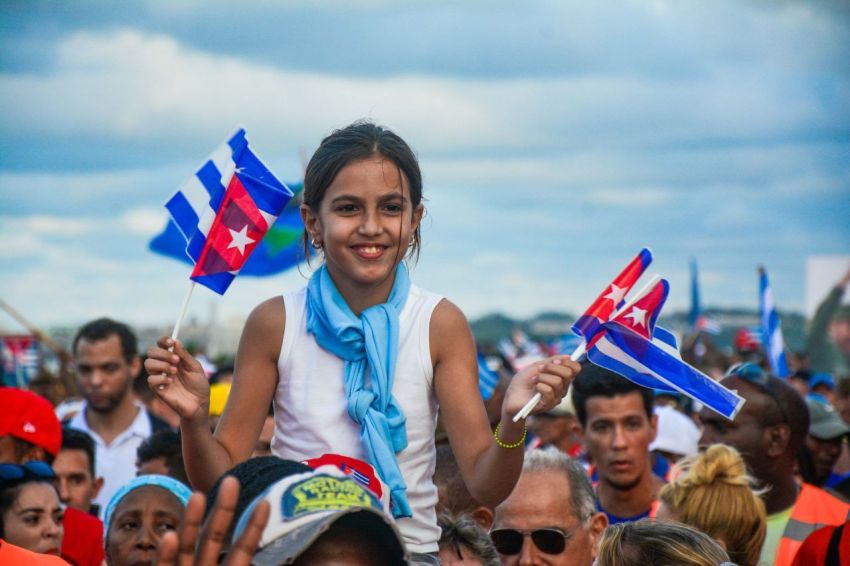
Helen Yaffe is a professor of Latin American political economy at the University of Glasgow and has written extensively on Cuban history and politics. She spoke to Green Left’s Alex Bainbridge about the current situation in Cuba, amid the United States government ramping up its imperialist aggression.
This is the first of a two-part interview. Watch the full interview here.
* * *
What is your assessment of the current situation in Cuba?
[US President Donald] Trump’s phrasing about “taking Cuba” absolutely echoes the sort of colonial, imperialist depiction of Cuba. There is no attempt at liberal framing anymore.
The pretence of asserting US influence over Cuba as being about human rights or democracy has all been abandoned. What we’re seeing now is raw imperialist design.
How serious is this? Cuba survived a previous moment of existential crisis, which was the collapse of the Soviet bloc, where Cuba lost 86–87% of its trade and investment.
This is a really frightening moment for Cubans and for all of us who understand Cuba’s symbolism globally and what it represents — not just to the Global South, although that’s most important, but also to those of us in imperialist countries who believe that socialism is a viable alternative.
There are some reassuring facts we can hold on to, such as [Cuba’s] very rapid effort to transition to renewable energy.
This is not new. The state has had a commitment to shifting to renewable energy since at least 2005, with what was called the Year of the Energy Revolution, when Cuban teenagers and social workers went door to door with backpacks full of energy-saving light bulbs and replaced them free of charge. Cuba became the first country in the world to complete that switch.
It has had a commitment to shifting from dependence on hydrocarbons to renewable energy. But, as is obvious to anyone who understands the blockade, it affects every sector, every area of development.
Any technological transformation requires massive capital, equipment and machinery, all of which are obstructed. Even when Chinese solar panels became more affordable, Cuba still has to import them, install them, integrate them into the national electricity grid and solve storage issues.
In 2024, Cuba announced plans to install 92 major solar parks using Chinese technology. It aimed to implement all of these by 2028 and meet about 50% of energy needs through photovoltaics.
Trump has intensified pressure. On January 29, he declared Cuba a threat to US national security and foreign policy and threatened tariffs on any country exporting oil to Cuba. This is the US using economic warfare to enforce the blockade extraterritorially. Since then, all countries have stopped exporting oil to Cuba.
In this moment of crisis, quite frankly, most of the world has been caught short. Mexico has stopped sending oil to Cuba, but it is sending humanitarian aid. Other countries in Latin America are doing the same, like Brazil, for example.
Although Cuba is making this transition to renewable energies, it’s not sufficient and it’s not ready to cut off oil.
So, the result has been a real crisis in Cuba. Hospitals have closed and are not conducting anything that’s not emergency surgery. Universities have sent students home. They’re asking them to do remote learning as in COVID, but how do you do that if you have a blackout and you can’t access your computer or the internet?
Workplaces are closed or limiting production. Transport — because this is the other thing, even if Cuba completes the switch to renewable energies, its transport fleet is predominantly still dependent on petroleum and diesel.
It’s a moment of crisis. The Cubans are responding with their collective, community, resilient responses that we saw during the Special Period, and we’ve seen in subsequent periods of crisis.
Cubans are turning inwards towards their own neighbourhoods and communities and getting organised, getting mobilised, setting up projects, setting up projects for the kids.
What about the practical impact that this US strangulation policy is having on Cuba?
With the blockade, it’s not just this oil embargo. This strangulation actually began with the first Trump administration. In 2019, he first forced an energy crisis on Cuba by threatening shipping companies that were carrying Venezuelan oil to Cuba that if they docked in Havana, they would face [Office of Foreign Assets Control] fines.
These are fines in the millions and billions that we have seen wielded against investors, traders — anyone who engages with Cuba. In fact, the record-breaking fines were imposed under the [Barack] Obama administration, so this is not something that Trump invented.
This is a very serious moment for Cuba.
Cuba stands as testimony to the fact that it is possible for a Global South country to throw off the yoke of imperialism and colonialism and to start investing in a human-based socialist development project that also looks after the environment.
The president of Cuba [Miguel Díaz-Canel ] made a speech the other day where he pointed out the Cubans had no oil entering the country for three months. I would challenge anyone in one of our countries to imagine what would happen in their own countries if there was no oil for three months.
We certainly wouldn’t expect to see these kinds of community collective responses that we’re seeing in Cuba.
Countries like Colombia are sending material aid, Brazil humanitarian aid, but not oil. And what about BRICS? Cuba joined BRICS as an associate member. Cuba is a member of the United Nations. Cuba is a member of ALBA. It’s a member of many different trade blocs and political blocs. Where are they?
Angola is a country that Cuba helped to liberate when it was invaded by the Apartheid regime of South Africa. More than 2000 Cubans gave their lives in Angola. Something like 400,000 Cubans went to fight alongside the Angolans. Angola has oil. Where is that oil?
What do you make of the recent reports about attempted negotiations with the US?
The reality is quite distinct from the impression that’s being given in the media and in political circles.
First of all, the Cubans have always been in talks with US governments, since Che Guevara first reached out in 1961 at an OAS [Organisation of American States] meeting and sent a box of cigars saying, “Let’s talk”.
The Cubans have always been prepared to talk, and they have talked through every administration. The first question is: are these negotiations or are these talks? Because those are quite distinct. Negotiations suggest compromise.
The Cubans have always said we can’t choose our neighbour. They talk about practical issues like migration, Coast Guard coordination, drug trafficking, oil leaks, postal links and flights. They have to talk, and they always have.
What happened recently was that Trump announced that Marco Rubio was talking to top Cuban leaders, and the Cubans issued a carefully worded denial saying there are no formal talks with the top leadership. That doesn’t mean there are no talks — just not at that level.
Díaz-Canel has since said that he and Raúl Castro [who served as president from 2008–18] are directing talks with US representatives. That reassures the Cuban population, because Raúl is part of the old guard of the Cuban revolution. But he did not say they are negotiating. He said they are identifying problems that need to be solved. He reiterated that any talks are based on sovereignty, equality and self-determination.
This is continuity, not a shift. When Cuba announced openness to investment, that was not new either. These policies have existed for years.
In fact, under the Obama brief rapprochement, he issued an exception to allow a company of Cuban Americans — two brothers — to set up in the Mariel Special Development Zone and to produce and sell tractors. That only got closed down because Trump came along and removed the suspension on Title III of the Helms–Burton Act.
If you go to Cuba and you see the small businesses that were set up, which are also destroyed by the Trump sanctions in this moment, a lot of them were set up with money that came from Cubans living in the US, Spain and elsewhere. The Cubans have been pointing out that the biggest obstacle to these investments and this engagement is US sanctions.
It’s a smart strategy. It points out that Cuba is open to receiving foreign investment. It had a new foreign investment law in 2014 making all of this possible and pointed out the restrictions.
Perhaps Cuba is supplying an off-ramp to Trump because Trump can now turn around and say, “Oh look, they’ve opened up their economy to foreign investors or to the Cuban American community.” So, I don’t think that anyone should be too alarmed or too surprised by the announcement by Díaz-Canel that they’re talking to representatives of the US government.