
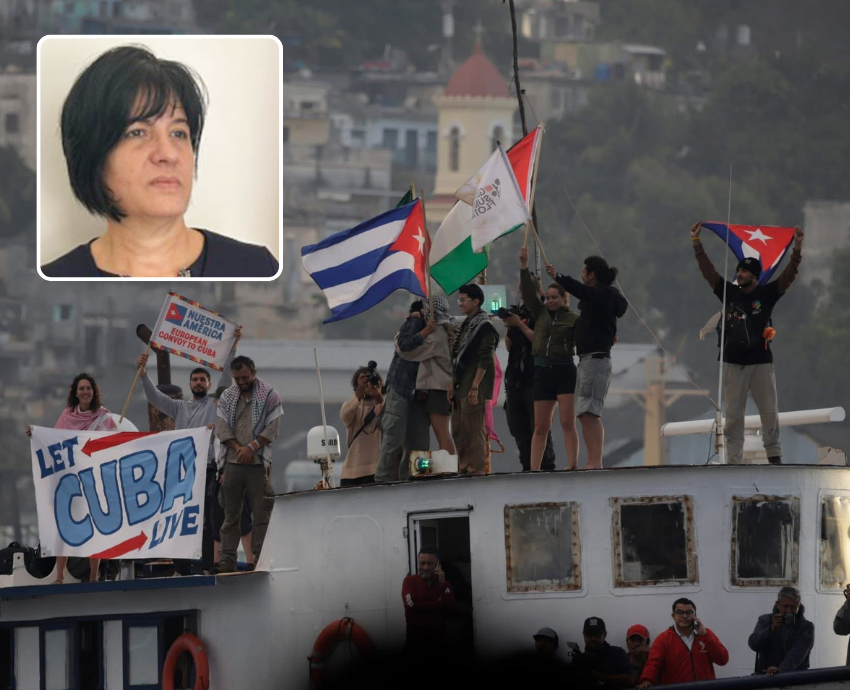
Two months have passed since United States President Donald Trump tightened US imperialism’s illegal 64-year economic blockade of Cuba, threatening countries supplying oil to the island nation.
The resulting oil shortage has led to widespread power outages, affecting many sectors of society and causing a humanitarian crisis.
Green Left’s Ben Radford spoke to Gilma Moreira Lino, the Cuban ambassador to Australia, about this escalation, how Cubans are responding and the importance of international solidarity.
* * *
How has Donald Trump’s tightening of the oil blockade on Cuba affected daily life?
The US publicly threatens Cuba, almost daily, with overthrowing our constitutional order by force. It seeks to take control of the country by further pressuring it economically with the aim of forcing Cuba to give in.
It is intensifying its rhetoric towards Cuba, amid a blockade on oil supplies to the country, which constitutes collective punishment against our entire people.
The humanitarian repercussions of the fuel blockade imposed on Cuba through Trump’s executive order are enormous. This order authorises the imposition of punitive tariffs on imports from any country that, directly or indirectly, supplies oil to Cuba.
Cuba relies heavily on imported fuel for all its essential services. Therefore, the consequences for the Cuban people are serious, affecting electricity generation, hospitals and health services, water and sanitation systems, public transport and the production and distribution of food.
This executive order deliberately and cruelly seeks to aggravate the suffering of the Cuban people and is contrary to the principles of the United Nations Charter and international law.
How are the Cuban people responding to this?
Despite this situation, the Cuban people will vigorously and courageously defend, in close unity and with international consensus, their right to self-determination, independence, sovereignty, territorial integrity and constitutional order.
We know we will live through difficult times; we have lived through difficult times — these in particular are very difficult. But we will overcome them together, with resilience, with the effort and skill of the majority of Cubans.
As our president [Miguel Díaz-Canel] expressed, faced with the worst scenario, Cuba is accompanied by one certainty: any external aggressor will come up against an unbreakable resistance.
I would like to make clear that all this theory of collapse and of a failed state, with which the US government has tried to characterise the situation in our country, is based on an imperial mindset and philosophy, but that is not part of the mentality of Cubans. In our vision, there is the concept of resistance, which has to do with defending the ideas we believe in, with the conviction of a victory in which we also believe.
What can you say about the speedboat attack on Cuba last month?
As reported on the morning of February 25, a speedboat was detected within Cuban territorial waters, bearing registration from Florida, US. As a Cuban Border Troops surface unit approached to identify it, the boat opened fire against Cuban personnel, resulting in the commander of the Cuban vessel being injured. During the confrontation, four attackers were killed and six injured; they were evacuated and received medical assistance.
The Cuban response to the incident strictly adhered to the regulatory framework of the Cuban Border Troops. Firearms are only used when we are attacked.
During the inspection of the offending boat, rifles of different calibres, pistols, magazines, ammunition, knives, camouflage uniforms, communication equipment and other materials were seized.
Since 1959, Cuba has had to face numerous terrorist and aggressive attacks originating from the US, at a high cost in lives, injuries and material damage.
Cuba does not attack, nor does it threaten. Cuba will defend itself with determination and firmness against any terrorist or mercenary aggression that seeks to undermine its sovereignty and national stability.
Our president described it as a “terrorist and mercenary aggression” and reiterated that Cuba will defend itself with determination against any such attempt. This act forms part of the long history of aggression from US territory and is exacerbated by the current climate of hostility and energy blockade. We strongly condemn it as a flagrant violation of our sovereignty and an act of terrorism.
Cuba reaffirms its commitment to protecting its territorial waters, on the basis that national defence is a fundamental pillar of the Cuban state, in support of the protection of its sovereignty and stability in the region. A thorough investigation is under way to clarify the facts.
What forms of international solidarity are needed right now?
It is not only a question of material support. There is a high level of awareness within the solidarity movement with Cuba about the particular situation we are experiencing.
Workers, trade unionists, social and political leaders and parliamentarians reaffirm their conviction that Cuba is a moral example. It has always demonstrated solidarity with peoples all over the world, and [the international responses] now show that a good part of the world stands with Cuba and seek to broaden and bring more people into the international solidarity movement with Cuba.
Solar panels, photovoltaic systems, medical supplies, sanitary materials, personal hygiene items and school supplies, as well as food, have arrived in the country.
What could the Australian government do to help the Cuban people?
We believe that, in a situation such as this, the world must not allow itself to be subjugated; the world cannot allow force to crush multilateralism, the purposes and principles of the United Nations Charter and international law.
The countries of the world must understand this and seek coordination, unity of action, constant denunciation, integration into blocs defending ideas, and also pursue economic, commercial, cooperative and collaborative actions that defend this multilateralism.
In our contacts with Australian representatives at different levels, we defend these ideas. We have conveyed the gravity of the situation: the attempt at energy suffocation, the humanitarian risks and the need to act urgently. Our message is clear: Cuba is grateful for any genuine gesture of solidarity.
The most important thing for Cuba, more than aid, is the willingness of each government to make use of its own sovereign prerogatives and defend its own right to trade freely with Cuba, without interference from the US. The international community should not allow the US government to have the power to interfere.
Cuba, like any country, in order to develop must rely on trade and on its own economy, and that is the relationship we seek with the rest of the world.
Cuba is not alone. At a moment like this, there are many — governments, countries, institutions and companies — that are willing to work with Cuba and that have already put forward channels, mechanisms and plans as to how we can do so.
There has been immediate support at the international level. There are various statements from spokespeople, foreign ministries, international leaders and movements that bring together different countries, solidarity movements, political parties from different countries and Cubans living abroad supporting our country.
In Australia, the solidarity movement with our country is strong and speaks out against the blockade, through different activities and actions in support of Cuba.
The ACFS [Australia Cuba Friendship Society], in its various branches in Sydney, Melbourne, Canberra, Brisbane, Newcastle, Perth, Adelaide and Albury, is always developing different initiatives, denouncing this new escalation by the US government against our country, for which we are deeply grateful.
How significant is the Nuestra América (Our America) solidarity convoy to Cuba?
The Nuestra América Convoy arrived in Cuba to build bridges of solidarity, denounce the blockade and demonstrate that Cuba is not alone.
The call-out brought together more than 600 members of organisations, trade unions, parliaments and solidarity movements with our country, from several countries around the world, demonstrating that the people, united, are invincible.
In a moving act of solidarity, held at the Havana Convention Centre, the Cuban president told participants: “Cuba feels embraced by all of you. Solidarity does not impose conditions, does not dictate, does not charge. It embraces and commits itself to a people skilled in giving embraces and showing solidarity.”
He affirmed that “Cuba will not yield, because it has the determination and courage of its people, and because they demonstrate that Cuba is not alone.”
He highlighted the significance of the presence of so many young people among those attending, the depth of the ideas they bring and the shared conviction that the struggle for a more just world must never cease.
“Continue to count on Cuba, because we continue to count on you,” he told those present.
In these difficult moments, it moves us that our country receives so much solidarity, a reflection of the love and respect that Cuba has left in every people with whom it has shared the best of itself.
The Cuban people deeply appreciate the material and spiritual support brought by the members of the Nuestra América Convoy, the result of international unity in defence of the Cuban people and their revolution, in the face of the escalation by the US government.