
In the midst of the most comprehensive smear campaign against the radical left in the past 50 years, France’s municipal elections, with the first round held on March 15, have resulted in wins for the far left and worrying gains for the far right, writes John Mullen.
* * *
The first round of France’s municipal elections took place on March 15, with the second round scheduled for the 22nd. French municipal councils have considerable power and are responsible, for example, for building and maintaining primary schools, developing social housing, and in some cases running a local police force.
Elections are held as a two-round list ballot with a substantial winner’s bonus. A list that gains more than 50% in the first round, or the highest vote in the second round, receives a bonus of roughly half the council seats. The remaining seats are then distributed proportionally among all lists that obtain more than 5% of the vote. In practice, this means that a list winning 51% of the vote will usually obtain about 75% of the seats.
If a second round is held, lists that received at least 10% in the first round can stand again or merge with others. Lists scoring between 5% and 10% cannot run independently in the second round but may join a qualified list.
Between the two rounds, lists frequently merge — often among left-wing parties seeking to prevent victory by the right or the far right. These mergers take two main forms. A political merger is based on a shared program and usually includes a commitment to support the municipal budget. A technical merger, by contrast, simply places candidates from different lists on the same slate without any promise of political solidarity once elected. Supporters argue that this arrangement allows the council’s composition to reflect more democratically the range of opinions in the electorate.
Polarisation
In the six years since the last municipal elections, political polarisation in France has deepened. President Emmanuel Macron’s camp, the traditional right, and the social-liberal Socialist Party (PS) have all lost ground, while the far right — led by National Rally (RN) — and the radical left, La France Insoumise (France in Revolt, FI), have expanded their support.
Predictions remain difficult. Turnout in municipal elections can be very low — abstention sometimes exceeds 50% — and the alliances formed between the two rounds are often decisive yet highly unpredictable.
A growing section of the traditional right is now willing to ally with the far right, giving the RN hope of taking control of a number of municipalities.
Fewer than a dozen French towns with more than 10,000 inhabitants are governed by the far right — even though the RN holds 118 seats in the National Assembly and won 13 million votes in the last presidential election under Marine Le Pen.
One of the main reasons for this gap is the RN’s historically weak local party organisation. Nevertheless, with support from the establishment media, the RN has been promoting the message that it — together with the traditional right — can “save France” from the alleged “threat to democracy” posed by the FI.
In three towns in the South — Toulon (170 000 inhabitants), Nice (350,000) and Marseille (850 000) — the RN scored well in the first round and may win the second round. In Marseille, the second-round result depends on whether the Socialist Party (PS) agrees to a united left slate.
In the rest of the country the fascists did not see the breakthrough we feared in the big towns, but in quite a lot of medium-sized communes they improved their vote considerably.
The left and antifascist fronts
There has been much turbulence on the left in recent months. The FI has been subject to a huge smear campaign alleging that the organisation and its well-known leader, Jean-Luc Mélenchon, are hostile to Jews.
The campaign is in many ways identical to the smear campaign in Britain against Jeremy Corbyn around eight years ago. In both cases, left-wing figures elected and re-elected to parliament for decades were never accused of anti-semitism until the Palestine movement and the radical left became a real problem for the powers-that-be.
Establishment cronies work fulltime sifting through Mélenchon’s very long public speeches looking for 10-second excerpts to misinterpret. All the other classic smears are blared out on the media day and night. Because the FI is getting stronger, the capitalists are determined to smash it.
The PS, which was pushed in 2024 into signing up to a radical program jointly with the FI, Greens and the Communists, has been looking for a way to reassert a break with radicalism and has joined in the smear campaign.
Several key PS figures argue that no alliance should be made under any circumstances with the FI, even to keep the fascists out. Raphael Glucksmann, who is likely to be the presidential candidate for the Socialist bloc next year, demanded in a recent public meeting — where he shared the platform with PS General Secretary Olivier Faure — that the PS “break definitively” with the FI. “We cannot fight for democracy with a friend of tyrants among us,” he thundered.
Leading PS senator, former minister for women’s rights and feminist, Laurence Rossignol, circulated an extract from my local FI group leaflet on social media, (which committed itself to boycotting companies supporting Israel); alongside it she placed a large photo of Nazi graffiti (“Jude”) on 1930s shops in Germany.
Other parts of the PS, though, won’t rule out cooperation, since refusing all alliances would no doubt mean victory for the right and even for the fascists in some towns.
The PS, much reduced in parliament since its horrific austerity governments of 2012–17, is still locally dominant. Around half of all towns with more than 10,000 inhabitants are run by the PS or by alliances that they dominate. PS mayors govern Paris, Rennes, Caen, Nantes and Montpellier, among others.
The PS national council recently voted against a national agreement on mergers with FI lists. Meanwhile, the FI leadership has proposed technical mergers for the second round with all other left lists, including those of the PS — particularly in towns where this could stop the fascists from winning.
In a few dozen towns, united left lists were formed for the first round. Toulouse and Limoges have both just announced second-round mergers, but in other towns, the PS will refuse. PS heavyweight Boris Vallaud grumbled on election night: “We thought the FI were going to lose out in these elections, but they’ve come out stronger”.
Citizens’ revolution?
The far-right has profited from the attacks on the FI. Following the death of a fascist street fighter in Lyon last month — which was blamed on the FI by the media, despite all evidence — far right violence has soared.
Dozens of leafletters and posterers across the country (three in my town of Montreuil alone) have been attacked by fascists. FI headquarters have been vandalised and meetings attacked. Some of the revolutionary left (but not all) have stepped up to loudly defend the FI. Left-wing Jewish groups published an open letter supporting Mélenchon.
The FI’s local election campaign has been one of the most dynamic for decades. Meetings with Mélenchon have attracted thousands, and mass door to door canvassing, not a tradition in France, has been generalised in working-class estates.
FI leaflets call for “a citizens’ revolution in your town”, free school meals for all children, rent freezes where the legal instruments exist, requisition of vacant buildings for housing, and emphasise green policies, opposition to Trump’s war and active solidarity with Palestine.
Before these elections, the FI — a young movement — governed only three towns, none of them larger than 20,000 inhabitants. However, its results on March 15 were impressive.
The FI won Saint-Denis (150,000 inhabitants) outright. In Roubaix (100,000), the FI gained 47%, making victory in the second round almost certain. FI won more than 20% of the vote in Lille, Limoges, Toulouse, Argenteuil and Montreuil.
The FI’s results have made the PS smear campaign look stupid and unprincipled. In any case, the FI campaign has kept anti-fascism and opposition to austerity and war in the public eye. It has also ensured that in hundreds of towns there will be a radical left opposition for the first time — with an FI presence on 8 out of the 10 largest councils in the country.
It is clear that the FI, which has progressed at each election, will remain the centre of gravity of the radical left, attracting many of the best young activists. The far left needs to come to terms with this.
Fightback
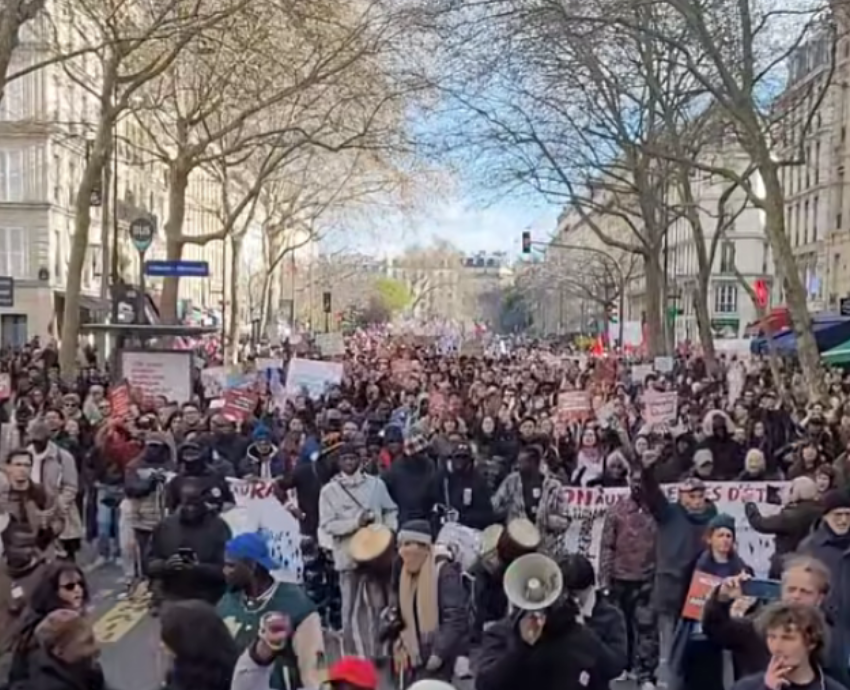
There have been dozens of antifascist initiatives around the country in recent weeks, some organised by the FI, and others by local alliances. Eight-five demonstrations were held around the country, on March 14, coordinated by the Marche des Solidarités. While the slogan showed some anarchist influence and could have been better chosen (“Against racism, fascism and state violence”), the entire radical left supported the demonstrations, and the timing — the day before the first round of crucial elections — was perfect.
When all opinion polls during the 2024 parliamentary election had predicted a fascist Prime Minister, the magnificent anti-fascist mobilisation during the campaign ensured that RN eventually came in third. Combining electoral opposition and permanent antifascist education with harassment of the RN is the way forward.
[John Mullen is a Marxist activist in the Paris region, and was on the FI’s local election slate. His website is randombolshevik.org.]