
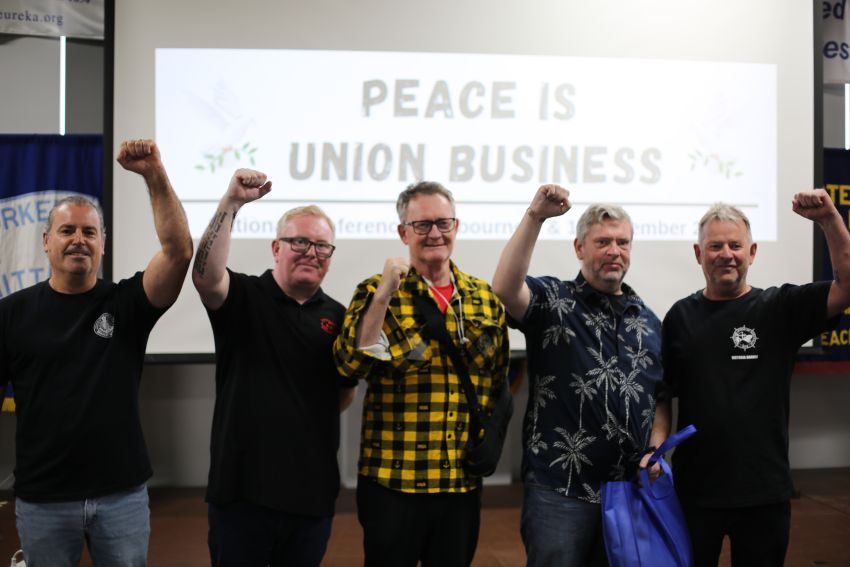
The following is an abridged version of a speech by Warren Smith, deputy national secretary of the Maritime Union of Australia, to the Peace is Union Business conference on December 9.
***
This conference has been called because the world is sliding into a more dangerous phase of permanent war and militarisation. From Palestine to Venezuela and Europe to Africa, ordinary workers, their families and their communities are the ones being killed, displaced, surveilled and silenced, while corporations and political elites profit.
The objectives that brought us here are clear: To rebuild a broad, militant movement of unions for peace and social justice, to reconnect the labour movement with its own proud peace traditions and to leave here with practical organising plans that mobilise our workplaces, our communities and our unions against war, racism and fascism.
There is a view, pushed hard by employers and conservative politicians, that unions should stick to “bread and butter” issues; a pay rise here, a safety win there, but unions should not be “political”. Unions should not have views on “foreign policy”, nor should they question “war and peace”.
That argument is designed to remove the organised working class from the biggest decisions about war, peace and national priorities and leave those decisions to the boardrooms, the generals and the spooks.
Unions are the largest democratic organisations of working people in this country. If we accept our role as being confined to a narrow economic one, we abandon the field on the questions that determine whether members live, die, are conscripted, bombed or see their social services, as well as their wages and conditions, gutted to pay for the war machine.
Unions understand this need for this broader role. In World War I, labour activists and peace campaigners — including unionists linked to the Australian Peace Alliance and anti‑conscription committees — led mass campaigns that defeated conscription twice and asserted that workers should not be blindly fed into imperial slaughter.
During the Vietnam War, unions did not just pass resolutions; maritime workers and others placed industrial bans on war‑related cargoes and helped build the momentum that led to the massive Moratorium marches and, ultimately, to Australian troops being withdrawn.
Peace is our history
“Peace is union business” hasn’t been invented for this conference; it describes what unions have done at some of the most important moments in our history.
In 1938, waterside workers at Port Kembla refused to load pig iron onto the Dalfram, bound for Japan’s war machine. The action became known as the Dalfram dispute and earned Conservative Prime Minister Robert Menzies the nickname “Pig Iron Bob”. Wharfies in other ports followed with bans on scrap iron, arguing they would not load cargoes that would be turned into weapons used against civilians and come back as bombs and bullets.
The same spirit infused the union movement’s long campaign against Apartheid in South Africa; the Seamen’s Union of Australia and the Waterside Workers’ Federation repeatedly banned South African ships and cargo, helped drive an international maritime oil embargo and later received personal thanks from former political prisoner and then-President Nelson Mandela for their role in the freedom struggle.
When unions put peace and anti‑racism at the centre of their work, they do more than express solidarity; they make exploitation, war and fascism harder to organise.
Beyond the waterfront — teachers, builders, nurses
The peace tradition is not confined to maritime and transport unions. Teachers’ unions, including the NSW Teachers Federation, have a long record of opposing war, defending peace education in curriculums and resisting attempts to turn schools into recruitment grounds for the military.
Health and nurses’ unions have campaigned against nuclear weapons and wars that create mass civilian casualties, and refugee crises that overwhelm public hospitals and health systems.
The Builders Labourers Federation’s Green Bans are often remembered as an environmental story, but they were also about peace and social justice: Unions using industrial bans to stop socially destructive developments, to defend communities and to say that workers will not build every project that capital demands.
In that same tradition, rail and public transport unions have challenged attempts to militarise infrastructure, demanding that public money go to socially useful services rather than war preparation.
The lesson is consistent: when unions act collectively and politically, they can reshape what is possible, far beyond the immediate workplace.
AUKUS, Palestine and the Pacific
This conference is meets at a time when Labor has signed up to AUKUS and is committing hundreds of billions of dollars to nuclear‑powered submarines and deeper integration into United States and British war‑fighting strategies.
Those resources are being torn away from health, education, housing, climate transition and public services, at the very moment when inequality is soaring and workers are under intense economic pressure.
The labour movement cannot be neutral about whether public money goes to nuclear submarines or to schools, hospitals, public housing and the climate jobs we desperately need. We must reject the false narrative that China is our enemy and is a threat to Australia.
The real threat comes from the US and Britain and their perpetual drive to war for corporate profits and expanded markets.
At the same time, the genocidal devastation in Gaza and the broader occupation of Palestine have exposed, in real time, how military alliances, arms deals and diplomatic cover enable the mass killing of civilians. Workers across this country are responding; public sector workers undertook solidarity actions; health staff spoke out about attacks on medical facilities; education workers refused to be silent; and unions are debating how to turn statements into industrial and political leverage.
Across the Pacific, workers’ organisations are raising the alarm that their homes are being treated as bases, buffers and bargaining chips in great power rivalry, while communities on the front line of climate change still wait for justice. The same Pacific that lives with the legacy of nuclear testing is now expected to host a military build‑up in the name of “deterrence”.
Why war is a union issue
War is not an unfortunate accident that occasionally interrupts “normal” economic life; it is built into a system that puts private profit and imperialist rivalry above human need.
The forces that fight to casualise labour, smash unions, privatise public services and deepen inequality are the same forces that lobby for weapons contracts, foreign bases and new theatres of war.
When governments legislate to weaken unions at home and expand war‑making powers abroad, they are pursuing one integrated project — to concentrate wealth and power in fewer hands, backed up by the threat and reality of ruling-class violence.
For workers, this plays out in multiple ways. It means workers have to fill the ranks of the armed forces, often for lack of other secure opportunities. It means communities are hit because social services are cut to pay for defence spending — which now runs into tens of billions of dollars each year and is forecast to rise steeply over the coming decade.
Labor currently spends $191.8 million each day on the military. This works out to be $8 million dollars each hour. It means our workplaces, from ports to universities to research labs, are integrated into military supply chains and weapons development, often via opaque “partnerships” and “security” arrangements that we are not allowed to debate. To say “peace is union business” is to say that unions must contest this whole agenda, not just its symptoms.
Learning from victories
When unions take peace seriously, they can change outcomes.
The anti‑conscription victories in 1916 and 1917 were won by broad alliances of labour, peace organisations, women’s groups and churches organising mass meetings, street marches, workplace agitation and the vote.
The Vietnam Moratoriums were consciously modelled on labour‑led protests in the US. Australian union involvement give the moratoriums enormous strength; they included bans on troop ships and munitions to explicit commitments by the Australian Council of Trade Unions [ACTU] and key unions to oppose the war.
The anti‑Apartheid movement likewise demonstrated that sustained union action can help delegitimise and economically isolate a regime that many governments were willing to tolerate, or even support.
When maritime workers, transport workers and others refused to handle South African cargo and sporting tours, they endured legal and political attacks. But it helped shift public opinion and made concrete the idea that racism and oppression abroad were a trade union issue here.
Australian unions played a central, often decisive, role in the Australian anti‑nuclear movement, from early resistance to French tests and uranium mining, through to current opposition to nuclear submarines under AUKUS.
From the mid‑1970s into the early 1980s, several unions used direct industrial action to disrupt the uranium industry and associated infrastructure, shaping Labor and ACTU policies for decades. It left in place an anti-nuclear legacy, which, today, is being threatened by all the new laws surrounding AUKUS nuclear submarines.
Today, as unions consider their responsibilities on issues like Palestine, AUKUS and far‑right mobilisation, these experiences are not just inspiring stories; they are guides to action.
The far right, racism and war
Combating the far-right, white supremacist and neo‑Nazi movements that are targeting the working class is one of the themes of this conference. These forces thrive in conditions of economic insecurity, militarism and racist fearmongering; they are cultivated by sections of capital and the political class that benefit from division and fear.
The labour movement has confronted this before, including campaigning against local fascist groups in the 1930s, opposing racism and apartheid, challenging the racist Northern Territory Intervention and the more recent anti‑Muslim and anti‑refugee policies.
Today’s far right wraps itself in national flags, talks endlessly about “security” and “the West”, and tries to turn anger at the cost‑of‑living crisis into hatred of migrants, Muslims, First Nations people and the organised left.
When unions campaign for peace, for an independent foreign policy, for refugee rights and for First Nations justice, they do more than adopt good moral positions; they cut across the recruitment base of the far right and assert a different kind of patriotism — one based on solidarity, equality and collective security.
Role of this conference
This conference aims to build connections between unions, regions and sectors that can translate into real campaigns in the months and years ahead.
That means mapping where military and security projects intersect with our workplaces; sharing experiences of industrial bans, community campaigning and political lobbying; and identifying concrete national demands that can unite unions around an agenda for peace and justice.
We are here to strengthen the links between unions and organisations, including the Independent and Peaceful Australia Network, peace groups, faith communities, First Nations organisations and migrant community groups, because a serious peace movement has to be broad, rooted and representative.
If peace is union business, every union has to ask what it means in practice when we leave this place. For some, it might mean committing to educate delegates and members about AUKUS, military spending and the alternatives — using workplace meetings, training courses and union communications to make the connections between war budgets and wage theft, between arms corporations and union‑busting employers.
For others, it might mean reviewing investment policies and superannuation portfolios to identify and challenge ties to arms manufacturers, military contractors and companies profiting from occupation and war.
In strategic industries — ports, logistics, transport, education, health, public services, construction, communications and manufacturing — unions can begin discussing when, and how, industrial power could be used to oppose specific wars, deployments, weapons systems or contracts, just as earlier generations did with pig iron, Apartheid cargoes and nuclear testing.
That does not start with a call for a sudden, isolated action; it starts with building member understanding, democratic mandates, alliances with affected communities and plans that can withstand legal and political attack.
As our movement already has severe industrial law constraints, any serious peace strategy has to take that into account. But history shows that when unions are united, prepared and linked to broader social support, they can act in ways that shift what is considered “legal” and “possible”.
An independent peaceful Australia
A thread running through much of this discussion is the question of independence — not in some abstract nationalist sense but independence from imperialist alliances and war‑fighting strategies that are not in working people’s best interests, either here or in the Asia Pacific.
For decades, Australia has locked itself into US‑led wars — from Korea and Vietnam to Iraq and Afghanistan — often on false pretences and almost always against the wishes of large parts of the population.
US bases and joint facilities on Australian soil help enable drone wars, nuclear targeting and military surveillance, making our communities potential targets while undermining genuine sovereignty.
An independent, peaceful Australia would mean stepping away from the US nuclear alliance, rejecting nuclear weapons and nuclear‑armed or nuclear‑powered platforms and signing and implementing the Treaty on the Prohibition of Nuclear Weapons, which Labor has promised but, so far, refused to do.
It would mean reorienting foreign policy towards diplomacy, development, climate action and genuine partnership with our neighbours, especially in the Pacific, instead of treating them as strategic chess pieces. It would mean redirecting defence spending away from offensive capability designed for distant wars and towards civil defence in the broadest sense: Housing, health, education, climate resilience, public transport and jobs that actually defend and sustain life.
Building a living movement
If this conference is to matter, it has to mean leaving here with a plan: A national union peace network or coordinating body; regular cross‑union meetings; agreed campaigning possibilities; and mechanisms for sharing resources, research and strategies.
It means each union has to make peace part of its core business in its own constitutional objectives, policies and education programs and ensure that peace questions are on its union meeting and activity agenda.
We also need to consciously mentor new generations of rank‑and‑file leaders, prioritising the leadership of women, First Nations members and migrant workers, so that peace work is union work, not an optional extra or the hobby of a few.
The forces that profit from war plan for the long term; our movement must do the same.
Our movement has never just been about wages and conditions; it has always been about whose lives matter, whose voices count and what kind of world working people will inherit. Peace is union business because war is always a class question and working people always pay the highest price in war.