-
A new free trade deal to be signed this year could allow foreign corporations to sue the Australian government for introducing environmental regulations on coal seam gas (CSG). Australia has joined 11 other countries — the United States, Malaysia, Brunei, Canada, Chile, Japan, Mexico, New Zealand, Peru, Singapore and Vietnam — in negotiations for the Trans-Pacific Partnership Agreement (TPP). Unlike most trade deals, other countries can sign on in the future. -
The Peruvian government has renewed its commitment to several controversial mining mega-projects. The projects have provoked huge regional protests against the environmentally destructive expansion plans of foreign mining corporations. Speaking at a mining industry conference held in the southern city of Arequipa on September 16, Minister of Energy and Mines Jorge Merino indicated that Conga (in Cajamarca), Tia Maria (in Arequipa) and Corani (in Puno) will be developed with the backing of President Ollanta Humala's administration. -
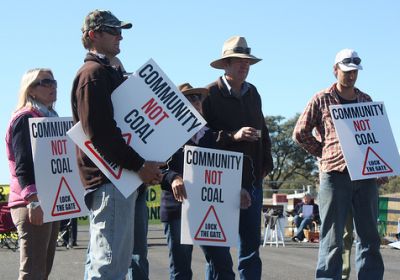
New regulations restrict coal seam gas (CSG) companies from residential housing areas in NSW, but do little to protect the rural landscape.
-
With Tony Abbott ruling the roost in Canberra, it is important for the climate movement in Australia to take stock and have a discussion about where to go next. It is easy to be discouraged by the election of Abbott. However, it should not be forgotten that the election was more than just a “referendum on the carbon tax”, it was also an electoral snapshot of a country that has been subjected to an exceptionally strong barrage of brainwashing for the past few years. The ideas spread through the media are powerful, but they are not invincible. -
During a visit to New York for the United Nations General Assembly, Ecuador’s foreign minister Ricardo Patino joined independent media outlet Democracy now! on September 23 to discuss his government’s involvement in two closely watched environmental legal battles.
-
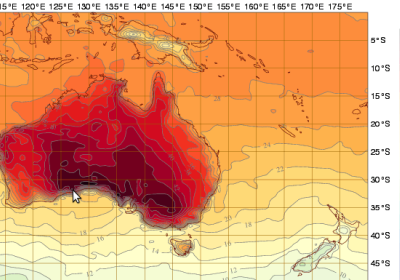
The Intergovernmental Panel on Climate Change (IPCC) released its first installment of its fifth assessment report (AR5) on climate change in Stockholm on September 27.
-
The Intergovernmental Panel on Climate Change just released its latest scientific report that looks at what the world’s top experts understand about climate change. The review takes years to complete, and will be used for years as a vital resource for climate science.
-
Ecuador’s foreign ministry announced on September 20 that the US has seemingly denied visas to a delegation set to travel to the United Nations General Assembly in New York, RT.com said the next day. The Ecuadorians were planning to present their case in an ongoing dispute against Chevron-Texaco. The ministry said the visas for the five Ecuadorian nationals were returned by the US Embassy in Quito “without any explanation”.
-
"We are at a critical point in human history," prominent Canadian environmentalist David Suzuki told an audience of about 500 people at a public forum at Sydney University, on September 25. "What we do or do not do in the next period will determine the future of the human species and the planet,” he said. The meeting, called "The challenge of the 21st century: Setting the real bottom line”, was sponsored by the Sydney Environment Institute, University of Sydney. It was part of a series of talks and media appearances by Suzuki on his Australian visit.
-
1. GM FOODS WON’T SOLVE THE FOOD CRISIS A 2008 World Bank report concluded that increased biofuel production is the major cause of the rise in food prices. GM giant Monsanto has been at the heart of the lobbying for biofuels (crops grown for fuel rather than food) — while profiting enormously from the resulting food crisis and using it as a public relations opportunity to promote GM foods. 2. GM CROPS DO NOT INCREASE YIELD POTENTIAL
-
Something is looming in the shadows that could help erode our basic rights and contaminate our food. The Trans Pacific Partnership (TPP) has the potential to become the biggest regional free-trade agreement in history, both in economic size and the ability to quietly add more countries in addition to those originally included.
-
One of the more disturbing images on federal election night was that of Coalition MP-elect Barnaby Joyce welcoming mining magnate Gina Rinehart as the special guest to his election party. Few things could reveal more clearly the strong connection between corporate power and government under Coalition rule. It is worth noting some of the policies that Rinehart is promoting for the Northern Territory because, let’s face it, they are likely to happen. One of her big ideas, which Kevin Rudd adopted before his election defeat, is the creation of a northern Australia tax haven.