Everyone Can be a Hero
By J. R. Birch
Inside Outsider Publications, 2010, 293 pages
In The Iron Heel, Jack London used a narrative from the future to present the dystopian and utopian possibilities that existed in his time. Everyone Can be a Hero, a new independently published book for older children and teenagers, uses a similar device.
-
-
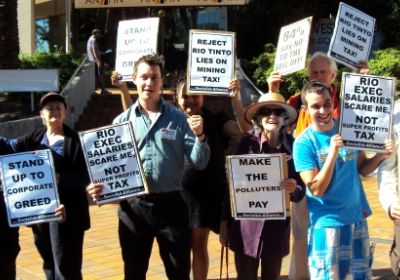
Much of the public discussion on Prime Minister Kevin Rudd’s proposed tax reforms — made in response to the Henry tax review — has centred on the projected 40% tax on “super-profits” in the mining industry. Most people probably agree that the big mining multinationals could afford to contribute a lot more to the public purse.
-
The Socialist Alliance has endorsed Dr Renfrey Clarke to run for the Senate in South Australia. Clarke was one of the founders of the Climate Emergency Action Network in 2008, and is a well-known activist and writer on environmental topics. He is a member of the Liquor, Hospitality and Miscellaneous Workers Union. A specialist on Russia and Latin America, Clarke worked for many years as a foreign correspondent for Green Left Weekly and other progressive media. Below, Clarke outlines the priority issues around which he campaigns. -
A huge crowd of 50,000 people marched in Auckland on May 1 against the New Zealand government’s plans to allow mining in the country’s national parks. It was New Zealand’s biggest protest march in living memory. Greenpeace ambassador Robyn Malcolm said: “For nearly 50,000 Kiwis to turn out and be prepared to speak with one voice, must tell the government something ... Our land will always be more important to our identity than some extra dollars in the pockets of mining companies.”
-
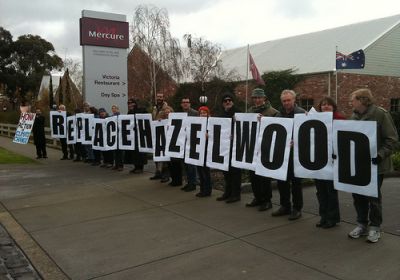
MELBOURNE — In the wake of the Rudd government’s backflip on climate change, more than 250 people rallied outside the Victorian parliament on May 6 to urge Labor Premier John Brumby and Coalition leader Ted Baillieu to commit to replacing Hazelwood coal-fired power station, the world’s dirtiest, with clean energy by 2012. -
One of the most common cliches western politicians like to use to describe the climate crisis is: “We are all in this together”. But this seemingly harmless platitude all too often conceals a dangerous lie. Actually, on a global scale, we’re not all in this together. Of course, global warming will impact everywhere, but it won’t affect every place in the same way. -
A key demand adopted by the World People’s Summit on Climate Change and the Rights of Mother Earth was for the industrialised First World nations to pay their “climate debt” to the underdeveloped nations. The summit was held in Cochabamba, Bolivia, over April 19-22 and attended by 35,000 people from around the world. A key concept promoted at the summit was that of vivir bien — living well. This is similar to the common idea expressed in the West, “live simply so that others may simply live”. -
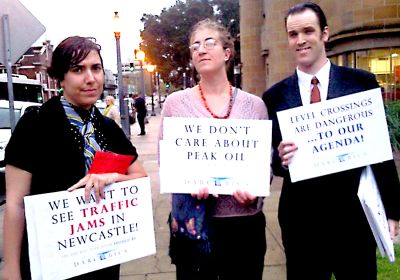
"Say no to Roe!", chanted more than 100 people at a rally outside state parliament on April 22. The rally was organised to oppose a five-kilometre freeway extension (Roe stage 8) between the Kwinana Freeway and Stock Road in Melville, south of Perth. Speakers said the proposed extension was expensive, unnecessary and environmentally destructive. It would desecrate Noongar sacred sites and threaten the endangered species.
-
As towns go, Orroroo in South Australia might seem small, but with 850 people it is one of the larger stops on the road between Broken Hill and Port Augusta. The countryside around it is marginal farmland. Only in the occasional year is there enough rain for a good crop of wheat, and in a process with well-researched links to global warming, the wet years have been getting fewer. It is ironic, therefore, that this district 250 kilometres north of Adelaide now seems destined to hurry climate change along.
-
Environmentalists have scored a win against logging in Mumbulla state forest in south-east New South Wales. Forests NSW suspending activity on April 28 after it was revealed the area may be part of an Indigenous Protection Zone. The Narooma News that day said areas due to be logged were gazetted as Aboriginal sites in the 1980s. Since March 29, activists have been fighting to save the native forest and its fragile koala colony.
-
In the Cochabamba football stadium on April 22, diverse indigenous peoples paraded around the track, thousands of local peasants sat in the stands, and thousands more activists from around the globe waved flags and chanted on the field. A common sentiment flowed through the crowd: something historic had occurred over the previous three days during the April 19-22 World People’s Conference on Climate Change and the Rights of Mother Earth organised by the Bolivian government in Cochabamba. -
Farmers at Caroona on the Liverpool Plains near Quirindi, New South Wales, have been defending their properties from invasion by BHP-Billiton’s coal exploration drillers. For 615 days, until March 25, they inspired coal-threatened communities everywhere with their blockade, by saying “No” — and meaning it. Trish Duddy and Tommy and George Clift have been at the blockade camp for every one of those 615 days, joined by other locals on a rolling roster for cups of tea, information-swapping, resolve-steeling — and symbolic trailblazing.