-
NEWCASTLE — Four activists from Newcastle climate action group Rising Tide scaled the roof of climate change minister Greg Combet's office on May 16. They attached solar panels to the roof and unfurled a banner that read: “Make polluters pay, fund renewable energy.” Rising Tide spokesperson Naomi Hogan said: “We have put these solar panels up on Minister Combet’s office to highlight the potential of renewable energy to power the nation. -
Dressed mainly in black, with black flags and banners to show the death of democracy in Tasmania, 6000 people took to Launceston’s streets on May 14 to oppose Gunns’ proposed $2.3 billion pulp mill, to be built on the banks of the Tamar River.
-
“No trade with apartheid Israel” was the main theme of a protest outside the “Water Solutions for the Coal Seam Gas Industry Breakfast”, held at Brisbane's Sofitel Hotel on May 18. A trade delegation from Israel was hosted at the breakfast, sponsored by the Australian Israel Chamber of Commerce and the Chamber of Commerce and Industry Queensland. The protest, organised by Justice for Palestine Brisbane, attracted about 20 people who held placards supporting Palestinian rights and calling for Australia to impose economic sanctions against Israel. -
Our society is heading in the wrong direction. According to a new “Australia’s Electricity Generation Mix 1960-2009” report commissioned by Environment Victoria, the proportion of Australia’s electricity generated by renewable energy has fallen from 19% in 1960 to 7% in 2008. Because Australia today generates 10 times the amount of electricity as it did in 1960, coal-fired electricity generation has increased by more than 1200%. -
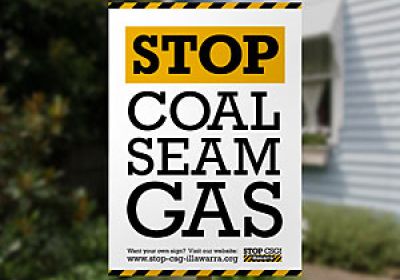
The Illawarra community plans to take action on May 29 to press their case for a moratorium on coal seam gas mining in the area. A mass human sign to spell the words “Stop Coal Seam Gas!” is organised at 11am that day on Austinmer beach, north of Wollongong. The organiser, Stop CSG Illawarra, is confident of a large turnout. The group’s regular organising meetings have attracted 100 or more people. The group has letterboxed 30,000 leaflets publicising the event and outlining the dangers of coal seam gas. -
The melting of the Arctic ice cap is the surest sign that dangerous climate change is already upon us. But some of the world’s most powerful governments are not worrying about what to do about it, they’re scrambling to profit from it.
-
Bolivian President Evo Morales proposed enshrining the Rights of Mother Earth in international law to the United Nations General Assembly on April 23. The proposal follows the Law on the Rights of Mother Earth that was enacted in Bolivia in January. The “short” law enacted is a set of principles. A more detailed version is expected later this year. The law commits the government to steadily integrate renewable energy sources in order to achieve national energy independence.
-
A group of 30 people held up construction of a second loader arm at Newcastle's third coal loader site on Kooragang Island on May 10, stopping a crane crew for about 90 minutes.
-
Campaign groups Western Downs Alliance and Six Degrees combined with a number of other activists and organisations to bring us the Rock the Gates Festival at Tara showgrounds from April 29 to May 4
-
After 12 hours on the road, travelling 800 kilometres from Newcastle through Gunnedah, Narrabri, Moree and Goondiwindi, just after sundown, our big blue bus pulled into Tara showground for four days of workshops and direct action as part of the Rock the Gate festival against coal seam gas mining.
-
The mining and banking companies creaming billions in super profits from the mining boom — the biggest mining boom in Australia’s history — have done very well from the federal budget that was delivered by the Gillard Labor government on May 10. The big mining companies will continue to pay the lowest ever share in tax and royalties while they make their biggest ever profits. -
On April 20, 2010, BP’s Deepwater Horizon oil rig exploded, triggering a months-long disaster that would end only after at least 4.9 million barrels of oil, and at least 1.9 million gallons of toxic chemical dispersants, had been injected into the Gulf of Mexico. One year on, the environmental destruction, while huge, is still only in the beginning stages. Experts warn that it will take decades to see the full consequences.