-
This year marks the 10th anniversary of the Codrington wind farm in Victoria’s southwest, the state’s first. On May 18, planning minister Matthew Guy announced approval for the latest, the three-turbine Chepstowe wind farm near Ballarat. But Victoria’s wind industry is threatened by the policies of the state’s new Liberal government. The government came to power with promises to ensure no-go zones for wind farms in the Macedon ranges, Bellarine and Mornington peninsulas, and the Great Ocean Road. These are some of the best areas in the state for wind farms. -
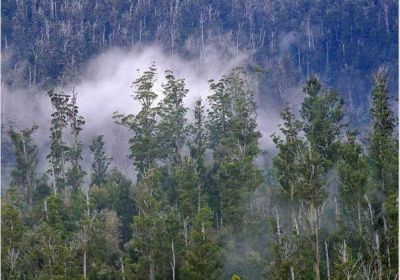
The deal to restructure the collapsing timber industry in Tasmania is struggling to make headway. Logging continues in old-growth forests at the same time as sawmills and woodchip mills close and more workers lose their jobs. Anti-logging protests are being held weekly outside the premier’s office in Hobart, and the talks between environment and industry groups continue despite a key player pulling out in frustration. The Wilderness Society (TWS) suspended its involvement in the Tasmanian Forest Agreement on May 18, citing a failure of leadership from state and federal governments. -
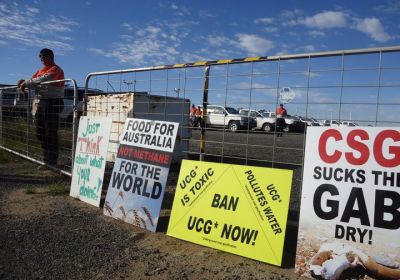
In the land of desperate excuses, coal seam gas is king. The new boom industry of the Queensland and New South Wales hinterlands contaminates ground and surface waters, while taking rich farmland out of food production.
-
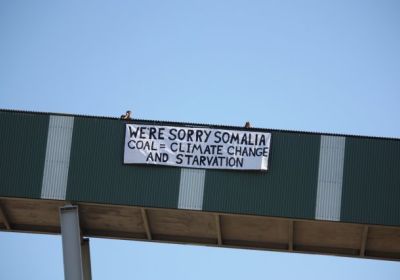
Members of climate action group NoPlanetB.org blocked the haulage of coal from Xstrata’s West Wallsend underground mine for several hours on May 30. A climber was suspended in a tunnel entrance on a haul road, used for transferring coal to the port of Newcastle. Others stood in front of trucks. The group sought to raise its concern about the demands from the coal industry, including Xstrata, that pollution from coalmines be exempt from the federal government’s proposed carbon tax. -
More than 3000 people turned out to Austinmer beach in the Illawarra on May 29 to form a “STOP COAL SEAM GAS!” human sign. Three helicopters, each from a big media outlet, circled above the cheering and waving crowd to film the historic event. Check out all the pictures and media coverage by visiting Stop CSG Illawarra's website: stop-csg-illawarra.org. A big team of more than 40 volunteers from Stop CSG Illawarra helped make the day such a success. -
“This is going to be the biggest environmental campaign this country has ever seen,” Drew Hutton, acting president of the Lock the Gate Alliance, told a rally of several hundred people outside the Sofitel Hotel on May 31. He was addressing the crowd outside a major conference of the coal seam gas (CSG) industry. “The coal seam gas sector and governments are hungry for cash, and are quite willing to tear up our countryside to get it. Every part of the country will be affected,” he said. -
Corporate media outlets claim Peru’s mining boom is doing wonders for the country’s economy, creating opportunities and making everybody richer. Quite a few Peruvians, mostly situated in the bubble-world of Lima’s wealthy areas, have been drinking the neoliberal kool-aid. Someone must have forgotten to tell those troublesome recalcitrants out in the provinces that the despoliation of their lands is good for them. -
More than 3000 people turned out to Austinmer Beach in the Illawarra on May 29 to form the "STOP COAL SEAM GAS!" human sign. Three helicopters, each from a major media outlet, circled above the cheering and waving crowd to film the historic event. Check out all the pictures and media coverage by visiting Stop CSG Illawarra's website. A big team of more than 40 volunteers from Stop CSG Illawarra helped make the day such a success.
-
About 20,000 people took part in Switzerland's biggest anti-nuclear march in 25 years on May 22, Swissinfo.ch said that day. “Chanting and waving placards, anti-nuclear protesters marched in two groups to the site of Beznau, Switzerland’s oldest nuclear power plant which is located in canton Aargau,” the article said. Organisers said about 150 political parties and environmental organisations joined the march.
-
The worst thing about the Labor government’s proposed carbon price scheme is that it’s a diversion from real action on climate change.
-
The historian William Cronon has been in the news recently in the US because of assaults on his civil liberties and academic freedom by the Wisconsin Republican Party. This story is likely to be of interest to Green Left Weekly readers because of the collision between university research and powerful corporate interests. However, Cronon's work as an environmental historian since the 1970s means that he deserves to be read by all those who take an interest in environmental issues and ecosocialist politics. -
New Coalition premier of NSW, Barry O'Farrell, may be rethinking his decision to slash the electricity power rebate to solar power customers after some of his own Liberal Party MPs vowed to vote against it. About 1500 angry people rallied at the plaza of Sydney’s Customs House on May 18 to protest the slashing of the rebate from 60 cents a kilowatt hour to 40c. The rally had to be moved from an overflowing indoor location