-
Asking the peak oil and gas industry body to prepare a report on Australia's future energy needs for federal and state energy ministers was always going to have a predictable outcome. The Australian Petroleum Production & Exploration Association (APPEA) was tasked to report to the Council of Australian Government (COAG) energy ministers meeting on August 18 and 19. Unsurprisingly, it recommended urgently producing and supplying more gas — and fast — before Australia runs out. -
I love this book. It is a showcase of four decades of Melbourne community radio station 3CR — one of Australia’s oldest and most progressive broadcasters, intertwined with the local and national landscape of political struggle from the mid 1970s until today.
-
AGL was in court on August 25 after pleading guilty to 11 counts of breaking political donation disclosure laws in relation to coal seam gas approvals. The breaches were first uncovered by the Gloucester community when it was fighting AGL's attempts to set up 110 coal seam gas wells on rich farming land near the town on the mid-north coast of New South Wales. They relate to donations AGL gave to the NSW Labor Party and the Liberals from 2008 to 2014. -
Forests in Cuba now make up 30.6% of the country’s land area, thanks to a reforestation initiative carried out by the socialist government, a new report has found.
-
In 2000, renewable energy made up just 6.3% of Germany's electricity. By last year, it had risen to 31%. Cloudy Germany became a leading innovator in solar energy. It did so not by subsidising large power utility companies, but by mobilising hundreds of thousands into energy cooperatives. The two legs of this democratic energy transition are Germany's commitment to phase out nuclear power and its feed-in tariffs, which allowed small renewable energy producers to sell their electricity. -
Despite a range of undemocratic measures by the Labour Party establishment in the face of hundreds of thousands of new members enthused by Labour leader Jeremy Corbyn's left-wing politics, Corby n looks set to win Labour leadership elections that finish on September 21.
-
CSIRO staff remain sceptical about the future of the group's climate research program, with media reports suggesting that science minister Greg Hunt's recent announcement of additional jobs in the area does not include any new funding from the federal government. The allocation of $37 million -- tied to the nascent Climate Science Centre in Hobart -- will apparently be sourced from CSIRO's own funds over 10 years and involves the creation of 15 new positions, based at locations still to be determined. -
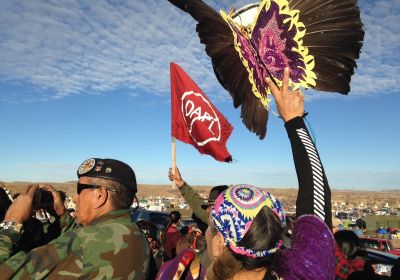
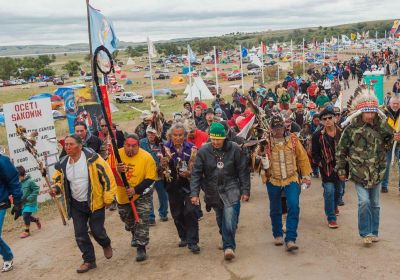
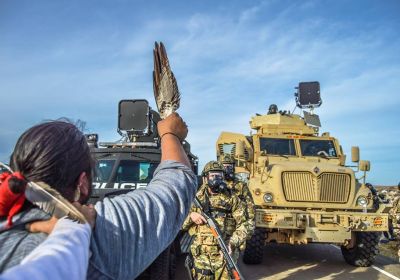
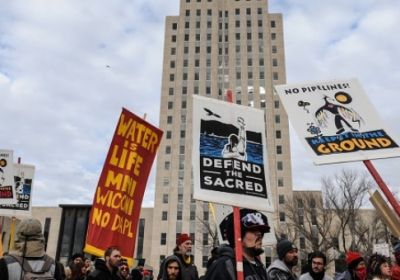
Despite ongoing resistance by the Standing Rock Sioux Tribe, a North Dakota federal court has ordered the indigenous group to stop their blockade protests against a US$3.8 billion oil pipeline.
-
Firefighters rallied outside state parliament house on August 16 to demand greater support for the victims of toxic contamination at the Country Fire Authority's (CFA) former Fiskville training facility. Fiskville was closed down in 2015, but a state parliamentary enquiry found that CFA management had known about the contamination since 2010 and allowed training to continue there. The chemicals have been linked to a rise in the number of incidences of cancer and other diseases among firefighters who trained there. -
Climate change is not just a scientific or technical problem, nor can it be solved in the “usual” way. Instead, people need to get organised and develop solutions that improve lives and communities as well as protect the environment. This was the central theme behind the “Creating a climate for change” public meeting held on August 11 in the Northcote Town Hall. The meeting was organised by the Melbourne Playback Theatre Company and Darebin Climate Action Now. -
A four-year campaign by local residents has forced agrochemical giant Monsanto to abandon its plans to build one of the world's largest transgenic seed factories in the province of Cordoba, Argentina. The campaign included protests, concerts, blockades and a campsite that had been maintained since 2013. Local activist Vanesa Sarton said of their struggle: "[It] has become an icon of resistance. It demonstrates that people can organize, and even though it had appeared that everything was ready, closed and sealed, these decisions can be overcome. If the people organise, it can happen.” -
Some would have seen One Nation Senator-elect Malcolm Roberts' performance on ABC's Q&A on August 15. He went hammer and tong repeating ad nauseum that academics are doctoring the science, that the major science bodies are corrupt and that the science on climate change is anything but settled. Here is one small excerpt from his exchange with British physicist Brian Cox: Roberts: “I'm saying ... two things. First of all, that the [climate] data has been corrupted and we know that the 1930s were warmer than today.”