
A quarter of the way into the 21st century, violence has become routine and people have become desensitised.
How do we explain the silent acceptance of state-sponsored violence? Has the horror of Israel’s genocide numbed people into a kind of silent acquiescence?
In New South Wales, Indigenous deaths in custody at the hands of law enforcement and custodial officers are happening more frequently.
An acquiescence to violence in general, and by law enforcement officers in particular, has flow-on effects that ensure none of us are safe.
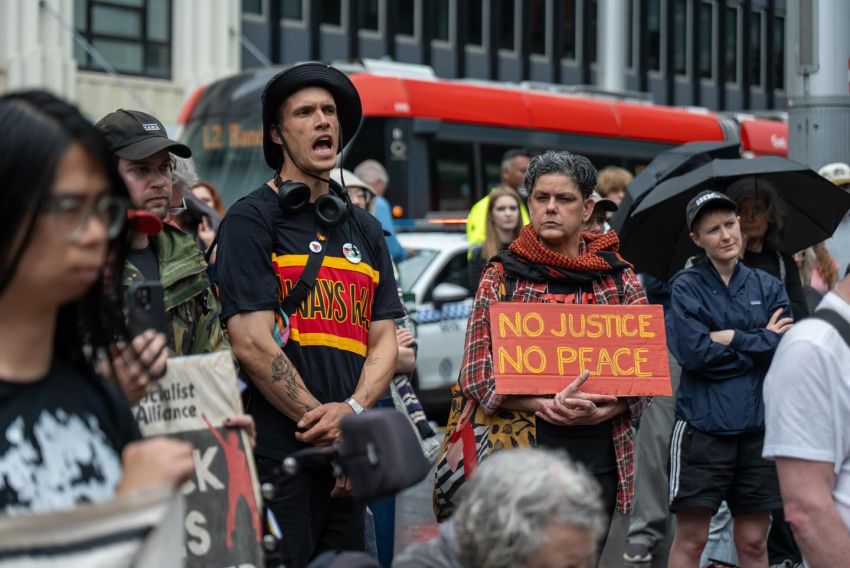
Dunghutti man Paul Silva delivered a powerful call for action last November 1 to end First Nations deaths in custody and police brutalisation at a rally at Sydney Town Hall.
He referenced NSW Coroner Teresa O’Sullivan who said, on October 14, it was “profoundly distressing” that there had already been 12 Aboriginal deaths in custody in NSW so far. Last year recorded the highest number of Indigenous deaths in custody since the Royal Commission into Aboriginal Deaths in Custody in 1991.
This damning statistic is a scathing indictment of law enforcement and the judicial system.
The ongoing and profound distress of family members and loved ones could be seen at the rally. Families gathered around large posters of their son, daughter, nephew, niece, uncle, aunt, brother, sister, mother or father and husband or wife killed by police or prison officers.
The trauma was palpable in their stories told by means of oratory, poetry and song.
Those seeking justice are largely confronted by silence, indifference, deflection, inaction and little or no recognition of their dignity as victims of state-sponsored violence.
Family members have informed me that inside the agencies of government lurks a bureaucratic cruelty that seems designed to crush people; opaque laws and regulations, government entities working at cross purposes, endless paperwork and doubt and suspicion at every turn.
Yet, in the face of this inertia, loved ones, human rights activists, lawyers, criminologists, researchers and others continue to fight for change.
The findings and recommendations of the Royal Commission into Aboriginal Deaths in Custody at the national level and the Select Committee of Inquiry on the High Level of First Nations People in Custody and Oversight and Review of Deaths in Custody in 2021 in NSW, sit on the shelf.
Caroline Andersen, mother of Wayne Fella Morrison who died in custody in Adelaide in 2016, informed me that moral leadership is needed to win change. Her submission to the NSW inquiry called for urgent systemic and structural changes to criminal justice in the state and across the country, based on the premise that collaborative ways forward are required.
Deaths in custody impact
Anyone, anywhere, at the wrong time in the wrong place could lose their life to police violence or misconduct. However, in addition to First Nations peoples, women in general, gay people, trans people, the homeless, marginalised and those suffering from mental anguish are most likely to be killed by police.
The first Sydney Gay and Lesbian Mardi Gras, in June 1978, was attacked by police in Kings Cross. Back then, I called out: “Stop police attacks on gays, women and Blacks!”
It says a lot about the state of NSW that, nearly 50 years later, this protest slogan still has salience. I mention this because understanding the ease with which violence was then meted out to gay, lesbian and trans people in the 1970s helps us understand the processes at work today.
In the 1970s and, up to the decriminalisation of homosexuality in NSW in 1984, gay people were treated as criminals and outlaws.
German American philosopher Hannah Arendt wrote about how it is always easier to inflict pain, humiliation and suffering on people who are not seen as deserving of a place in society.
Arendt knew this as an outsider and asylum seeker fleeing Nazi Germany. She theorised that stateless people and other oppressed groups experience a kind of radical exclusion; they have a way of falling outside the natural jurisdictions and protections of the law and are therefore not afforded the rights and dignities given to others. “Who has the right to rights?” she asked.
Taite Collins, a non-indigenous man whose partner Collin Burling died in police custody on July 15 last year, also spoke at the rally organised by Silva and Blak Caucus. Collins said after his lover’s death, mostly Aboriginal people in Waterloo reached out, acknowledging the shock of his loss and grief.
Burling did not die because of a mental health call to police. But it is worth looking at the numbers of those suffering mental anguish killed by police responding to 000 calls for help.
Mental Health Carers NSW and BEING sent an open letter to the NSW police minister stating that 52 people experiencing mental health crises were killed by police in the five years to last July. These individuals were shot, tasered or smothered.
Currently a new health-led model to respond to mental health emergencies is being discussed. Judy Deakin, whose son Jesse was shot dead by police in July 2023, has worked tirelessly to stop police being the first responders to people suffering a mental health episode, unless there is evidence of a serious threat to life.
Three deaths in custody cases
In 2020, George Floyd, aged 47, was killed on a street in Milwaukee, United States. His final words “I can’t breathe!” were heard around the world. They still echo today. The public interest in this death highlighted the brutality, bias and racism embedded in US police forces, and a powerful Black Lives Matter movement emerged.
After legal proceedings, the City of Milwaukee settled with Floyd’s family for US$27 million. Derek Chauvin, the police officer held responsible, was sentenced to 22 years in prison.
David Dungay jnr, aged 26, died in Long Bay Prison in 2015. He was uncle of Paul Silva. NSW custodial officers pinned him down until he could no longer breathe. Camera footage shown at the coronial inquest in July 2018 showed David yelling out: “I can’t breathe!”, “I can’t breathe!”
The coroner in 2019 found that none of the five guards who restrained Dungay should face any disciplinary action or be held accountable for his death. Instead, “limited systemic deficiencies in training”, was said to be responsible.
Burling, aged 46, died in front of a public housing tower in Waterloo, last year. At least six police officers pinned him down on the ground.
Unlike many cases of police violence where evidential facts were difficult to prove, in this case the last moments of Burling’s life were recorded by Collins. Burling can be heard saying “I can’t breathe”, before he appears motionless.
These three deaths in custody have much in common. While lethal force by police or prison officers is only justified in situations where lives are in danger, none of these victims posed a real threat. None had committed any serious criminal offence.
All three were relatively young and all died at the hands of male officers. At least one dominant male officer asserted their authority by inflicting pain. The three victims were members of marginalised minorities; all were clearly heard to cry out: “I can’t breathe!” All three deaths were preventable.
The only way to make sense of any death in custody is to understand that deeply structured violence is embedded in male-dominated coercive social hierarchies that discriminate against the marginalised.
The three deaths expose the links between bureaucratic cruelty, ignorance, disadvantage, neglect, discrimination and violence.
If we lived in a world where violence was less tolerated and normalised, there would be fewer deaths at the hands of the state. Conversely, impunity for state-sponsored violence ensures that deaths in custody will continue.
Dungay, Floyd and Burling all had a right to be safe and a right to live.
There needs to be a greater public outcry to demand those responsible for the deaths of Dungay and Burling (and many others) be held accountable. There must be transparent and independent investigations into every death involving police or corrective officers, and those found responsible must be held accountable in a court of law.
Only through such rigorous accountability can lessons be learned, reforms implemented and justice achieved.
[Mark Gillespie is a ’78er and a social anthropologist.]