
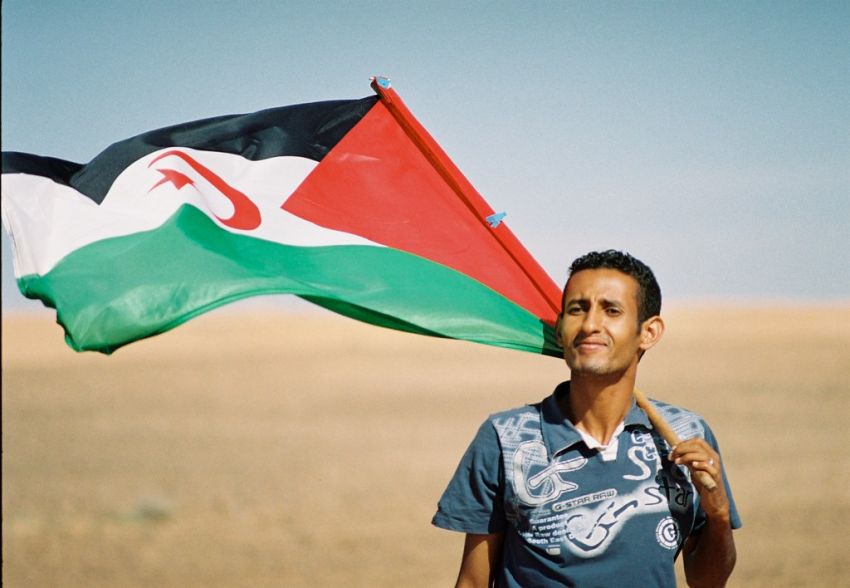
February 27 marks the national day for non-self-governing country, Western Sahara. Known as the last colony of Africa, it is the largest country on the United Nations’ decolonisation list waiting for a referendum of self-determination.
Australia-Western Sahara solidarity activist Ron Guy spoke with Ambassador Malainin Lakhal, deputy permanent representative of the Sahrawi Republic to Ethiopia and the African Union, for Green Left.
* * *
In regard to the European Union’s (EU) continued support in upholding Ukrainian sovereignty against the Russian invasion, how does this fit with the EU’s case of Morocco’s continued occupation of Western Sahara?
The contradiction is evident. The EU defends Ukraine’s sovereignty on the basis of the UN Charter, territorial integrity and the prohibition of the acquisition of territory by force, but it doesn’t defend the same rights in Western Sahara, and supports the Moroccan occupation, either directly or under the table.
If that is not hypocrisy and double standards, I wonder what it is. International law cannot be selective, nor geographically conditional, yet they don’t mind defending the devil in this case while pretending to be the angels in others. And to tell you the truth, this is one of the main reasons why no one seems to be taking [the EU] seriously in the Global South.
Western Sahara remains a Non-Self-Governing Territory, whose people are eligible of the right to self-determination, under international law. However, its people had decided since 1976 to establish their own sovereign and independent state, the Sahrawi Arab Democratic Republic, which is a full member state of the African Union and recognised by more than 84 countries worldwide.
Morocco invaded the territory militarily in 1975. The International Court of Justice, in its advisory opinion of October 16, 1975, clearly concluded that Morocco has no sovereignty over Western Sahara and that no legal ties existed that would negate the Sahrawi people’s right to self-determination. Since then, the UN General Assembly and Security Council have consistently reaffirmed the right of the Sahrawi people to decide their future.
If the EU upholds the rules-based international order in Ukraine, it cannot ignore those same rules in Western Sahara. Supporting international law in one context while undermining it in another erodes the credibility of the entire legal framework. The principle of non-recognition of illegal territorial acquisition must apply to Western Sahara as it applies to any illegally invaded or occupied territory.
Moreover, Europe’s tolerance of Morocco’s occupation is not neutral. Through trade agreements, fisheries partnerships, political support, media and diplomatic shielding, the EU has effectively normalised a colonial situation. That normalisation contradicts both European supposed values and binding international law.
If Europe truly wishes to defend sovereignty, self-determination and territorial integrity, then consistency is not optional, it is an obligation.
Despite recent wins by Western Sahara against the EU’s trade agreements with Morocco regarding Western Sahara’s natural resources, the EU is trying to find ways of circumnavigating international law to exploit these resources. Can you explain?
For decades, certain EU institutions and member states have entered into trade and fisheries agreements with Morocco that include products originating from Western Sahara. These agreements have generated billions of dollars in revenues derived from Sahrawi natural resources: Phosphates, fisheries, agricultural exports, renewable energies, sand etc., without the consent of the Sahrawi people.
The Polisario Front, as the internationally recognised representative of the Sahrawi people, challenged these agreements before the Court of Justice of the European Union. The court repeatedly ruled, most recently in 2024, that Western Sahara is distinct and separate from Morocco under international law, and that EU-Morocco agreements cannot lawfully apply to Western Sahara without the consent of its people.
This is not a political opinion; it is binding European jurisprudence.
Yet instead of fully complying, parts of the European Commission have attempted to reinterpret or bypass these rulings. This undermines the EU’s own legal order. No union can claim to be governed by law if it selectively implements court decisions when politically convenient.
Beyond legality, there is a moral dimension: economic agreements with the occupying power strengthen and finance the occupation. They entrench demographic engineering, subsidise settlement expansion and make the occupation economically profitable.
The EU could choose another path, one based on neutrality, legality and engagement with all regional actors, including the Sahrawi Republic, Algeria, Mauritania and civil society. Such an approach would promote stability rather than deepen division.
The African Union is in full support of Western Sahara. Do you see a time when Morocco will achieve their goal, now that the United States under Donald Trump and Israel under Benjamin Netanyahu have recognised Morocco’s annexation? How is the African Union responding to this interference?
No external power has sovereignty over Western Sahara to grant it to Morocco. Sovereignty resides exclusively with the Sahrawi people. Recognition by third states does not alter the legal status of the territory under international law and only complicates the situation while marking forever these states as warmongers and colonialist supporters no matter what their excuses are.
Western Sahara remains listed by the United Nations as a Non-Self-Governing Territory awaiting decolonisation. The right to self-determination is a jus cogens norm, an overriding principle of international law. It cannot be extinguished by bilateral deals or geopolitical transactions or political preferences.
As for the African Union’s position, it was and remains unequivocal. The Sahrawi Arab Democratic Republic is a full founding member of the African Union. The union recognises it as the legitimate and sovereign government of Western Sahara and at the same time considers Morocco’s presence in parts of the Sahrawi territory as an illegal occupation.
Morocco sits in the same organisation as an equal member alongside the Sahrawi Republic. That fact alone invalidates the narrative of “annexation” and ridicules any Moroccan claims. In fact, many don’t know that the Sahrawi Republic is the Diplomatic Dean of the Northern region’s countries, and presides over regional meetings in which Morocco takes part, just so you see the degree of incoherence of the Moroccans in the African Union.
At the last African Union summit, African leaders adopted resolutions declaring slavery and colonialism crimes against humanity and genocide, and they dedicated 2025 as a year to reparatory justice. These positions directly reinforce the Sahrawi struggle as one of Africa’s unfinished decolonisation processes.
Nonetheless, and while Africa still faces structural limitations in global power politics, the continental consensus on Western Sahara is still there. Morocco may gain temporary diplomatic endorsements thanks to its well-known chequebook diplomacy, corruption and blackmailing, but it cannot erase the core foundation of international law, nor the will of the Sahrawi people.
History shows that colonial situations may persist for years, but they do not become legitimate through endurance.
The use of drones by Morocco has taken many innocent lives, including Saharawi shepherds, Mauritanian and Algerian citizens. Is the African Union taking measures to record such human rights violations, to hold account such individuals and state players?
The use of armed drones by Morocco in Western Sahara represents a serious escalation and raises grave concerns under international humanitarian law. Reports indicate that drone strikes have targeted not only combatants but mostly civilians, including Sahrawi nomads, Mauritanian and Algerian traders, and others traveling in areas near or beyond the Moroccan military wall. Such actions may constitute extrajudicial killings and violations of the laws of armed conflict, particularly the principles of distinction and proportionality.
Western Sahara is a territory recognised by the UN as awaiting decolonisation. The situation is not an internal Moroccan matter; it is an international conflict between an occupying power and a people seeking self-determination. Under the Geneva Conventions, civilians in occupied territories are normally protected persons under the fourth Geneva Convention. Targeted killings without due process and without clear military necessity violate international law.
Unfortunately, impunity is indeed a growing problem worldwide. But documentation matters. Evidence preserved today forms the basis of future legal action, whether before international courts, regional human rights bodies or domestic jurisdictions applying universal jurisdiction.
Morocco’s increasing reliance on drones, militarisation and the use of force does not demonstrate sovereignty or legitimacy; it reveals insecurity and the absence of a political solution. True sovereignty is grounded in the freely expressed will of a people, not in walls, surveillance systems, oppression or advanced weaponry.
No military barrier, no drone technology and no strategy of intimidation can permanently extinguish a people’s right to self-determination. History has repeatedly shown that when a people are determined to claim their legitimate rights, coercion can only postpone, not prevent, justice.
The Sahrawi people have consistently demonstrated resilience, patience and steadfast commitment to their cause. For decades, despite displacement, occupation and repression, they have neither surrendered nor abandoned their demand for a free and fair referendum. Their perseverance is not a temporary reaction; it is a sustained national conviction that their future cannot be decided by force.