
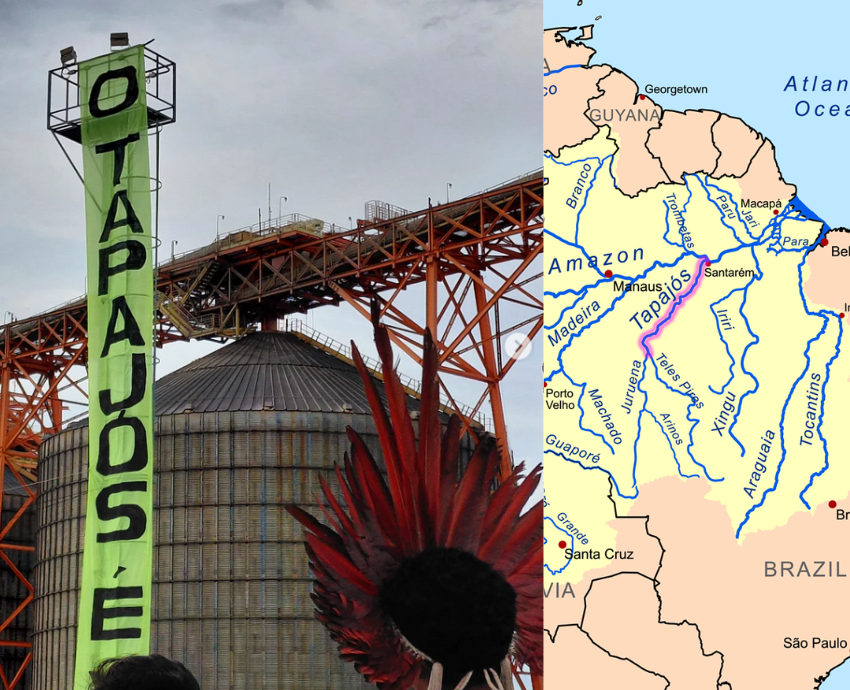
The Brazilian government has been forced to revoke Decree 12600, following more than a month of protests by local indigenous communities in the city of Santarém, Pará — a state in northern Brazil covering a large portion of the lower Amazon.
The Luiz Lula da Silva government’s Decree 12600, published on August 29 last year, opened up vast stretches of the Madeira, Tocantins and Tapajós rivers as part of its National Privatisation Program, to mostly benefit agribusiness and mining. The decree’s promotion of dredging, destruction of riverbanks and rock formations and circulation of large vessels would have impacted water quality, climate change and biodiversity, as well as supported the expansion of mining and agribusiness operations.
The activities implemented as part of the decree would have impacted communities’ livelihoods by affecting fishing, noise levels, pollution and local transport. Dredging was also planned to take place in areas containing important funerary and archaeological sites.
The government and agribusiness companies did not consult people from the 14 indigenous territories and hundreds of riverine communities on the proposal, despite free, prior and informed consent being required under the constitution.
The Madeira and Tapajós rivers are major tributaries of the Amazon River, sustaining thousands of communities and ecological systems of global importance.
Agribusiness companies use the waterways to transport monoculture crops, such as corn and soybeans, from deeper in the Amazon to the coast for processing and export. Just a handful of multinational corporations control most of Brazil’s agribusiness sector.
Cargill — a United States-based multinational that has cornered much of the global food market, particularly in corn and soybean — was set to be a major beneficiary of Decree 12600 due to cheaper, more frequent transport from its upstream ports.
The US’s biggest privately owned company is responsible for a long list of crimes in Brazil and globally, including land grabbing, child labour and trafficking, tax evasion and price fixing.
Cargill actively drives and profits from large-scale deforestation, climate change, environmental destruction and community displacement. Corporate financiers — such as BNP Paribas, Barclays and Santander — are complicit in this, having provided billions of dollars in loans and financial services to Cargill.
In recognition of the multinational’s role in the region, thousands of indigenous people from the Lower Tapajós began blocking access to Cargill’s grain port in Santarém — at the mouth of the Tapajós River — on January 22, calling for the scrapping of Decree 12600.
Communities from Lower Tapajós — along with other indigenous peoples — were part of the temporary occupation of the “blue zone” at last year’s COP30 conference, in protest at being ignored during climate negotiations.
About 7000 indigenous people from 14 different ethnic groups blocked the only access road to Santarém’s airport and temporarily occupied the terminal, on February 4, which forced the government to suspend plans to dredge the Tapajós River. The 250-kilometre-long infrastructure project would have dredged the river to make it navigable year-round for big agricultural barges.
Since the government had only abandoned its dredging plans — not the decree in its entirety — hundreds of protesters symbolically occupied one of Cargill’s anchored vessels on February 19, unfurling banners that read “Our river is not for sale” and “Revoke the decree of death”.
Protesters ramped up the pressure by occupying Cargill’s port terminal in Santarém on February 21.
Protesters rallied at Cargill’s offices in São Paulo on February 22, in solidarity with the occupation in Santarém and calling for the scrapping of Decree 12600.
Following more than a month of sustained protests and occupations, the federal government announced on February 23 that it will revoke Decree 12600. Local communities celebrated following the announcement, which represents a significant victory against social and environmental destruction.