
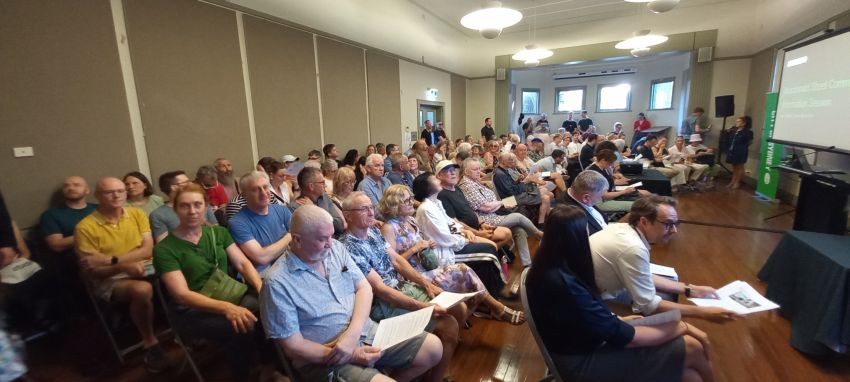
A packed meeting in Erskineville Town Hall on February 24 rejected the City of Sydney’s plans for a new road that would create a significant rat run through the inner-city suburb.
The City of Sydney and property developer Coronation argue the proposed new road is necessary to accommodate thousands of new residents in a growing subdivision known as Ashmore Estate.
Resident action group Friends of Erskineville (FoE) argues that the extension of MacDonald Street is unnecessary, as there is already car access to all existing and planned apartments. It says the main impact of the new road would be to increase the volume of through traffic.
The idea that increasing road capacity reduces congestion runs counter to decades of empirical evidence. Instead, it induces traffic volume to grow, a principle known as the iron law of traffic.
Conversely, reducing road capacity tends to reduce car trips. After George Street in the CBD was closed for light rail, overall traffic volume in the CBD fell by 8%.
Many Erskineville residents were reminded of this when they recently celebrated the 40-year anniversary of the local “road wars”, when residents blockaded streets to retain temporary road closures the then NSW Labor government had wanted to remove.
The road closures had been installed to limit through traffic that had caused many serious injuries and even deaths of pedestrians. Then, independent City of Sydney councillors, including Clover Moore and Jack Mundey, supported the residents. The residents won and the road closures became permanent. The result was walkable streets, leafy small parks and a reduction in injuries.
Today, 73% of children at Erskineville Public School walk or ride to school — a very high figure for cities.
A petition against the new road was launched at the 40-year anniversary event on November 26 last year and quickly reached nearly 1000 signatures.
With the support of Greens councillors Sylvie Ellsmore and Matthew Thompson, a motion was passed at City of Sydney on December 15, which included a reference to a future meeting with FoE and affected residents.
However, mayor Moore and deputy lord mayor Jess Miller have publicly expressed doubts about FoE’s campaign materials, referring to them as “misinformation”, even though FoE had fact-checked its claims, including with transport researcher Chris Standen from the University of NSW.
Despite the City of Sydney’s motion, FoE was not invited to the information session meeting on February 24, where the community was told to only ask questions. In response, FoE compiled a list of suggested questions for residents to ask regarding safety and inadequate traffic modelling. More than 140 people attended that packed meeting where Moore outlined her achievements in urban planning and the traffic engineers gave their justification for building a new road into a traffic-calmed area.
When residents were allowed to speak, the criticisms started to flow, including the neglect shown to the impacts of traffic outside a very limited zone. Many talked up the value of the walkable and bike-able neighbourhood and said the narrow streets would not cope with the influx of extra through traffic caused by opening up a local street to a direct path from the WestConnex motorway off-ramp.
Many expressed support for Moore’s advocacy of wider footpaths and bike lanes, but said the new road proposal was a departure from that legacy.
At the end of the meeting, a motion by FoE from the floor called on the City of Sydney to pause the new road and design a solution, with the community, for the public space that aligns with the City’s Sustainable Sydney 2050 Vision. It passed overwhelmingly.
Moore agreed to more public meetings and for council to come up with a solution that was “predominantly for people and not for cars”.
Moore knows that active transport and sustainable cities advocates disagree with the planned road. She would also know that some council staff are opposed.
Globally, the momentum is for cities to shift from car dependency towards safe, cheap, efficient and environmentally sound ways of moving around. Recent changes in London, Paris and New York show that with political will, it can be done. With an activated and well-organised community, Gadigal Country can join those ranks.
[Andrew Chuter is the president of Friends of Erskineville.]