
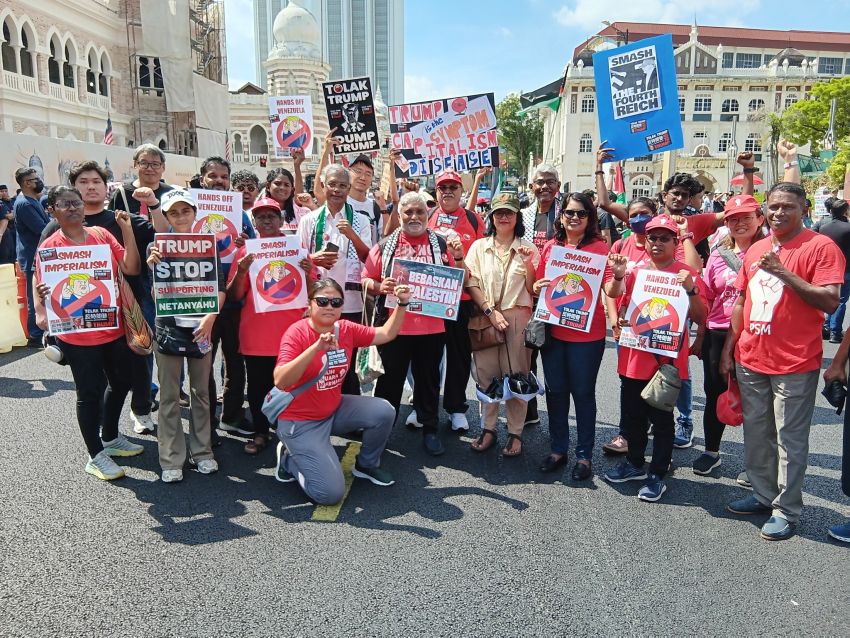
The Socialism 2025 Conference, held in Malaysia’s capital Kuala Lumpur on November 15–16, brought together about 200 socialists and activists from across the Asia-Pacific. The Parti Sosialis Malaysia (Malaysian Socialist Party, PSM) has hosted the event annually since 2005, and it has become one of the largest gatherings of socialists and progressives in the region.
Malaysia is one of the few locations in the region (compared with Singapore, Indonesia and Thailand) where socialists can meet openly to share experiences and build the connections necessary for collective struggle.
Socialism 2025 was opened by PSM chairperson Dr Jeyakumar Devaraj, who stressed the need for socialists in the region to work towards economic independence and greater solidarity in the face of multiple crises.
A common thread running through the conference was the impacts of colonialism, capitalism and imperialism, and the ongoing struggle to build socialist alternatives. Speakers shared insight into what socialists and progressive groups are doing on the ground, and the challenges and contradictions they face.
While hosting the conference, PSM activists led a housing rights and anti-eviction campaign following the demolition of homes in Kampung Papan, leading to some of them being arrested. Grassroots and local campaigning, such as for housing rights, are an important element of the PSM’s work, alongside national campaigns and building international solidarity.
Sri Lanka
Sri Lankan socialist Janaka Adikari, Central Committee member of the People's Liberation Front (Janatha Vimukthi Peramuna, JVP), the leading party of the Sri Lankan National People’s Power (NPP) coalition, gave the keynote speech, which was attended by the Venezuelan and Cuban ambassadors. Adikari discussed the JVP’s attempts to implement democratic and progressive policies since the NPP won government last year.
Adikari described the JVP as a Marxist-Leninist party that is “trying to build socialism from the ground up” in a society wracked by decades of ethno-nationalist policies, corruption, authoritarianism and neoliberalism. Building a mass base among the people, he said, was key to any achievements made so far.
Adikari said the JVP has had some success in implementing reforms such as raising wages and pensions, implementing student scholarships, organising workers living abroad and tackling corruption. However, he noted that the party has “political, but not state power” and the government still faces challenges because it inherited a dysfunctional capitalist system and massive International Monetary Fund debt.
In response to a question from the floor suggesting the JVP had not done enough in support of Tamils, Adikari said the JVP has many Tamil members, and promotes an anti-racism line in support of Tamils, but does not support Tamil separatism.
Thailand
Thai delegates from the Assembly of the Poor and the Miners and Farmers Federations emphasised the devastation that neoliberal policies and global value chains — in which profits flow to the Global North — have on the lives of peasants, farmers, miners and the environment.
The groups stressed that ecosocialist solutions and degrowth are essential, saying that climate justice and land reform must come from peasants, farmers and oppressed peoples, and that indigenous peoples need to be at the centre of the struggle.
Lapapan Supamanta, from the Assembly of the Poor and La Via Campesina, told the conference that “endless capitalist growth” had displaced peasants from their land to maximise profits through the implementation of industrial-scale agriculture and “cash crops”. Supamanta’s organisation is fighting back by asserting food sovereignty, implementing agroecology (a sustainable ecological and social practice of agriculture) and pushing for workers’ and peasants’ rights.
Key to this is the liberation of peasants — broadly defined by Supamanta as oppressed people working the land. Her group is involved in an 80-house-strong agroecology commune near the border with Cambodia, incorporating emerging agricultural and political organisations.
Lek, from Socialist Worker Thailand (SWT), spoke about the struggle to organise under a military dictatorship and economic crisis. They said workers face exploitation by Eastern and Western countries alike, as well as by their own ruling class, pointing out that while the economy is in shambles, the king is the richest monarch in the world.
Despite challenges, and its small size, the SWT maintains Marxist education, regular meetings and Palestine solidarity actions.
Indonesia
Delegates from the Peoples Liberation Party, Organisasi Kaum Muda Sosialis (Socialist Youth Organisation) and Perempuan Mahardika (Free Women, PM), emphasised the rapidly declining democracy and widespread frustration amongst workers in Indonesia.
PM representative Mutiara Ika Pratiwi said massive job cuts and a lack of quality, safe and viable jobs had catalysed the uprising in August–September last year.
Pratiwi said PM is fighting for democracy and job security through feminist struggle within workplaces, explaining that violence against women in the workplace and the home is widespread. The right to dignified, decent work in a safe workplace free from gendered violence is a key demand, and groups such as the Indonesian Women’s Alliance are organising women workers and students against workplace and domestic violence.
A special evening session of the conference brought together speakers from Indonesia, the Philippines and Thailand to discuss the recent popular youth-led uprisings. All agreed that strong leadership from the socialist left was lacking — but for different and complex reasons in each country.
The speakers spoke candidly about problems the socialist left faced during the uprisings, such as the contradiction between the spontaneity of the uprisings versus the need to protect activists from the worst forms of state violence.
Anti-imperialism and Palestine
A special session was dedicated to Palestine, discussing international solidarity and Western complicity in Israel’s genocide. Kamal Aarif, from the anti-imperialist youth group Gegar Amerika (part of PSM), spoke, as well as Baha Hilo from BDS Malaysia, and myself from Socialist Alliance.
Continuing the discussion on imperialism were sessions on counter-hegemony and anti-imperialist struggles. The ongoing struggle for West Papuan independence was represented by Victor Yeimo from the National Committee for West Papua.
Harleen Kaur, from the International People’s Assembly in India, spoke about the unfinished agenda of the 1955 Bandung Conference, which founded the Non-Aligned Movement, and called for a “peoples’ BRICS”, led by mass movements rather than dominated by capitalist interests. This line of thought was continued by Mikaela Erskog (from Tricontinental, South Africa) who pointed out the contradictions among BRICS members, such as India’s support for Israel, and the fact that while BRICS claims to be anti-hegemonic, it is not anti-capitalist.
The PSM’s Sivarajan Arumugam discussed the legacies and challenges of the Bandung Conference, arguing that while Bandung was imperfect, it provided alternative models to imperialist hegemony and sowed the “seeds for global socialism”.
The rise of the far right
The far right is also on the rise in the region, taking advantage of ethnic and religious tensions and the failure of economic liberalism to improve living standards across the Asia Pacific.
Dr Herbert Docena, from Partido Sosyalista, used an anti-eviction campaign on Sicogon — a small island in the Philippines — as a case study to demonstrate how communities can switch support to the far right when their basic needs are not being met.
Peasant communities on Sicogon refused to be evicted by the large conglomerate Ayala Corporation, in a land grab following a devastating typhoon. After being pressured by representatives of former president Benigno Aquino III’s liberal party to give their land over to Ayala, feeling betrayed, the majority voted for Rodrigo Duterte.
Jacob Andrewartha, from Socialist Alliance, pointed to how policies implemented by so-called social democratic parties in Australia and elsewhere, such as anti-refugee and anti-union policies, paved the way for the rise of the far right.
The PSM’s Gandipan Natha Gopalan explained how the far right in Malaysia is mobilising the working class within traditionally liberal institutions, such as community, family and sporting groups. Far-right figures have also coopted images from the working class and marhaen (marginalised and oppressed) to gain support, and have been successful in building grassroots-style networks. The right has also co-opted Malaysia’s pro-Palestine movement, he said.
Gopalan asked what it would take for socialists to have an equivalent level of community-based organisational structures to the far right.
Socialists from Global South countries represented at Socialism 2025 are trying to build socialism while bearing the brunt of climate change and imperialism. Those of us in Global North countries like so-called Australia are more or less in the “belly of the beast”. Socialists in Australia must double efforts to build support for anti-imperialist and anti-colonial struggles, campaigns for climate justice and for an end to the Australian-US-British military alliance, AUKUS, while strengthening people-to-people solidarity and collaboration in the region.