
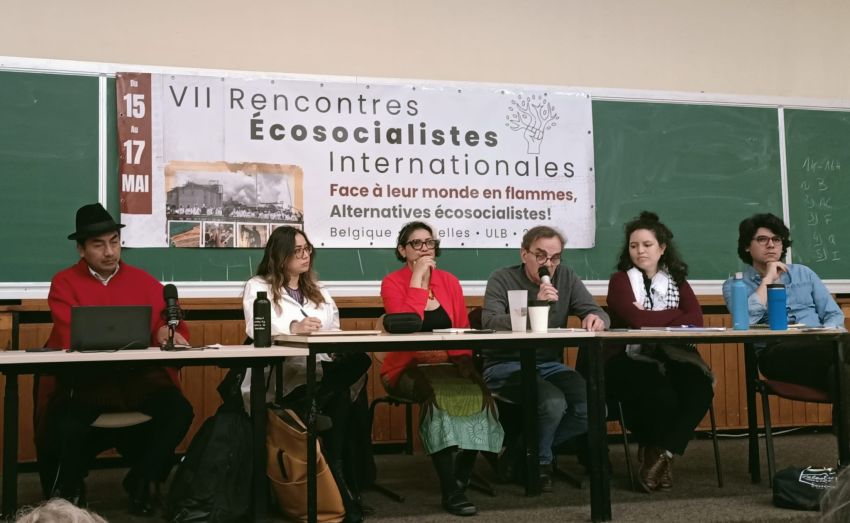
The Seventh International Ecosocialist Gathering, held at the Free University of Brussels from May 15–17, took place as humankind is menaced by the apocalyptic combination of environmental breakdown, genocidal wars of conquest, pandemics and intensifying social collapse.
In addition, the European Union’s Green Deal, puffed up by its authors as the global leading effort to reverse the overarching and accelerating global climate emergency, is being diluted by those in power in Berlin, Paris and Brussels.
The years of mobilisation led by Fridays for Future after 2018, and to which public opinion was told the Green Deal was a serious response, soon gave way to other priorities: recovery from the COVID-19-generated economic collapse and the long-cherished scheme for European rearmament, for which Russia’s invasion of Ukraine provided a perfect justification.
The far right also continued to grow, because the Green Deal, implemented largely by the corporations, had very little to say to working people, especially the poorest.
The Ecosocialist Gathering, attended by hundreds of activists from Europe and elsewhere, was a serious effort at confronting this dark scenario. It featured discussions on what an ecosocialist transition should look like and the paths to follow across different fields: trade unionism, education, land defence, geopolitics, artificial intelligence, extractivism, debt cancellation, ecosocialist planning, eco-fascism and more.
Three broad themes that kept surfacing throughout the conference included: organised labour’s task in ecosocialist transformation; organising against extractivism, agribusiness and debt slavery (especially in the Third World); and specifying the programmatic and strategic prerequisites for advance.
Trade unionism and ecosocialism
Invaluable contributions came from ecosocialist trade unionists trying to convince fellow workers of the need for the rapid closure or conversion of polluting industries.
The power of positive example came through in the presentations of two Basque Country trade unionists, Ainhara Plazaola, environment officer for the Basque Workers Solidarity (ELA) trade union confederation, and Iratxe Delgado, from the Social Action department of the abertzale (patriotic) trade union confederation Basque Workers Committees (LAB).
Plazaola explained how her confederation had advanced over the past decade in its understanding of ecosocialist transition, now codified in the 2026 Ecosocialist Manifesto of the Basque Country, which LAB and ELA endorse.
In response to a question as to how the confederations counter fearmongering about job losses, both speakers stressed the importance of ongoing conversations with workers — job site by job site — as to the reality of the environmental crisis, combined with demands on the regional Basque government to properly fund the transition.
In the case of ELA, essential elements of a just transition are now included in the collective bargaining demands the union and its workplace delegates make on companies and the government.
Companies have to supply data from the past five years on their greenhouse gas emissions, waste management and energy and water use. Using this data, ELA demands plans to improve emissions, energy and water use and for collective mobility plans at company, industrial estate or regional level — to be funded by the companies themselves or by government.
When a polluting company closes or scales back, ELA demands that it shift its production model to sustainability and/or that its workers be redeployed to other companies. If neither option is possible, the government must guarantee a decent income and retraining for the workers affected.
For Palzaola, these demands are transitional: “We need a radical change of the system, a change that is going to happen anyway, because capitalism has brought us to the planet’s limit. The question is, what kind of change it will be and who it will benefit: the working class or capital?”
The gathering heard other examples of trade union engagement with ecosocialist transitions from the oil industry in Nigeria and Colombia and steel and automotive sectors in Italy, with discussion centring on the need for public control and investment.
Rearmament, remilitarisation and Ukraine
Like the left as a whole, the ecosocialist current has been divided over what stance to take towards the Russian invasion of Ukraine and European rearmament.
The gathering gave space to both aspects of the conflict, with sessions devoted to Ukraine’s resistance in the context of rising inter-imperialist rivalry and to the fact that entire industrial sectors are now being converted towards arms production, a vast reallocation of resources that could be devoted to the ecological transition and social services.
After hearing from two Ukrainian ecosocialists, trade unionist Artem Tidva, of the Ukrainian left organisation Social Movement, and Vitaliia Kilinkarova, degrowth expert and fellow Social Movement member, the conference audience would have been in no doubt as to the scale of death, destruction, displacement of people and environmental havoc that Putin’s war has wreaked on their country.
The parallels between this criminal operation and Israel’s genocidal occupations of Gaza and southern Lebanon were lucidly drawn out by Joseph Daher, Syrian academic and internationalist activist.
In the workshop on remilitarisation, Ansje Vanbeselaere, of the Belgian anti-imperialist solidarity movement Intal, Elsa Collonges, an activist in the French General Confederation of Labour, and Tayeb Khouira, national secretary of France’s most radical union confederation Solidaires, explored labour conflicts in countries where workers are refusing to manufacture for war, such as Italy.
Irrespective of differences over the Ukraine conflict, all three speakers supported, in the face of rearmament, the demand for conversion towards socially useful production and the nationalisation of arms production.
Partial victories that prepare others
The gathering was also the occasion for celebration of an important victory, necessary in the face of so much disaster. In the plenary “Ecosocialism as a brake on capitalist catastrophe”, Mariana Riscali, National Executive member of Brazil’s Party of Socialism and Freedom, told the inspiring story of the largely indigenous protest movement’s success in forcing the Luiz Inácio Lula da Silva government to reverse its privatisation of three Amazonian rivers: the Madeira, Tocantins and Tapajós.
Activists occupied the riverside terminals of US multinational Cargill in the state of Pará for 33 days and coordinated a boat protest that surrounded one of Cargill’s soybean cargo rafts, and which was supported by an occupation of Cargill’s headquarters in São Paulo. Trade unions also expressed their support for the protests.
A protest had previously taken place during COP30 in November, where it was announced that the indigenous peoples affected would be part of a consultation process, but nothing of the sort took place until the protests forced the Lula government to retreat.
In a similar vein, the workshop on “Building alliances against green colonialism and extractivism” took up the issue of the “ecological” projects imposed on the countries of the Global South by the corporations of the Global North.
Felipe Gutiérrez Ríos (Petroleum Observatory South), Pedro Ramiro (Observatory of Multinationals in Latin America) and Marjorie Keters (French Eco-Syndicalist Network) spelled out how critical mineral mining, agrofuel monocultures and renewable energy projects imposed without community consent regenerate the dispossession, pollution and repression of trade union rights associated with “old” colonialism.
Keters explained how her network tries to mobilise public opinion against “green” colonialism through encouraging exploited workers to describe their plight in open letters: “The publication of open letters brings together workers in the same sector, service users and local residents. For example, it was through an open letter published in several media outlets that [French multinational] Veolia workers alerted service users and environmental campaigners to their fight for decent working conditions, as well as for a healthy environment. Employees also act as environmental watchdogs.”
Highlights
Two sessions in the gathering stood out: the presentations by Simon Hannah (Anti-Capitalist Resistance, Britain) and Martin Lallan (Anticapitalistas, Spanish state) on “the return of economic planning” after its degeneration within the former Soviet bloc, and the discussion on ecosocialism and degrowth.
This exchange between Daniel Tanuro (the guiding force behind the Fourth International’s Manifesto for an Ecosocialist Revolution) and Hugo Abad Frías (Research and Degrowth International) saw both sides of an often-fraught debate trying to find common ground in the name of building a more politically compelling alternative to the ecologically catastrophic status quo.
A final highlight was the session in honour of the contribution of ecosocialist author and activist Michael Löwy, without whose lifelong contribution the ecosocialist cause would lag far behind where this gathering showed what it has achieved to date.
[Dick Nichols attended the Seventh International Ecosocialist Gathering for the Australian Socialist Alliance.]