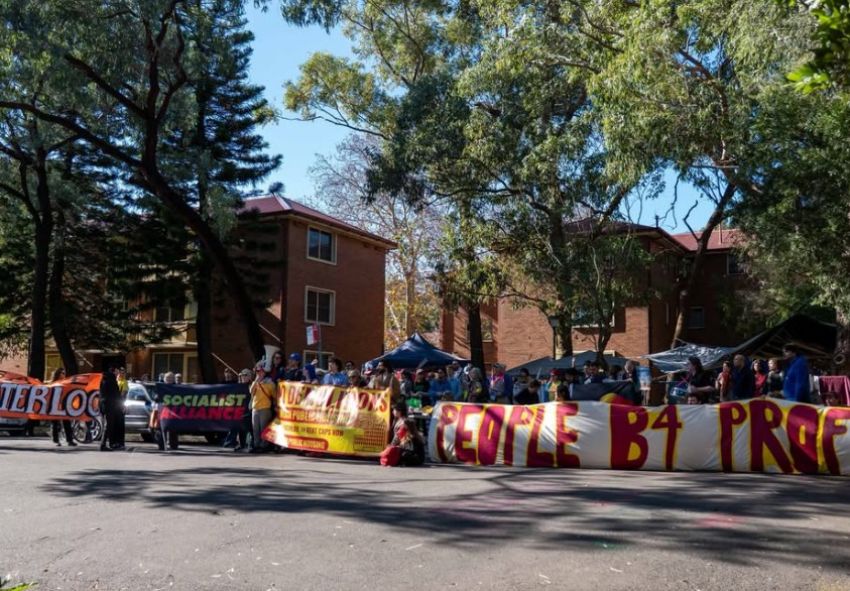
The push to stop the first of three demolition stages for the Waterloo estate continues and support for the encampment at the Waterloo south site is growing.
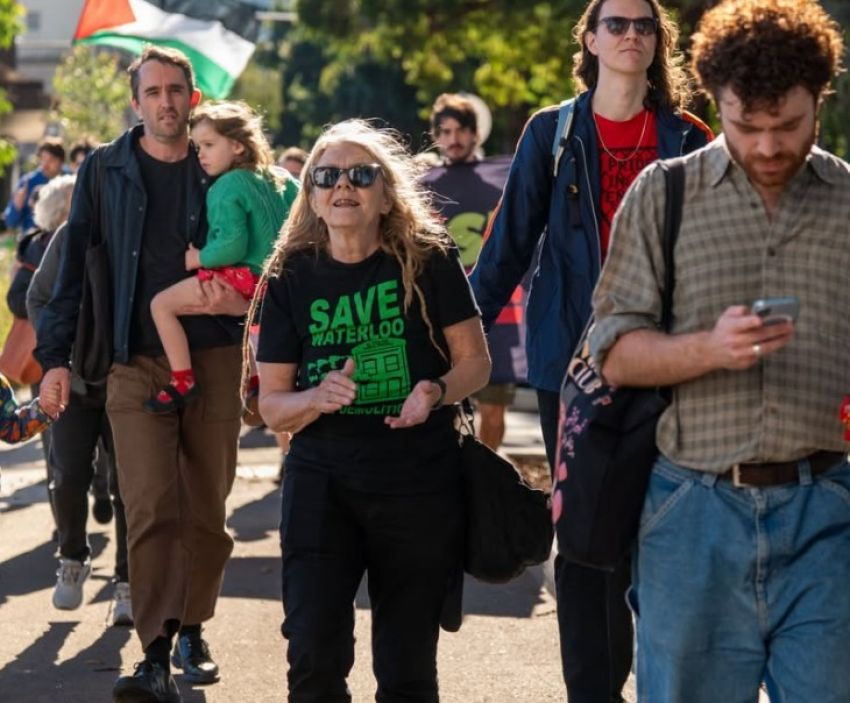
A speak-out at TJ Hickey Park on May 31, followed by a march through the affected housing blocks, drew a range of people to hear from residents and supporters about why Labor’s plan to demolish good public units was really a thinly disguised gift to its developer mates.
The Waterloo south area slated for demolition is the biggest area of the three stages: it makes up about 65% of the Waterloo Estate. The buildings are slated for demolition across a six-to-nine-month period.
Karyn Brown, a resident at Waterloo and an activist in Action for Public Housing, skewered Labor’s proposition that it was delivering “positive outcomes” for tenants.
“To justify this demolition and displacement of 750 people to heaven knows where — because there really aren’t many vacant properties in the area — Labor has been slandering [the residents],” Brown said.
“Ten years ago, [former Liberal MLC] Brad Hazzard said we’re ‘generation after generation of dole bludgers’. [Former Liberal MLC] Pru Goward said we’re ‘drug dealers and drug addicts’ and this week [minister for local government] Ron Hoenig yet again said that there’s a drug dealer on every floor.
“Well, that’s not true. What is true is that there are drug dealers in every suburb.
“[NSW housing minister] Rose Jackson said that the Waterloo community is ‘not functional’. I disagree with that. But even if it was a non-functioning community, you don’t make it ‘functioning’ by chopping it up and scattering it to the winds.
“You look at what is needed to make it function and give it to the residents.”
The campaign to save the Waterloo public housing estate is not new. Hazzard told more than 2000 residents in 2015 that the Coalition government wanted to turn the 19-hectare estate into one of Australia’s largest “urban renewal projects”.
Five years later in 2020, most residents still did not know where they would be forced to move, or when. That anxiety has remained with residents.
Hazzard wanted to triple the density at the estate, with more than 6000 high-rise dwellings to replace about 2000 homes spread across the Matavai and Turanga high-rise towers, several large apartment blocks, small blocks of flats and single-storey houses. About 30% of the new development would be social housing, and the remaining 70% privately owned.
Then housing minister Melinda Pavey talked up “new and better fit-for-purpose housing” and creating a “world-class precinct” around the new Metro station, which opened in 2024.
In words that Jackson has since echoed, Pavey said: “By deconcentrating disadvantage, we can breathe new life into local economies to re-energise social housing to create vibrant communities, not just buildings.”
Fast forward and NSW Labor says the first stage of the Waterloo renewal project, with the Stockland consortium, will deliver more than 1000 new social homes, 600 affordable homes and about 1500 private homes.
It claims that the homes slated for demolition are “nearing the end of their intended lifespan of 40–70 years” and are “expensive to maintain”. It also said they did not meet “contemporary accessibility and sustainability standards” and were “not meeting many tenants’ specific needs”.
Brown said some homes had been renovated, including with ramps out the front. “Don’t let them tell you that they have to knock them down to make things accessible.”

Homes NSW says it is collaborating with the local Aboriginal community.
However, Aunty Joan Bell, who has had a long association with Waterloo, said at the rally that the estate should not be demolished. “We live here. This is our place. We don’t want to move. We want to stay where we are,” she said.
She refuted the government’s claim that Waterloo attracted “a lot of bad people”. “The kids here respect me … I walk around here at 12 o’clock and the kids all ask me how I’m going. These are the kids that people say are ‘bad kids’.”
Brown said the government was promising that “all the problems will be magically solved — after the redevelopment”. In her experience, developers and housing providers are not that generous, she said, but added: “If things to make our lives better are available, we should have them right now, not after we get kicked out.”
Brown responded to Jackson and Hoenig’s argument that “mixed development” on the site would lead to “functioning communities”.
“We don’t need wealthy neighbors to inspire us. We already have a mixed development on the estate … with private housing on the other side of that building and to the south. We also have Green Square, which, thanks to the Metro, means people walk through and inspire us every day.”
Brown said there are 120 private residences and businesses in the middle of the estate, including people in the caring professions. “They can still afford to live here, near where they work, but if Labor puts these million dollar-priced apartments here, all the other rents will go up too, and these workers will not be able to afford to live here.”
Brown said public housing must be increased “wherever there is vacant land”, but it must be built by the government “because we don’t need profit-making off essential developments”.
[To find out more and join the Waterloo protest, visit Action for Public Housing.]