
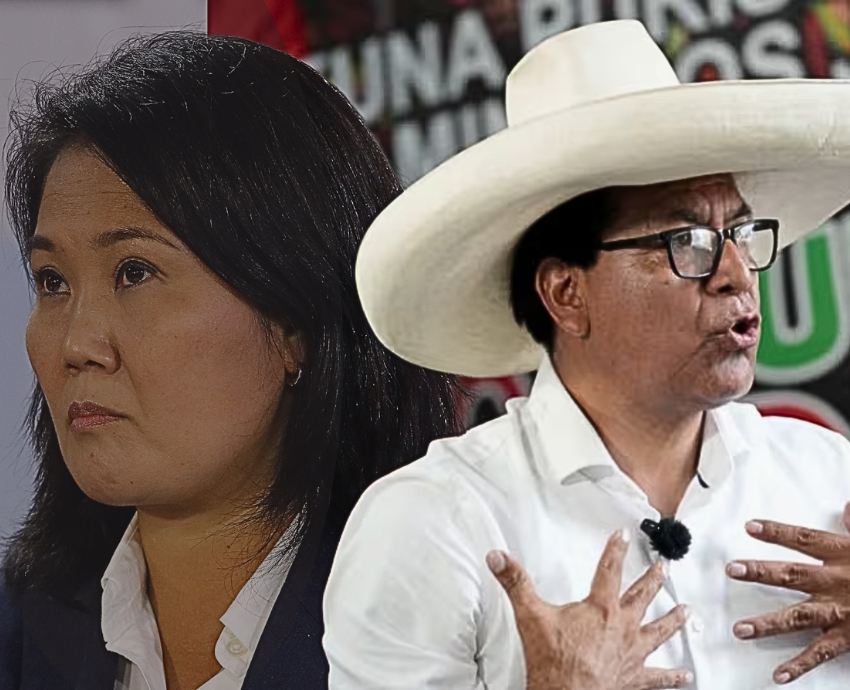
Following Peru’s June 7 presidential run-off election, it appears likely that far-right candidate Keiko Fujimori will become the country’s ninth president in 10 years. While no official result has been declared at the time of writing, Fujimori leads centre-left candidate Roberto Sánchez by just 40,000 votes — a margin of 0.2% — with 99.38% of ballots counted.
Sánchez garnered support from the country’s highlands and poorer southern regions, which have historically been marginalised by Lima-centred governments. He was endorsed by former President Pedro Castillo and campaigned on a similar platform to Castillo’s 2021 election program.
Sánchez served as the foreign trade and tourism minister under Castillo and presented himself as a reformist alternative to the distrusted political establishment. He campaigned for the creation of a constituent assembly to draft a new constitution.
The current constitution was imposed by Fujimori’s father, Alberto, in 1993, following his notorious autogolpe (“self-coup”), where he suspended the constitution and unleashed the military on the streets.
Sánchez initially proposed nationalising the country’s strategic resources — such as copper — which he said “belong to the people”. However, after narrowly defeating far-right candidate Rafael López Aliaga to progress to the run-off, he moderated his platform.
Rather than nationalisation, Sánchez proposed reviewing existing mining contracts, introducing windfall taxes on extraordinary corporate profits and a wealth tax. He appointed former economy minister Pedro Francke as a top advisor last month. Francke, who served under Castillo, said a Sánchez government would promote private investment while implementing redistributive polices and raising public spending.
Fujimori campaigned on a familiar “law and order” platform centred around maintaining the neoliberal status quo, which has dominated for decades and been largely responsible for the country’s many crises.
Alberto Fujimori imposed a United States-sponsored neoliberal “shock therapy” in the 1990s, privatising public enterprises, eliminating state subsidies, further deregulating the economy and attacking labour laws.
The legacy of Alberto Fujimori’s policies, which have continued under successive governments, is a deeply unequal country with widespread poverty. The top 1% control almost half (44.7%) of the country’s wealth, while the bottom 50% control almost nothing (0.1%). While the average poverty rate is already a staggering 27.5%, this rises to more than 40% in the poorest inland regions.
The vast majority (70%) of workers are in the informal sector, without rights, social security and pension payments. However, this rises to almost 95% in rural areas.
Fujimorismo
Fujimori continues to champion Fujimorismo as leader of the far-right Popular Force party, which dominates Congress and has captured most of the state’s institutions.
From this position, she can approve laws that benefit herself, Fujimoristas and the rest of the economic elite. Fujimori has slowed down and undermined investigations into her role in accepting bribes and using illicit money to fund her election campaigns.
Fujimori is firmly against changing the country’s highly restrictive abortion laws, which criminalise the right to abortion, even in cases of rape.
A Fujimori presidency would represent a deepening of the neoliberal extractivist model, in which mostly large transnationals siphon off huge profits and leave behind social and ecological devastation. She would further criminalise the communities resisting extractivism and expand impunity for the police and military involved in repressing them.
Fujimori won majorities in the country’s coastal regions and the capital city of Lima, whereas Sánchez won in most of the highland and southern regions, which largely reflects the country’s unequal development model.
Economic and political power is concentrated in Lima and among coastal elites, while much of the wealth generated through mining, oil and agribusiness comes from inland regions that remain significantly poorer.
The highlands were also the most affected by police and military repression that killed, tortured and disappeared tens of thousands of innocent people during successive neoliberal governments’ purported “anti-terrorist” campaigns against Shining Path guerrillas. Many communities associate Fujimorismo with state violence and impunity.
More recently, southern regions like Ayacucho and Puno were the epicentres of mass anti-government protests that erupted following Castillo’s removal in late 2022. Police and military repression killed at least 50 people, many of them indigenous, which reinforced local hostility to Lima’s political establishment.
In Puno, more than 85% voted for Sánchez, in a widespread rejection of Fujimorismo. Unsurprisingly, Fujimori is attempting to annul votes from the region.
Irregularities
More broadly, the run-off election was marked by irregularities. The National Jury of Elections (JNE) is heavily influenced by Fujimorista interests.
The JNE accredited members of the Fundación Disenso — a right-wing think tank founded by Spain’s far-right Vox party — as electoral observers for the run-off.
Fundación Disenso chair Santiago Abascal, who previously led Vox, openly supported López Aliaga during the first round and questioned the results when he failed to progress to the run-off.
The JNE also published official documents declaring Fujimori as the winner even before all the votes had been tallied, before later deleting the documents.
Sánchez announced on June 23 that he would not recognise Fujimori as president, due to electoral fraud in the overseas vote. He pointed out that the electoral records from overseas were not immediately digitised after voting for the run-off, a long-standing policy that the National Office of Electoral Processes changed after the first round of presidential elections. The overseas vote in the run-off largely favoured Fujimori, with about 63%, or 194,781 votes.
Sánchez called for national mobilisations on June 27 to pressure electoral authorities to respond to legitimate allegations of fraud.
The election also highlighted widespread disillusionment with the political establishment — about 6 million voters abstained, despite compulsory voting laws. Polling shows Congress consistently maintaining an approval rating of less than 10%. More than half of its members are under investigation for crimes such as influence peddling, abuse of authority, money laundering and links to organised crime.
Nevertheless, Popular Force will dominate the new Chamber of Deputies and Senate — winning 41 seats in the 130-seat Chamber of Deputies and 22 seats in the 60-seat Senate. The country returned to a bicameral Congress for the first time since Alberto Fujimori’s regime imposed a unicameral Congress in 1995.
Popular Force already dominates Congress as part of a right and far-right coalition, and has pushed through a series of laws that facilitate organised crime, roll back environmental protections and grant immunity for police and military responsible for human rights violations.
US influence
The election also occurs amid a broader right-wing shift across Latin America, backed by the US and as President Donald Trump seeks to reassert US imperialist interests in the region. Peru is of strategic interest to the US, with significant mineral reserves and extensive economic ties with China — its single largest trading partner.
Investigative journalist Paolo Benza revealed that the US government, through the NGO International IDEA, funnelled millions of dollars to Peruvian media outlets for dubiously named projects such as “Political Dialogue in Peru” (US$7.5 million) and “Citizen Expression in Peru” (US$2.3 million).
A leaked March cable, signed by secretary of state Marco Rubio, encouraged embassies and consulates to work alongside the US military psychological operations unit to spread pro-US propaganda, particularly through recruiting local influencers, academics and community leaders abroad.
US ambassador Bernardo Navarro, a wealthy businessman and close ally of Rubio, was appointed by Trump in May last year. Since then, he has played an active role in furthering US imperial interests, including threatening to use “every available tool” against the Peruvian government for delaying the US$3.5 billion purchase of F-16 fighter jets in April.
During the first round of the presidential elections, Navarro visited various polling booths and met with JNE officials.
The US’s preferred candidate was likely López Aliaga — a self-described “Peruvian Bolsonaro” and vocal Trump supporter. However, the US has always had a strong relationship with Fujimorismo and designated Peru as a “major non-NATO ally” earlier this year, with plans for deepened military cooperation and a US naval base.
There were significant mobilisations in Lima and some regions on June 12–13, protesting the electoral irregularities and rejecting Fujimori.
In terms of broader resistance to the predicted deepening neoliberal onslaught, the left is divided and fragmented at a national level. However, grassroots resistance is strong, particularly in the south, where indigenous organisations and peasant movements have always mobilised against extractivism and state repression.
The significant “Gen Z” protests over the past year also demonstrate that many Peruvians refuse to accept the neoliberal status quo.