
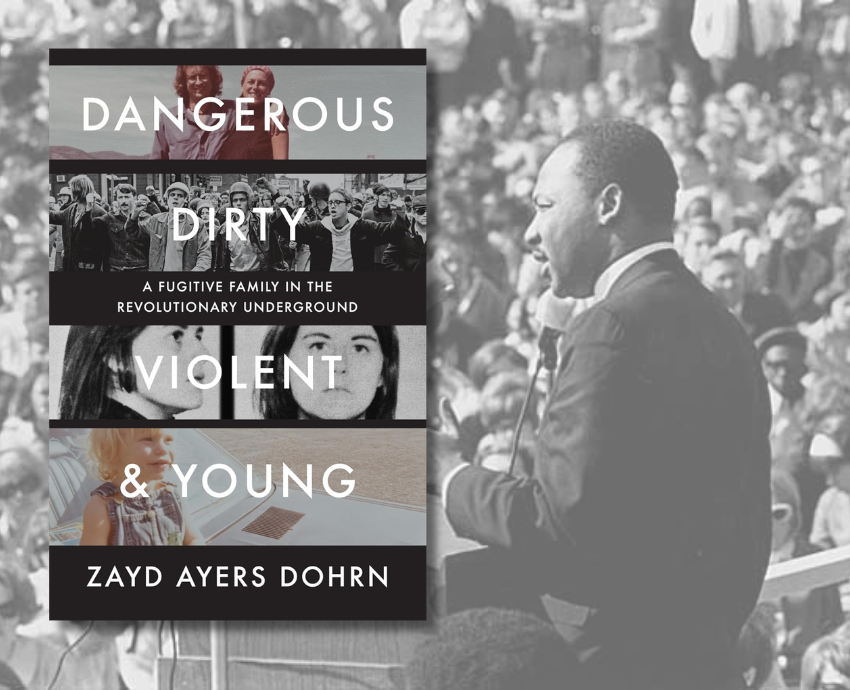
Dangerous, Dirty, Violent, and Young: A fugitive family in the revolutionary underground
By Zayd Ayers Dohrn
WW Norton & Company
May 2026
448pp
In the second half of the 20th century, a wave of young people radicalised in the United States, inspired by anti-colonial revolutions, the civil rights movement, the Vietnamese people’s resistance to US imperialism and the horror of political assassinations of progressive leaders.
This is the context for Zayd Ayers Dohrn’s powerful, well-written and candid memoir, Dangerous, Dirty, Violent and Young: A Fugitive Family in the Revolutionary Underground. In it, he explores his upbringing by Weather Underground leaders on the run from the Federal Bureau of Investigation and Central Intelligence Agency during the 1970s.
Ayers Dohrn explores the idealistic impatience of youth and the deeply personal impacts of his parents’ activism and choices. He is a playwright, journalist and screenwriter and created the podcast, Mother Country Radicals.
His parents, Bernardine Dohrn and Bill Ayers, were two key leaders of the Weather Underground, a militant faction that split from the national anti-war group, Students for a Democratic Society (SDS) in 1970, to engage in what they termed “armed revolutionary struggle” against the US government and in solidarity with the Vietnamese National Liberation Front.
Drawing on his family’s legacy of revolutionary optimism, Ayers Dohrn probes questions about radicalism, the shifting tactics of resistance and the universal challenge of fighting for a better world.
Ayers Dohrn was born in 1977 and was three years old when his parents surfaced and surrendered to authorities. Other Weather Underground members — often in alliance with members of the Black Panthers and the Black Liberation Army — continued their clandestine activities into the 1980s.
The group planted bombs in empty police cars at the Pentagon, the Capitol Building and other locations they considered symbols of the government, giving advanced warning to occupants to prevent casualties.
In his memoir, Ayers Dohrn grapples with his family history and his parents’ decision to have children while living on the run.
For years, Bernardine was on the FBI’s 10 Most Wanted list. After surfacing, she spent seven months in jail, in 1982, for refusing to give testimony to a grand jury. Most charges against Bernardine and Bill were dropped, owing to the prosecution’s illegal methods in gathering evidence.
Bernardine and Bill went on to work in community organising, law and higher education. Bill published his own memoir, Fugitive Days, in 2001. The recent fiction film, One Battle After Another, is said to be loosely based on the Weather Underground’s history.
Green Left’s Bill Nevins recently spoke with Ayers Dohrn about the book’s explosive themes and the legacy of groups such as the Weather Underground.
* * *
Your book shares a lot of information about your parents, particularly about your mother Bernardine, who has not written her own memoir. What was your motivation in writing?
I wanted to understand her better, and to pass along her story and her legacy to future generations, including my own daughters. I think she’s an important historical figure, as well as a fascinating person, and I felt her story hadn’t been well told before (partly because she never chose to tell it herself).
What were your other goals in publishing this book and creating the podcast?
I wanted to tell the story of my family, and also the story of a half-century of revolutionary struggle in America. In these times, it seems more important than ever to look back at stories of resistance, to figure out what went right and what went wrong so we can draw lessons for our own historical moment.
“Revolution” is mentioned many times in your book — and in Weather Underground publications and films about them. It is also mentioned in the Paul Kantner/Jefferson Airplane song “We Should Be Together”, from which you drew your book’s title. How would you describe the revolution your parents and their comrades were striving for?
They wanted to overthrow the US government and to establish a new socialist, anti-racist country on its foundations. That may seem silly or grandiose now, but remember that the mid-to-late 20th century was an age of revolutions.
These young activists had witnessed revolutions in Cuba and Algeria and seen countries across the world throw out their colonial oppressors. They were also watching a tiny, outmatched Vietnamese resistance fight the largest military in the world to a standstill.
So, it wasn’t all that crazy to imagine that the [US] empire was on the verge of toppling. They were also young and idealistic and impatient with the hypocrisy and injustice of the world they had inherited.
Some critics have observed that mass movements for social change are often disrupted or set back by violent tactics — pointing to the Irish Republican Army, the Black Panthers or the American Indian Movement. Can you comment on this, as regards your own research into the SDS and the Weather Underground’s history?
I don’t agree with the premise. Many mass movements for social change have a more radical, disruptive, even violent wing of resistance, and it’s not always clear which aspect of the movement “works” and what sets it back.
Nelson Mandela was widely praised as a peaceful, democratic leader in his later life, but he spent years as part of the ANC’s military wing. And I see no evidence that the Black Panther Party set back the civil rights movement. The peaceful mass movement was repeatedly targeted by white supremacist government and vigilante violence, which led to the quite reasonable decision by the BPP to arm themselves in the name of self-defence.
Irish novelist Sally Rooney recently said, “Many of our old familiar methods of protest and dissent have by now proven completely inadequate to the challenge before us.” Can you comment on the current state of politics and resistance in the US?
I agree with her. We need to do more. I’m not sure that we have yet developed the proper strategies and tactics to meet our current moment.
You are a college professor and a parent of a college-bound student. What might you say if one of your students or your child told you they were dropping out to work for the resistance, either above or underground?
I trust my daughters to make their own decisions. Now, they want to be an artist and a journalist. It seems unlikely, but if they decided to join a resistance movement, I would of course support them.
Please tell us about your rock musical, Revolution(s) — a collaboration with Tom Morello [activist, songwriter and former lead guitarist for Rage Against the Machine] that was produced in Chicago last year. Will there be more performances or a tour?
It was a great experience working with Tom — he’s a radical and a revolutionary, and a creative trailblazer. The show is a great mix of his punk/metal/hip-hop roots and a story about generations of resistance in America. We had a sold-out run at the Goodman Theatre in Chicago last fall, and the producing team is hoping to bring Revolution(s) to New York next year.
Anything else you might like to share with our readers?
Just that it is worth remembering why that generation fought so hard. They were young and idealistic and impatient with the hypocrisy and injustice of the world they inherited.