
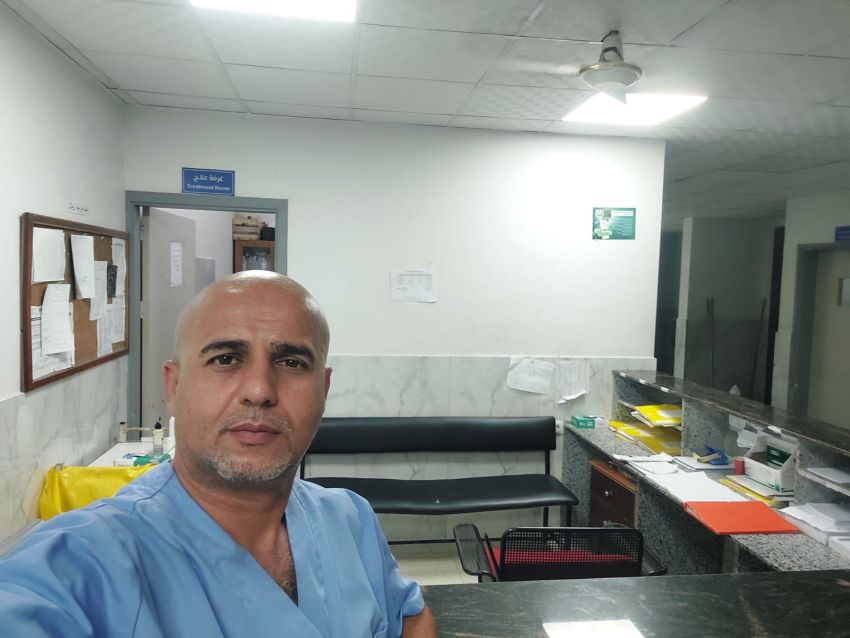
Mohammed Hamad, a Palestinian clinical nutritionist working at Al-Shifa Hospital, has survived the war on Gaza, despite being displaced several times. Jude Alexander conducted this interview with Hamad in the middle of his 32-hour shift, where he is a volunteer. It was written from messages on WhatsApp and translated using an app.
* * *
What is it like to work in Al-Shifa Hospital?
There’s a lot of work; the situation here is chaotic. We are overwhelmed with medical cases resulting from injuries and patients with various diseases. I am busy, but I will tell you about my day.
This is what it is like. I sit for a few minutes at the nurses’ station before the next call comes in. The cup of coffee beside me has already gone cold and I can’t remember whether it’s my third cup today or my fifth. The bright white lights above my head never seem to turn off and neither do the sounds around me.
I hear the constant beeping of medical monitors from nearby rooms, the hurried footsteps of staff moving through the corridors and my colleagues speaking in tired voices as they move from one patient to the next. The smell of disinfectant, mixed with dust, fills the air and somehow finds its way into every corner.
By the time I finish this shift, I will have spent more than a full day inside the hospital.
How do you cope with such long shifts?
I have been at work since early this morning and I will return to my tent in Deir al-Balah tomorrow at 4pm — effectively a 32-hour shift. I will then have two days off before returning to work and repeating the same routine. My body feels heavy and my eyes ache from lack of sleep, but there is always another patient who needs help.
Sometimes, late at night, when the hallways become a little quieter, I think about home, about sleeping in my own bed and about sitting with my family without constantly looking at the time. But then another alarm sounds or another patient needs care and I get up once again and continue my work.
I work these long hours because travelling between Deir al-Balah and Gaza City has become extremely difficult. The distance, the high transportation costs and the intense workload make staying at the hospital and working extended shifts the most practical option.
These shifts are exhausting, not only for me but for many healthcare workers. There are several reasons for this, including the limited number of hospital departments and medical facilities that remain operational in Gaza, as well as the large number of injured people and patients who require care. At the same time, we face severe shortages of medical supplies, equipment and resources, which increases the responsibility and pressure on healthcare staff every single day.
Can you describe your work?
Today I worked with a patient who has been in hospital for around 50 days, after a very serious injury. He is one of the wounded; he recently underwent major surgery, including a partial removal of the duodenum and removal of the spleen. Beyond the medical complexity, what stands out most is how fragile his condition has become after such a long and difficult journey. He is unmarried, very kind and deeply loved by his family, yet he remains strongly attached to life despite everything he has been through.
He is now suffering from severe malnutrition and depends on carefully calculated tube feeding to help rebuild his strength and support his recovery. Working with him feels very sensitive, because every adjustment in his nutrition plan can make a real difference in how he responds and heals. The main goal of the nutritional plan is to correct malabsorption, support wound healing, enhance immunity, prevent nutritional deficiencies and maintain an appropriate body weight and energy level.
I am providing 1.5 grams of protein per kilogram of body weight, to prevent muscle loss and support immune function, 4 grams of carbohydrates per kilogram and 1 gram of fat per kilogram. We are also correcting deficiencies in iron, vitamin B12, calcium and vitamin D.
In moments like this, you don’t just see a diagnosis — you see a person who has been through a lot and is still fighting to recover, step by step.
Can you describe the chaos of your workplace? Did your medical training prepare you adequately for this?
Work here has become extremely chaotic, mainly because of severe overcrowding and very limited resources. The hospital has suffered significant damage during the war and although some sections have been restored, many wards are still operating beyond their capacity. As a result, we are constantly facing an overwhelming number of patients with not enough beds, equipment or basic supplies.
The daily working environment itself is very harsh. Even simple things that most people take for granted are missing or insufficient. There are ongoing shortages of clean water, food and proper sanitation facilities. The heat is intense and, in many areas, there is no reliable cooling system, which makes long working hours even more exhausting. We often cannot find a proper chair to rest on and, if we do, it is sometimes broken.
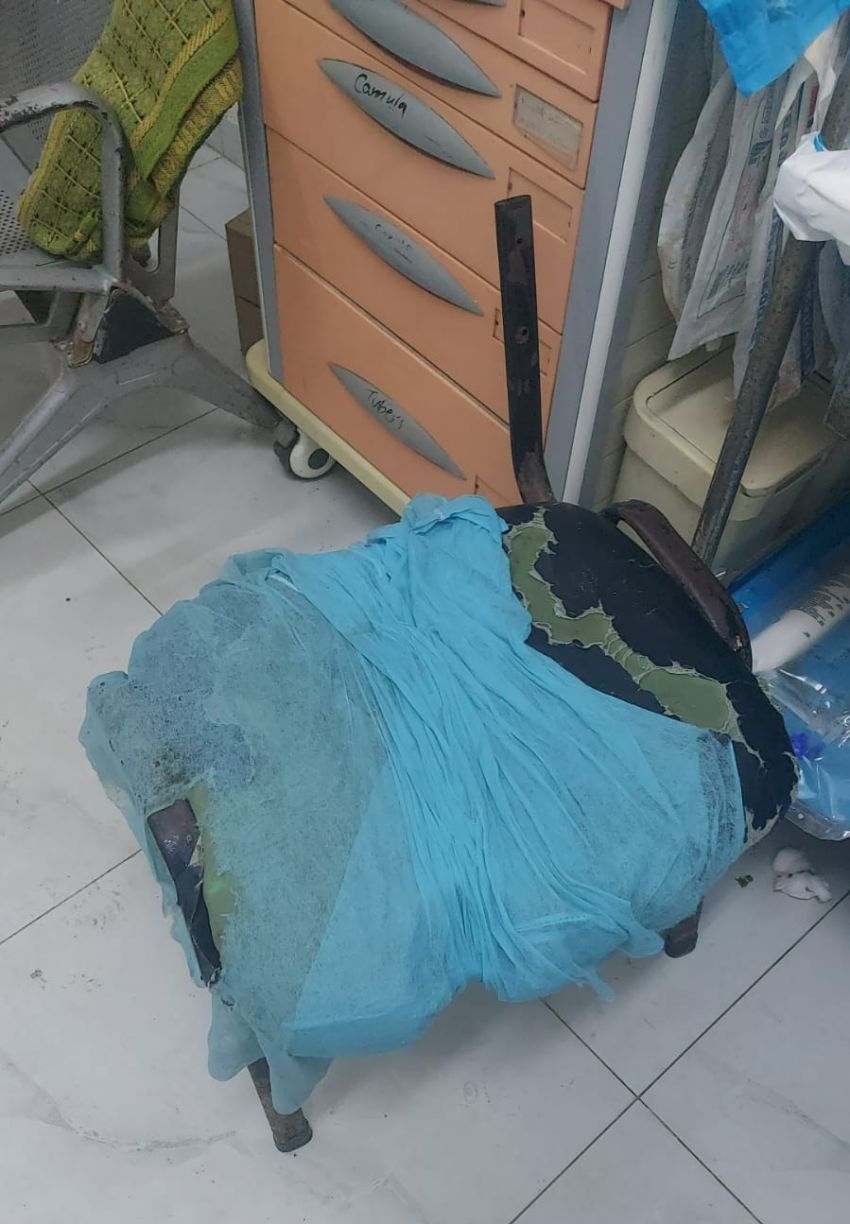
In these circumstances, I try to give everything I can — my full attention, energy and clinical judgement — to each patient, prioritising according to urgency and working closely with the team to manage whatever resources are available. A lot of the work becomes about improvisation, adaptation and trying to maintain dignity and care despite the limitations.
My medical training prepared me for the clinical side of care, but not for this level of sustained crisis and resource scarcity. The knowledge helps, but the reality on the ground is far more demanding than anything we were trained for, both physically and emotionally. Despite the immense pressure and scarcity of resources, the medical staff continue their work calmly and resolutely, treating every patient as a life worth fighting for.
[Update: After the interview, Mohammed Hamad told me an electrical fire had broken out and the orthopaedic department and an operating room on the upper floors were burned. His patient is still unstable and needs continuous monitoring.]