
The rise of One Nation in the polls comes off the back of four decades of neoliberalism delivering declining wages, less union strength and a worsening housing crisis.
One Nation, with the help of the establishment media, has positioned itself as the alternative to the Liberal-Labor duopoly on housing, saying sharp cuts to immigration will solve the crisis. This is scapegoating, designed to ramp up racism when the cost-of-living crisis is adding to ordinary people’s alienation with the major parties.
What would a durable response to the housing crisis involve?
It is well established that house prices and rents are out of control, having risen by substantially more than the rate of wage rises for more than a quarter of a century.
Negative gearing and the 50% capital gains tax discount — a John Howard Coalition government “reform” in 2000 — incentivised people on above average incomes, and especially the wealthiest 5–10%, to use property investment to reduce the amount of tax they would otherwise have to pay.
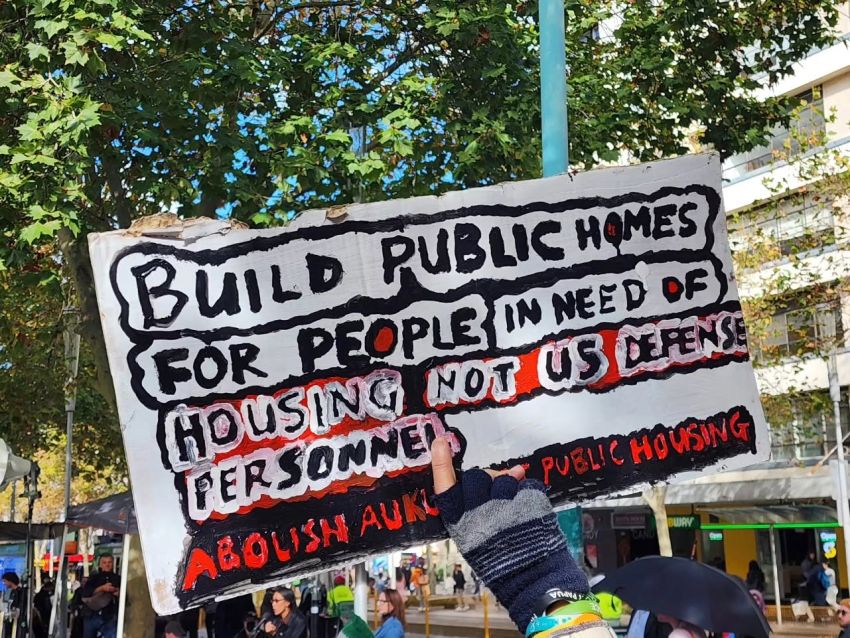
However, arguably, an even bigger contribution to housing unaffordability has been the move away from state investment in public housing.
The state and federal government public housing funding arrangement from after World War II until the late 1980s led to the percentage of public housing steadily rising to a peak of around 5% of overall housing.
But successive state and federal governments since the 1990s have reduced the amount of public housing as a percentage of overall housing stock. This accelerated from 2000 onwards.
According to public housing advocacy group Australian Housing and Urban Research Institute, public housing is now less than 3% of overall housing stock. This stands in stark contrast to the Netherlands (29.1%), Austria (24%), Scotland (24%), Denmark (21%), Sweden (17%), England (17%) and France (16%).
To exacerbate matters, NSW and Victorian Labor governments are forcibly evicting tenants and demolishing public housing, rather than refurbishing and adding to existing stock.
Labor’s 2023 Housing Australia Future Fund is completely inadequate, with an annual budget of just $500 million. The federal Labor government is failing to hit its market-based targets for new, mostly private, housing construction by a wide margin.
Immigrants have not been responsible for a decades-long backlog of underinvestment in public housing, and cutting immigration will worsen skills shortages (including in construction), while doing nothing to address the public housing shortage.
Expand public housing stock
To start to raise the percentage of public housing we need to immediately build hundreds of thousands of dwellings.
Such a “big build” would be deflationary by putting downward pressure on house prices and rents, alongside Labor’s modest changes to capital gains tax and negative gearing. This would reduce the amount of money workers have to spend on rent and mortgage repayments (which goes directly into the bank accounts of big landlords and banks). This money would instead be freed up for other products and services.
A recent Green Institute report noted that the Anthony Albanese government is building fewer public homes per million people than any federal government since World War II. Compare this to the post-war years, when governments were responsible for building 18% of all dwellings.
The Green Institute calls for the re-establishment of a publicly owned housing developer and an immediate build of 360,000 homes over five years, followed by 50,000 dwellings a year thereafter.
A 2023 report prepared by Oxford Economics on behalf of the Construction, Forestry and Maritime Employees Union (CFMEU) called for a 40% super profits tax to fund the construction of 53,000 social and affordable dwellings a year. It said the shortfall of 729,000 social and affordable dwellings would grow close to a million dwellings by 2040 if action was not taken.
The Albanese government’s decision to place the CFMEU under administration has effectively silenced its advocacy on housing.
The Australian Manufacturing Workers’ Union (AMWU) has called for prefabricated housing to be part of the solution. Notably, this could create pathways for jobs in prefabricated housing construction and logistics in areas traditionally reliant on thermal coal mining and burning, like the Hunter and Latrobe Valleys. The AMWU has been a leading voice within the union movement to call for alternative jobs for workers in traditional coal-producing regions as the world reduces its use of coal.
What could it look like?
A public housing “big build” could consist of larger developments located near train stations and infrastructure, plus low-rise apartments and prefabricated dwellings in suburbs and rural areas.
Homeowners in suburbia could be incentivised to sell properties to the public housing developer for conversion from single houses with large backyards into multi-unit developments.
By adding density to the suburbs, a big build could help address urban sprawl. Student housing, aged-care facilities, publicly owned childcare centres, shelters for women and children fleeing gendered violence and boosting the stock of Aboriginal community controlled housing could all be part of the program.
A public housing big build would create a solid pipeline of quality union construction jobs and apprenticeships, addressing the construction industry skills shortage, which currently sits at 300,000 workers.
In the lead-up to the Victorian election, it would be useful for all those who support public housing to unite behind a call for a big build. It would put the heat on One Nation’s attempt to blame immigrants for a crisis that continues only because the establishment parties have refused to fund public housing.
A robust campaign for public housing could help take the wind out of One Nation’s sails and convince those who short-shortsightedly believe that One Nation offers any lasting solutions for the workers’ movement.