
Politics is being shaken by polls showing a surge in support for far-right Pauline Hanson’s One Nation party (PHON).
A May 31 Australian Financial Review/Redbridge Group/Accent Research poll showed One Nation had leapfrogged the incumbent Labor Party with 31% support. A June 1 Roy Morgan poll had One Nation and Labor on level pegging, with 27% each.
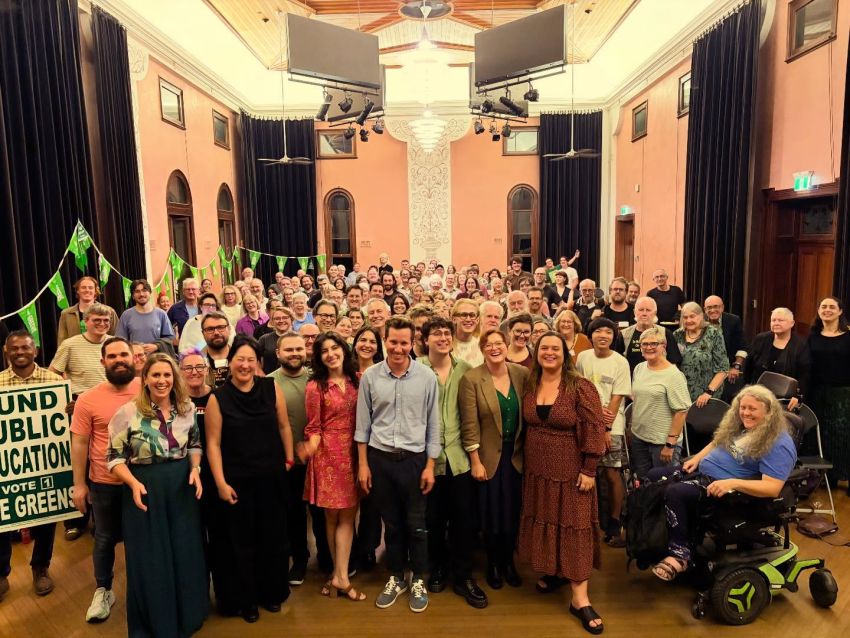
Below is part of the speech given by Max Chandler-Mather, executive director of the Green Institute, to the “Building The Next Green Wave” public forum on Gadigal Country/Sydney on May 2.
Chandler-Mather discusses why some working-class people are voting for One Nation and the social context behind declining support for the major parties. He highlights the disconnect between the political establishment and ordinary people, noting that Labor’s federal election win last year was “a mile wide and an inch thick”. He emphasised that building “transformational politics” means moving beyond negotiating with the Labor Party to seeking to “replace” it.
• • •
The Green Institute is doing a social and economic survey of the country. We’ve been door knocking for the past two months and last weekend we were in Inala, a working-class outer suburb of Magan-djin/Brisbane, sort of like Western Sydney; it is very multi-cultural.
We were asking people detailed questions about financial stress, social isolation and alienation. The first door I knocked on was this guy in his 30s, a dad of four kids, a renter and really financially stressed. His main issue was that every Christmas, he couldn’t buy all the presents he wanted for his kids. He worked 51 hours a week as a landscaper; he had taken a second job just so they could afford the rent, and fuel costs had really pushed him into the red.
We spoke for about 30 minutes. The last question we asked was “Who did you vote for in the last federal election”. He said “I donkey voted. I hate them all.” I said “OK, who are you thinking about this time?” He said: “Look, I don’t like Pauline Hanson, I think she’s a racist. And I live in this really multicultural suburb and she’s wrong. Multiculturalism is really good and I really strongly believe in it. But I’m thinking about One Nation.”
I was like “Well, why?” And he was like: “I just think we need to blow it up. We need to start again.”
You might cringe at that but if we are going to get to that next stage, then there are two critical questions we need to answer.
How is it that working people across the country are reaching that conclusion? And what does it say about the potential for genuinely transformational politics?
When we talked longer, he was very open to voting for the Greens and excited by the idea of taxing the big corporations. He loved the idea of building more public housing. He thought rent caps were a fantastic idea.
Back in the 1980s, someone like this guy would have been a member of his trade union, as 50% of workers were back then. This meant the Labor Party, which was not doing good things even then, at least had a genuine social and organic organisational connection to 50% of the working class. That union membership right now is 12%.
This meant that they would have had a genuine sense of collective power and strength. Some like this guy would have understood that there was a political movement that had the capacity to improve their material standing and not on the basis of a sort of nihilistic anti-politics, but a genuine collective movement.
The hollowing-out [of collective organisation] over the past few decades has left a febrile and unstable political democracy because now the vast majority of people are completely disconnected from either major party.
If that’s the giant tinder that’s out there, the spark is the enormous increase in financial and housing stress over the past 10 years.
During the big economic crises, say in the 1970s, as inflation increased, there was a massive upsurge in labour militancy. Working people’s response was collective action.
If you look at Australia, or continental Europe, or even Britain in the 1970s, the response to the stagflation crisis then was an enormous burgeoning, collective movement of working people.
I think Australia, at one point, lost 800,000 collective days to industrial action. Over a 10-year period, there were about 6 or 8 million workers involved in some form of industrial action. Look at that data now and it’s like a couple of thousand.
So, rather than being funnelled into large collective movements, that anti-political sentiment, feeling disempowered and never having the experience of wielding collective strength, manifests as a form of almost anti-political nihilism. That’s not workers’ fault.
One mistake I think the left has made is to lecture people who don’t vote for us, as if they are somehow voting against their material interests.
We need to think about people’s material interests on two axes; one is which party is going to give me the best stuff for my life — which is perfectly reasonable if you are struggling to pay the rent — and the other axis is time.
How long is it going to take to build a million homes? You and whose army is going to take on big corporations? These are genuine things that people will decide.
“How much power does your movement have? I have never experienced winning like that before, so what makes you think you can do it?”
That is what we are confronting now. And, by the way, I think Labor’s biggest asset is low expectations. It is why [Prime Minister Anthony] Albanese or [NSW Premier] Chris Minns go out of their way to tell you that things can’t happen. It is critical to their success to lower expectations so far that people can be happy to get an extra $10 in their pay packets, despite their rent going up $50 a week.
The positives are examples from across the world, right now, about how parties and political movements can respond.
Right now, people in politics wildly underestimate how much people do not like politics and how much financial stress people are in.
We need to start speaking about a universalist transformational platform that stops conceiving of change as something that happens in negotiation with the Labor Party and rather conceives of it as completely replacing the way our political and economic establishment works.
The bigger thing is how do you get people to pay attention to politics, in particular those who have no reason to. Part of it is the rhetoric, plus a transformational platform and willingness to stand up to both the Labor and Liberal Party and say, as [English Greens leader] Zack Polanski has said, that we’re not here to be disappointed in you, we’re here to replace you.
It is also about organisation and building a mass party. From my experience, the best way to break through that political nihilism is face to face, whether it’s in your workplaces, at the door, in community groups. It’s talking and bringing people with you on that transformational change.
I’ll finish with this thought. If the political system is hollowed out right now, and if there are no longer these organic connections to large civil society institutions, that means that we are at a weak point — but so are the other side.
Labor’s 2025 victory lacks the sort of institutional weight that conservative and social democratic parties had in the 20th century.
This means that if we can build the sort of movement we need to make change, it’s going to be a lot easier, in some ways, than confronting establishment parties in the 20th century, that were able to corral working people based on their organisational connection to those communities.
This no longer exists. It means that when you door knock, you’ll find that most people do not care about politics. You’ll find that most people are fed up with it and are ready to listen to the idea that they can vote for something different and better.
We should take hope from this. It means that we will face some setbacks, but we’re presented with enormous potential and opportunity.
If the British Greens can go from polling 7% to 23–24% in the space of a year is testament to this, there’s absolutely no reason why that couldn’t happen in Australia.
[Max Chandler Mather’s full speech can be found here.]