
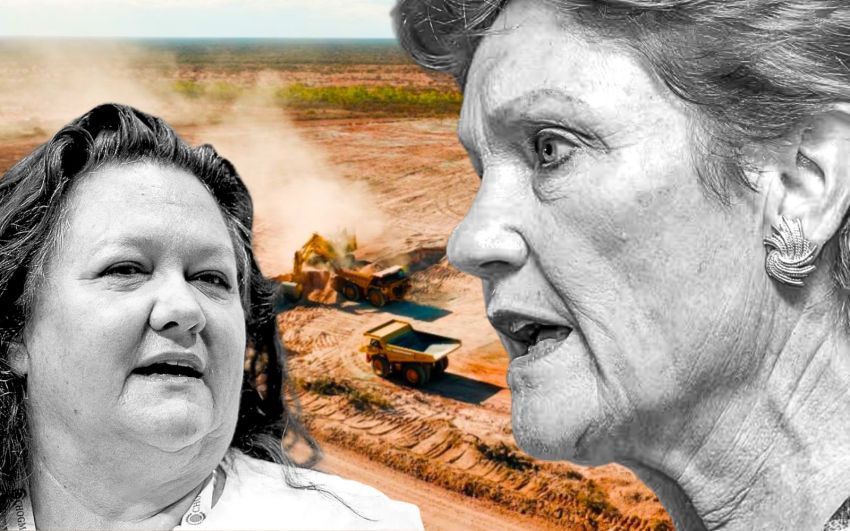
Senator Pauline Hanson has been a “one-trick pony” for her entire political career, with nothing to offer other than punching down on the already marginalised, vulnerable or oppressed.
However, Hanson made headlines on May 21 with her call for a 10% royalty to be paid on the value of gas at the point of extraction to replace the Petroleum Resource Rent Tax (PRRT). She did this at the Australian Energy Producers Conference in Kaurna Yerta/Adelaide.
The significant gas industry expansion, meaning skyrocketing income and profits for the big petroleum companies, has not translated into higher tax revenue via the PRRT because of the way it is designed.
Hanson also pushed for a 30% tax break for mining exploration in exchange for the federal government having the option to buy a 30% stake in new projects.
Hanson described her policy as “bold”, saying: “We want more gas, more oil and more energy to drive our economy forward, pay down our debts and secure our energy future … Any profits made on Australia’s equity ownership will be put into a sovereign wealth fund to reinvest and grow, not to be rorted by future governments.”
Her party is encouraging more fossil fuel extraction precisely when it should be phased out. Labor and Liberal MPs were still quick to condemn the policy, not wanting the big oil and gas corporations to cough up a single cent more in taxes or royalties.
Liberal MP James Patterson gave Hanson’s pretence of taking on big oil an undeserved boost, claiming that she had “borrowed from Venezuela and Hugo Chávez, not Australia”.
This is complete nonsense, but Hanson is looking to differentiate herself from the Liberals, while fending off the call for a 25% tax on the value of gas exports, pushed by Independent Senator David Pocock, The Australia Institute and the Greens.
Spiralling fuel prices and the surge in oil company profits flowing from United States President Donald Trump’s unpopular war on Iran are clear for all to see. Polling by the RedBridge Group in February found that more than 60% of people who identified as Pauline Hanson’s One Nation (PHON) voters supported such a tax.
Beating up on migrants and kids with autism is not going to be enough to distract people from their pain at the pump. Neither was it going to maintain Hanson’s “battler hero” status, especially given her decision to accept Gina Rinehart’s gift of an aeroplane.
Hanson said people are “rightly unhappy” and “public unrest is building” about the negligible returns from the oil and gas sector. But she is equally quick to condemn the idea of a 25% export tax as “economism [sic] vandalism”.
While PHON’s policy is sketchy, a 10% royalty paid on gas at the point of extraction would be much less than the approximate $17 billion a year that could be raised by imposing a 25% tax on gas, after processing, for export.
Hanson claims her proposal for the Commonwealth to part own future gas projects is an application of the “Norwegian model”. It comes nowhere near Norway’s 78% tax on oil and gas profits or the 67% government stake in Equinor, the country’s largest multinational oil and gas corporation.
The oil and gas industry are not the only corporations making huge profits from resources that belong to all of us, while paying very little in taxes and royalties.
Western Australia’s mining companies, including Hancock Prospecting owned by Hanson’s patron Rinehart, typically pay royalties of 7.5% for the iron ore exported in simple crushed form. Not much of that makes it to the First Nations people from whose land the ore is extracted.
The Federal Court ruled in May that Fortescue Metals Group (FMG), 35% owned by self-styled “philanthropist” billionaire Andrew “Twiggy” Forrest, must pay the Yindjibarndi people in the Pilbara $150 million as compensation for cultural loss, for mining their lands without permission since 2013.
That may sound like a lot, but FMG has extracted iron ore to the value of $50 billion from Yindjibarndi land over that time. The amount ordered by the court is equivalent to 0.3% of the mine’s turnover and may drop as low as 0.1% by the mine’s expected end of life in 2045.
The two biggest iron ore miners, BHP and Rio Tinto, typically pay 0.5% of their turnover to Traditional Owners. Native Title only requires miners to negotiate terms with Traditional Owners, but the latter have no legal rights to veto a mining project outright.
A 25% gas export tax and a rise in mining royalties would be a modest, but welcome, redistribution of wealth; it would be more than enough to immediately cover Labor’s proposed cuts to the National Disability Insurance Scheme.
Socialist Alliance sees such reforms as stepping stones towards a much more profound policy — to bring the mines into democratic public ownership. This does not mean operating them like a private corporation, in which the government is the majority shareholder. It is about replacing management with those who do the work and the communities on whose land the company operates.
A mining industry run on this basis opens up new and vital possibilities for sustainability and justice. Rather than simply redistributing a portion of the industry’s wealth away from its private owners, it would be entirely returned to communities.
In the case of the oil and gas industry, 100% of the revenue could be used to fund its replacement and other carbon reduction policies, while guaranteeing workers a transition to new jobs without any loss of pay or conditions.
This may seem like a radical proposal, but without it there is no serious possibility of confronting the existential threat of runaway global warming. Hoping for a kind of “green capitalism” is a fantasy. The system that produced this mess will not get us out of it.
It is for that reason that Socialist Alliance in WA is taking the platform of “Take back the wealth — Bring the mines under worker and community control” to the next federal election in 2028.
We have to be as radical as reality, so join us!
[Sam Wainwright is a national co-convenor of the Socialist Alliance and the Senate candidate in the 2028 election.]