
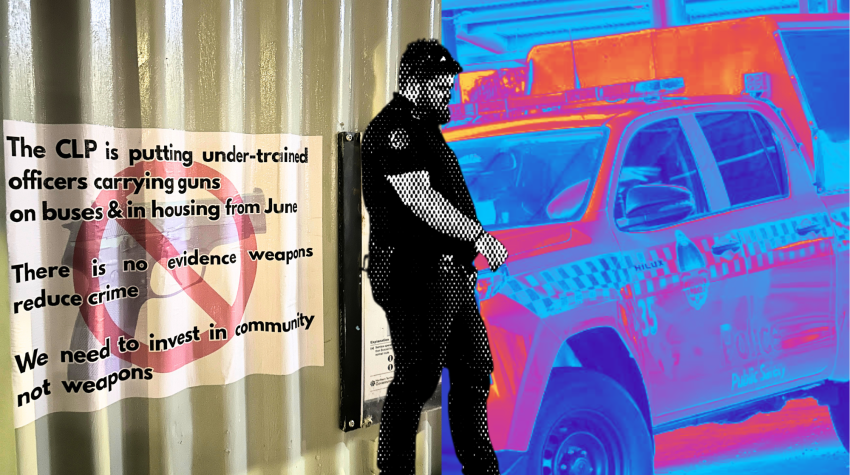
The Northern Territory Country Liberal Party (CLP) government rolled out its new Police Public Safety Officer (PPSO) squad on June 29, replacing Transit Safety Officers and Public Housing Safety Officers with armed police officers.
The policy will mean PSSOs, who receive less training than normal police officers, can carry guns on public buses and into public housing.
The PPSO rollout is consistent with the Lia Finocchiaro government’s unique approach to safety, which is to spread weapons and fear throughout the community. In August last year, it implemented a 12-month trial of capsicum spray, allowing people to buy it for “personal protection”.
Its May budget devoted record sums to policing and prisons, while social housing and alcohol and other drug services remain woefully overstretched and underfunded.
Public spaces in the NT are already over-surveilled and over-policed. The Finocchiaro government is refusing to listen to people with lived experience and expertise about the investments that are needed to make everyone safer.
Grassroots community group Justice not Jails was one of more than 40 signatories on an open letter, delivered last year to the CLP government, calling for an end to “tough on crime” approaches to community safety. It also called for the capsicum spray trial to be scrapped and for no guns to be allowed on public buses or in public housing.
“As we have seen globally, introducing guns into our communities does not make them safer,” said Justice not Jails member Dr Sophia Nicolades. “It increases the risk of violence, death and trauma.”
“This is particularly the case for people who are targeted by police and security due to systemic bias and prejudice. Public buses are not a place for weapons wielded by barely trained PPSOs.”
The PPSO program does not have the support of medical and health professionals, or those who have experienced the brunt of racist policing.
Dr Sarah Dorrington, co-chair of the Royal Australian and New Zealand College of Psychiatrists, said: “For people experiencing distress, trauma, or acute mental illness, a heavily punitive presence can escalate harm rather than improve safety.
“If the NT government is serious about community safety, this is better served by investing in health-led responses to crises for de-escalation and access to appropriate health and mental healthcare, not just more punitive measures in public spaces.”
Anglicare NT CEO Craig Kelly said he “hopes the government will renege the decision to deploy armed PPSOs” and instead “work alongside the community and legal sectors to achieve community safety. We continue to support public safety models that prioritise prevention and supportive intervention over a punitive approach such as armed PPSOs.”
Justice not Jails member Dr Adelle Sefton-Rowston said she was “concerned that PPSOs who have guns will use them in front of school children on buses ... Who is going to ensure nobody gets accidentally shot? Guns in public spaces creates a culture of aggression, while introducing other forms of safety support could in fact create a calm and harmonious space for commuters.”
Young First Nations people already experience negative stereotyping and prejudice in public spaces, particularly given the CLP government’s emphasis on “youth crime”.
The Finocchiaro government appears intent on exposing more people to the risk of harm, instead of putting in place measures that will overcome poverty, trauma and discrimination.
[Stephen W Enciso is a member of Justice not Jails.]