
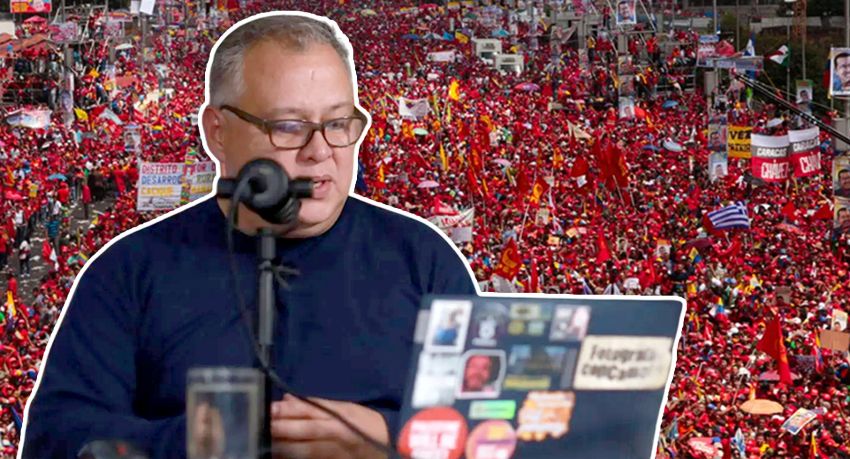
Reinaldo Iturriza is a Venezuelan sociologist and political activist, who served as minister of communes between 2013–14 under President Nicolás Maduro.
In this interview conducted by Santiago Mayor, and originally published in Spanish at Diario Red, Iturriza looks at the political significance of the communes, why they emerged and where they stand today.
Below is an abridged and edited version of the English translation done by LINKS International Journal of Socialist Renewal, which Green Left is publishing in two parts. Read part one here.
* * *
You have been involved in the process of organising and building communes as minister of communes, but also as an activist and intellectual. What are communes? What is their objective?
The communes, and before them the communal councils, can be understood as the political formula trialled by the Bolivarian leadership, and in particular [former President Hugo] Chávez, to organise that fraction of the working class that became the backbone of the movement: the subproletariat.
By this, I mean the poor who work, but whose labour does not guarantee them sufficient means to ensure their reproduction as a labour force.
I have elaborated this in more detail elsewhere, but briefly: the subproletariat was the subject of the popular rebellion of February 27, 1989 [known as the Caracazo]. During the neoliberalism of the 1990s, the subproletariat became the largest segment of the Venezuelan working class.
Excluded from the market, politics and citizenship, this sector became politicised under Chávez’s leadership. It did everything possible to bring him to power.
It defended democracy when it was threatened by the elites and led the huge street demonstrations that succeeded in reversing the 2002 coup. Months later, it was on the frontline of resistance to the oil industry managers’ strike and sabotage, and the business owners’ lockout.
This sector saw the oil industry recover and experienced the effects of the first attempts at democratic redistribution of that income, an experience completely foreign to today’s subproletariat.
This sector progressively gained access to healthcare, education and food. Its neighbourhoods began to appear on official maps. Millions obtained identity cards for the first time.
They achieved their most resounding political victory in the 2004 recall referendum, which decided whether Chávez would remain in power.
In 2005, the Bolivarian leadership faced the problem of how to organise a subproletariat that, by definition, did not work in factories, distrusted traditional forms of political intermediation and demonstrated a huge vocation for political experimentation.
The answer, broadly speaking, was promoting popular self-government in the neighbourhoods. These self-governments were, among other things, to identify the productive potential of these territories and organise communities to develop it.
This was the context in which the first communal councils were created. Later, in 2008, when experiences of self-government began to show greater political potential, there were the first attempts to create communes.
The communes were conceived as having relative autonomy. This meant not being subordinate to any formal power, but also not functioning as small, self-sufficient communities.
In Chávez’s words, they had to organise themselves in a network, “like a gigantic spider’s web covering the territory with the new” but never outside the bounds of the strategic horizon of the Bolivarian Revolution.
In this sense, they represented a kind of grassroots popular vanguard to implement the program of change.
What is the current state of community organising in Venezuela?
That is a good question, especially since it has become customary to appeal to the existence of the communes as a kind of political and even ethical reserve that could eventually counterbalance more authoritarian or conservative tendencies within Chavismo.
It is true that things are not going very well, and it is equally true that prospects are not encouraging, but on the positive side, at least there are the communes.
However, it is important to emphasise that the past 10 years have been a time of recomposition of the ruling bloc, of huge political disaffiliation and of an economic policy that has not prioritised the interests of the working class. These have been times of managing the status quo, which means that the scope for political experiments has been reduced to historic lows.
To this, we must add that after January 3, the US government essentially manages and decides how our income is spent. In other words, the problem is no longer even the scope of action of the communes, but the scope of sovereignty of the republic.
This question of the relative autonomy of the communes is now presented in a radically different context: it remains to be seen whether, beyond the possibility of managing very limited amounts of resources for the execution of very limited amounts of local projects, the communal leadership has the will and capacity to reaffirm its autonomy. Autonomy not only in the face of state and party institutions, but predominately in the face of a foreign power that intends to decide the nation’s fate.